
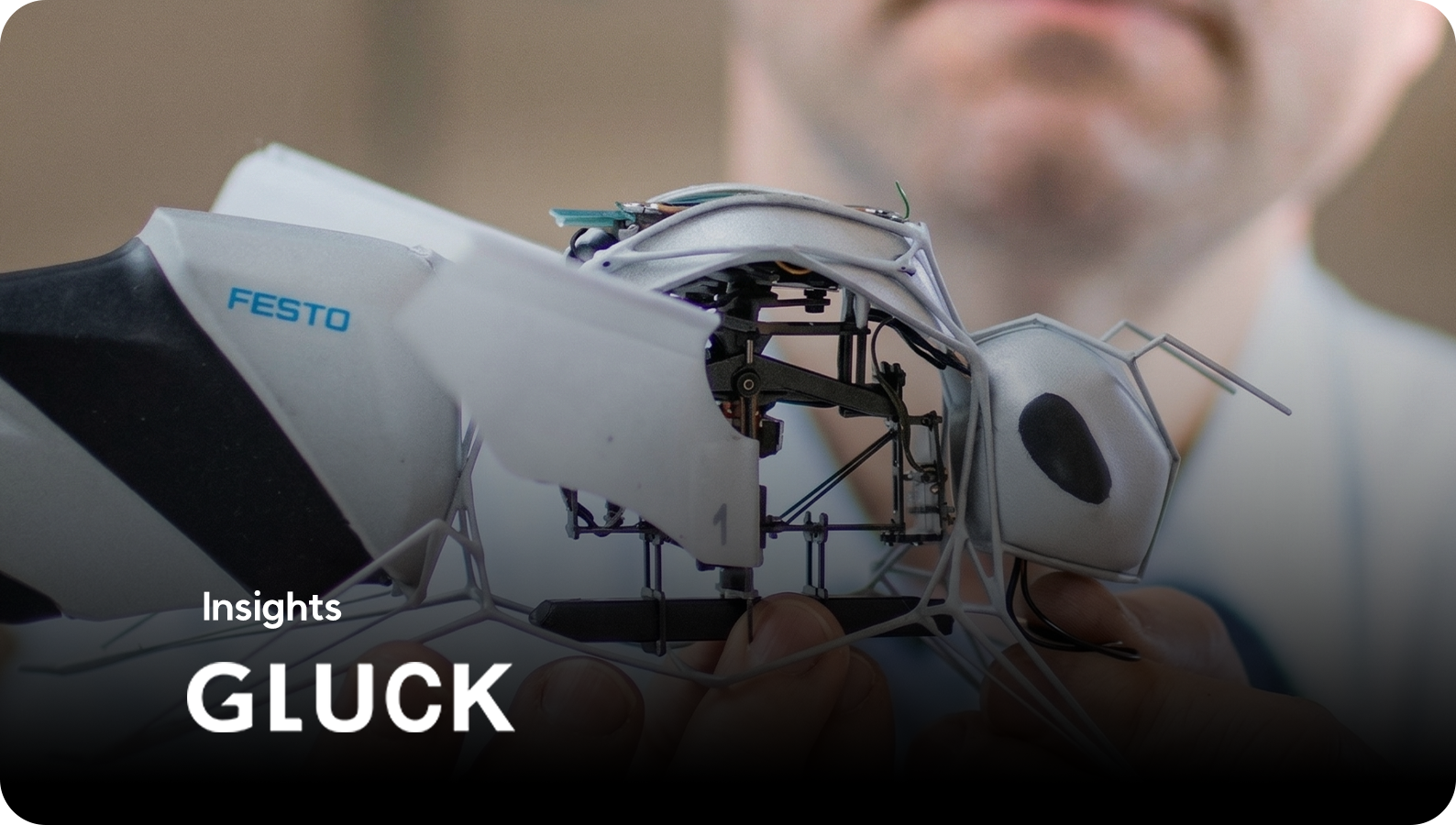
자연의 구조와 움직임에서 아이디어를 얻는 생체모방 설계는 오랫동안 다양한 기술 개발에 활용돼 왔습니다. 최근에는 디지털 설계와 첨단 제조 기술이 발전하면서, 실제 로봇 개발과 정밀한 부품 설계에서 빠르게 확장되고 있습니다.
Festo가 개발한 초소형 자율 비행 로봇 바이오닉비(BionicBee), 벌의 비행 방식을 바탕으로 설계된 이 로봇은 작은 크기 안에 정교한 구조와 기능을 구현해야 한다는 점에서 설계와 제조 기술이 함께 뒷받침되어야 하는 프로젝트였습니다.
바이오닉비, 초소형 비행 로봇
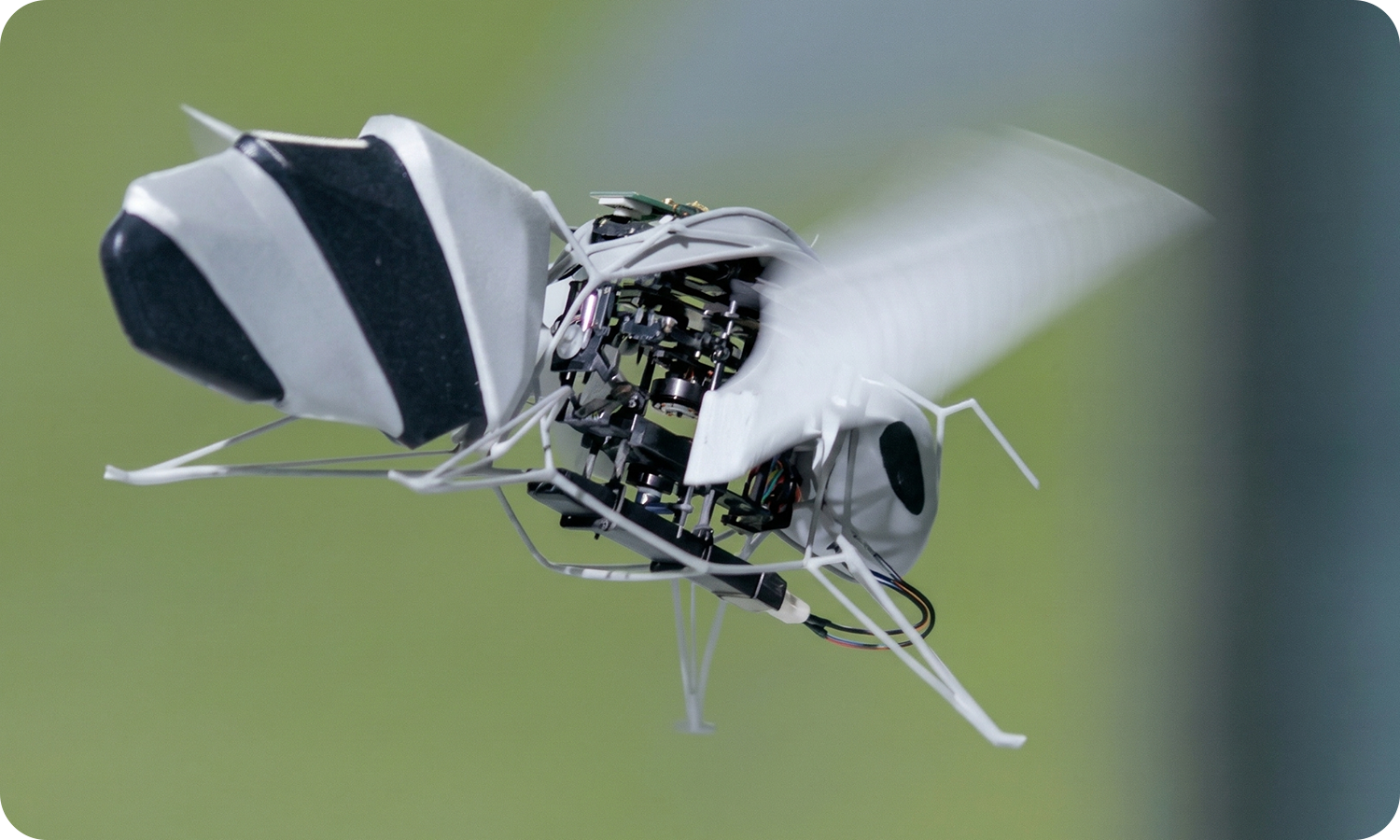
Festo는 자동화와 제어 기술 분야의 기업이지만, 한편으로는 자연에서 아이디어를 얻은 로봇 연구도 꾸준히 선보여 왔습니다. 바이오닉비(BionicBee) 는 그 흐름에서 나온 대표적인 사례로, 초소형 비행 로봇에 자율 제어 개념을 결합한 프로젝트입니다.
이 로봇은 날개 길이 약 240mm, 무게 약 34g 수준의 작은 비행체입니다. 크기는 작지만, 실제 구현 과정에서는 구동, 제어, 통신 기능을 함께 담아야 했기 때문에 구조 설계와 제작 정밀도가 매우 중요했습니다.

특히 바이오닉비는 단순한 소형 비행체가 아니라, 스스로 비행 경로를 판단하고 제어할 수 있도록 개발됐다는 점에서 의미가 있습니다. 좁거나 복잡한 공간에서도 비행할 수 있도록 설계됐으며, 여러 대가 동시에 움직이며 서로의 위치를 인식하는 군집 비행 개념도 함께 구현했습니다. 각각의 기체가 개별적으로 비행을 제어하면서도 동시에 함께 움직여야 했기 때문에, 이 프로젝트에서는 설계와 제어, 제작 완성도가 모두 중요하게 작용했습니다.
이 사례는 단순히 작은 로봇을 만드는 데 그치지 않고, 초경량 구조 설계와 자율 제어, 정밀 제조 기술이 함께 결합돼야 한다는 점에서 의미가 있습니다.
34g 초경량화 드론 제조 방법, 고해상도 3D프린팅

바이오닉비를 만드는 과정에서 가장 큰 걸림돌은 무게였습니다. 34g이라는 가벼운 몸체 안에 모터, 배터리, 통신 회로, 기어박스 같은 필수 부품을 모두 집어넣어야 했기 때문입니다. 부품이 조금만 무거워져도 비행 성능은 급격히 떨어집니다.
기존의 절삭 가공이나 금형 방식으로는 이 문제를 해결하기 어려웠습니다. 내부가 비어 있으면서도 튼튼하게 하중을 버티는 복잡한 격자 구조를 만들어야 했지만, 기존 제조법으로는 그런 미세한 형상을 뽑아내는 것이 불가능했습니다. 결국 해답은 미세한 단위까지 표현할 수 있는 산업용 3D 프린팅 기술에서 찾았습니다. 특수 소재를 사용해 종이처럼 얇으면서도 단단한 로봇 뼈대를 찍어냈습니다. 여기에 알고리즘 기반 최적화 설계를 적용해 경량화 구조를 개선했습니다.
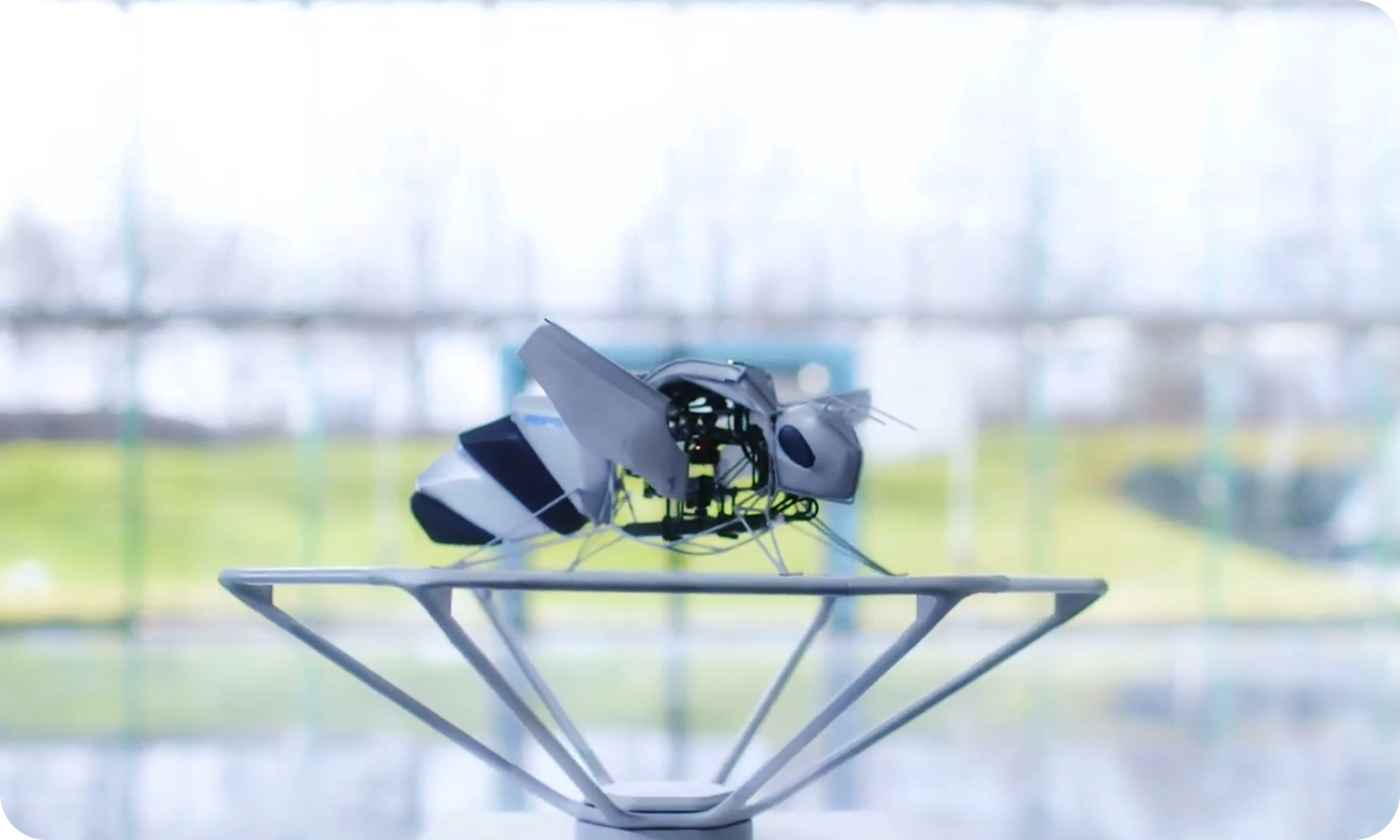
특히 이 프로젝트에서는 단순한 소형화보다, 가벼우면서도 필요한 강도를 유지하는 구조 설계가 더 중요했습니다. 3D프린팅은 이런 요구에 맞춰 얇은 벽 두께와 복잡한 형상을 정밀하게 구현하는 데 유리했고, 비행 로봇에 필요한 경량화 된 부품 제작에 적합한 선택지가 됐습니다.
그 결과 로봇 프레임의 무게를 20g에서 3g으로 줄이는 성과를 거두었습니다. 뼈대에서 줄인 17g의 여유 덕분에 더 큰 배터리와 정밀 센서를 탑재할 수 있었고, 이는 곧 안정적인 자율 비행으로 이어졌습니다. 이는 제조 기술의 정밀도가 설계의 자유도를 어디까지 넓힐 수 있는지 보여주고 있습니다.
동일한 품질의 대량 로봇 제조 솔루션
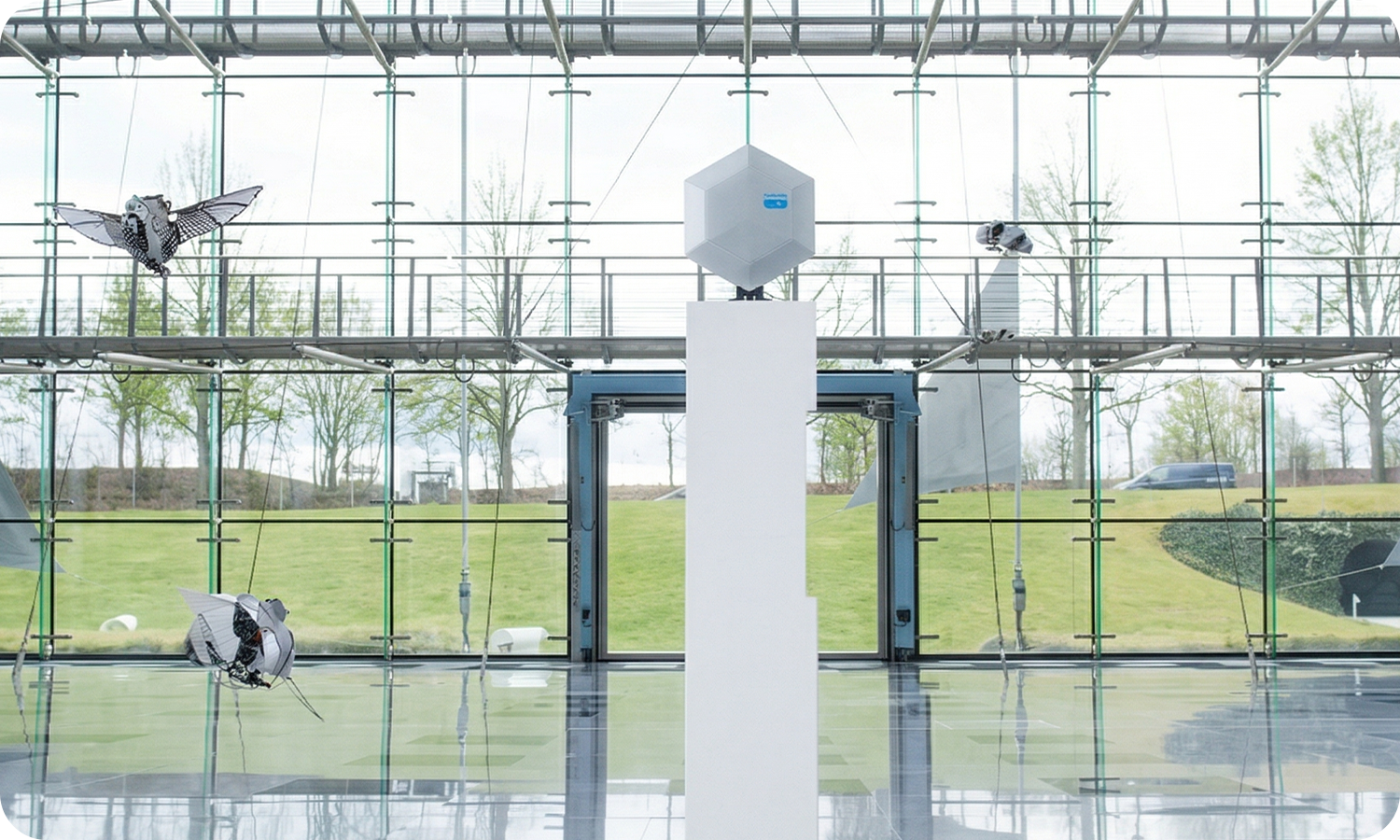
바이오닉비 프로젝트의 의미는 수십 마리의 로봇을 똑같은 품질로 만들어냈다는 점에 있습니다. 여러대의 로봇이 동일하게 군집 비행을 하려면 모든 로봇이 0.01g의 무게 오차도 없이 동일하게 작동해야 합니다. 산업용 3D 프린팅은 디지털 설계만 있으면 수백 개의 부품을 편차 없이 즉시 생산할 수 있는 환경을 제공했습니다.
완성된 바이오닉비는 초당 15~20Hz 수준으로 날개를 구동하며, 벌의 날갯짓을 참고한 비행 시스템을 구현했습니다. 이를 바탕으로 훼스토는 약 20대의 바이오닉비가 동시에 공간 안에서 비행하는 시연도 선보였습니다. 여러 기체가 서로의 위치를 인식하며 함께 움직였다는 점에서, 이 프로젝트는 단일 비행체 개발을 넘어 군집 제어까지 확장된 사례라고 볼 수 있습니다.
이 과정에서 산업용 3D프린팅은 반복 개발과 정밀 제작 측면에서 강점을 보였습니다. 동일한 디지털 설계를 바탕으로 복잡한 프레임 구조를 빠르게 제작할 수 있었고, 설계를 수정한 뒤에도 새로운 버전을 빠르게 다시 검증할 수 있었습니다. 특히 무게 중심이나 구조 형상을 여러 차례 조정해야 하는 프로젝트에서는, 훨씬 유연하게 대응할 수 있다는 점이 장점으로 작용합니다.
결국 이 사례는 3D프린팅이 단순히 복잡한 부품을 만드는 데 그치는 것이 아니라, 다수의 기체를 반복적으로 개발하고 성능을 맞춰가는 과정에서도 유효한 제조 방식이 될 수 있음을 보여줍니다. 초소형 비행 로봇처럼 설계 변경이 잦고 정밀도가 중요한 분야일수록, 이런 제조 유연성은 더 큰 의미를 갖습니다. 이는 다품종 생산이 필요한 고기능성 로봇 분야에서 3D 프린팅이 강력한 제조 수단이 될 수 있음을 의미합니다.
산업용 3D 프린팅, 로봇 양산 시스템으로의 전환

훼스토의 바이오닉비 사례는 산업용 3D프린팅이 단순히 복잡한 부품을 만드는 기술에 그치지 않고, 정밀한 구조 설계와 다품종 대량 생산을 함께 뒷받침할 수 있다는 점을 보여줍니다. 금형 없이 복잡한 형상을 구현할 수 있고, 설계 변경 이후에도 빠르게 다시 제작하고 검증할 수 있다는 점에서 로봇 개발과 같은 분야에 특히 잘 맞는 방식입니다.
글룩(GLUCK)은 이러한 제조 방식에 맞춰 대규모 산업용 3D프린팅 인프라를 바탕으로, 정밀한 로봇 부품 제작부터 반복 생산 대응까지 연결할 수 있는 제조 체계를 운영하고 있습니다. 산업용 SLA 3D프린팅을 통해 최대 ±50μm(0.05mm) 수준의 정밀도를 구현할 수 있으며, 복잡한 구조나 경량화가 필요한 부품 제작할 수 있습니다.
또한 바이오닉비의 사례처럼 미세한 구조 설계를 통한 경량화와 부품 일체화를 가능하게 합니다. 특히 약 50기의 대형 산업용 SLA 장비가 24시간 가동되는 글룩의 3D 프린팅 스마트 팩토리는 수백, 수천 대의 군집 로봇이나 복잡한 서비스 로봇 부품을 디지털 설계파일 만으로 바로 생산 할 수 있는 독보적인 '온디맨드(On-demand) 대량 생산' 시스템을 제공합니다.
이런 제조 인프라는 로봇 분야에서도 의미가 있습니다. 개발 초기의 시제품 단계부터 구조 조정, 반복 검증, 양산 전환 준비까지 하나의 흐름으로 이어갈 수 있기 때문입니다. 결국 산업용 3D프린팅은 로봇 제조에서 설계를 자유롭게 할 수 있을 뿐만이 아니라 개발 속도와 설계 변경에 빠르게 대응할 수 있는 방식에서도 중요한 역할을 할 수 있습니다.
피지컬 AI 시대에는 더 빠르게 개발하고, 더 빠르게 검증하는 연구개발 속도가 중요해지고 있습니다.
글룩은 아이디어가 실제 로봇으로 구현되고 구동되기까지의 제조 과정을 함께합니다.
로봇 제조, 지금 바로 글룩과 상담해 보세요!
📩 글룩 홈페이지 & 온라인 견적: https://www.glucklab.com
📂 글룩 포트폴리오: 글룩 포트폴리오 확인하기
References
[1] VoxelMatters, “Biomimicry Takes Flight: 3D Printed BionicBee,” VoxelMatters. (online article).
Link: https://www.voxelmatters.com/biomimicry-takes-flight-3d-printed-bionicbee/
34g Ultra-Small Flying Robot Bee: Dozens of Lightweight Drones Made with 3D Printing
Biomimetic design, which draws inspiration from the structures and movements of nature, has long been utilized in various technological developments. With recent advancements in digital design and cutting-edge manufacturing technologies, it is rapidly expanding into actual robot development and precise part design.
The BionicBee, an ultra-small autonomous flying robot developed by Festo, is a highly notable example of this. Designed based on the flight mechanism of a bee, this robot required both advanced design and manufacturing technologies to implement intricate structures and functions within a tiny size.
BionicBee, the Ultra-Small Flying Robot
While Festo is well-known as a company in the automation and control technology sector, it has also consistently showcased robotics research inspired by nature. The BionicBee is a representative example resulting from this trend, combining the concept of autonomous control with an ultra-small flying robot.
This robot is a tiny aircraft with a wingspan of about 240mm and a weight of around 34g. Although small in size, its actual implementation required driving, control, and communication functions to be integrated together, making structural design and manufacturing precision extremely important.
Notably, the BionicBee is not just a simple small aircraft; it is highly significant in that it was developed to autonomously determine and control its flight path. It is designed to fly in narrow or complex spaces and successfully implements the concept of swarm flight, where multiple units move simultaneously while recognizing each other's positions. Because each aircraft had to control its flight individually while moving together concurrently, the completeness of design, control, and manufacturing all played a crucial role in this project.
This case is meaningful because it goes beyond simply building a small robot; it demonstrates the necessary integration of ultra-lightweight structural design, autonomous control, and precision manufacturing technology.
Manufacturing Method for the 34g Ultra-Lightweight Drone: High-Resolution 3D Printing
The biggest hurdle in creating the BionicBee was its weight. All essential components, such as the motor, battery, communication circuits, and gearbox, had to fit inside a light 34g body. Even a slight increase in component weight would cause flight performance to drop drastically.
Traditional machining or molding methods struggled to solve this problem. It was necessary to create a complex lattice structure that was hollow inside yet strong enough to withstand structural loads, but it was impossible to produce such micro-geometries using conventional manufacturing methods. Ultimately, the solution was found in industrial 3D printing technology capable of expressing microscopic details. Using special materials, they printed a robot skeleton that was as thin as paper yet highly rigid. Furthermore, algorithm-based optimization design was applied to improve structural lightweighting.
In this project, a structural design that maintained the necessary strength while being lightweight was much more important than simple miniaturization. 3D printing was highly advantageous in precisely implementing thin wall thicknesses and complex geometries to meet these demands, making it the perfect choice for manufacturing the lightweight frames required for flying robots.
As a result, they achieved the remarkable feat of reducing the robot frame's weight from 20g to just 3g. The 17g of clearance saved from the skeleton allowed for the integration of a larger battery and precise sensors, which directly led to stable autonomous flight. This perfectly demonstrates how far the precision of manufacturing technology can expand the freedom of design.
Mass Robot Manufacturing Solution with Consistent Quality
The true significance of the BionicBee project lies in the fact that dozens of robots were produced with the exact same quality. For multiple robots to perform swarm flight identically, every robot must operate uniformly without even a 0.01g difference in weight. Industrial 3D printing provided an environment where hundreds of parts could be produced instantly and without variation, relying solely on digital designs.
The completed BionicBee operates its wings at a rate of 15 to 20Hz, implementing a flight system inspired by the flapping of a real bee. Based on this, Festo demonstrated about 20 BionicBees flying simultaneously in a shared space. Since multiple aircraft moved together while recognizing each other's positions, this project can be seen as a case that extends far beyond single aircraft development into swarm control.
Throughout this process, industrial 3D printing showed massive strengths in terms of iterative development and precision manufacturing. Complex frame structures could be rapidly produced based on identical digital designs, and even after modifying a design, the new version could be quickly verified again. Especially in projects requiring multiple adjustments to the center of gravity or structural shape, the ability to respond flexibly serves as a tremendous advantage.
Ultimately, this case demonstrates that 3D printing is not just for making complex parts; it can be a highly effective manufacturing method in the process of iteratively developing multiple aircraft and aligning their performance. In fields like ultra-small flying robots where design changes are frequent and precision is critical, this manufacturing flexibility holds even greater significance. This means that 3D printing can be a powerful manufacturing tool in the high-functionality robotics sector requiring high-mix production.
Industrial 3D Printing: Transition to a Robot Mass Production System
Festo's BionicBee case shows that industrial 3D printing goes beyond being a technology for simply making complex parts; it can seamlessly support precise structural design and repetitive production at the same time. Because complex shapes can be realized without molds, and designs can be quickly remanufactured and verified after modifications, it is a method particularly well-suited for fields like robot development.
GLUCK operates a manufacturing system capable of connecting precise robot part production to repetitive production responses, backed by a large-scale industrial 3D printing infrastructure tailored to this exact manufacturing approach. Through industrial SLA 3D printing, a precision level of up to ±50μm (0.05mm) can be achieved, making it highly applicable to the production of parts requiring complex structures or extreme lightweighting.
Furthermore, much like the BionicBee case, it enables lightweighting and part consolidation through micro-structural design. In particular, GLUCK's 3D printing smart factory—where approximately 50 large-scale industrial SLA machines operate 24 hours a day—provides an unmatched 'On-demand mass production' system capable of immediately producing hundreds or thousands of swarm robots or complex service robot parts using nothing but digital design files.
Such a manufacturing infrastructure is highly significant in the robotics sector. This is because the entire flow—from the initial prototype stage of development to structural adjustment, repetitive verification, and preparation for the transition to mass production—can be seamlessly connected in one unbroken chain. Ultimately, industrial 3D printing can play a vital role in robot manufacturing, not only in terms of design freedom but also regarding development speed and the ability to respond rapidly to design changes.
In the era of Physical AI, the speed of R&D—developing faster and verifying faster—is becoming increasingly critical. GLUCK is with you throughout the entire manufacturing process, from the moment an idea is conceived to when it is implemented and operated as an actual robot.
Robot manufacturing, consult with GLUCK right now!
📩 GLUCK Website & Online Quote: https://www.glucklab.com
📂 GLUCK Portfolio: Check out GLUCK's success stories
References
[1] VoxelMatters, “Biomimicry Takes Flight: 3D Printed BionicBee,” VoxelMatters. (online article).
Link: https://www.voxelmatters.com/biomimicry-takes-flight-3d-printed-bionicbee/
#글룩 #3D프린팅 #산업용3D프린팅 #SLA3D프린팅 #로봇제조 #군집로봇 #초소형로봇 #생체모방로봇 #바이오닉비 #경량화설계 #적층제조 #스마트팩토리 #로봇양산 #GLUCK #3DPrinting #Industrial3DPrinting #SLA3DPrinting #RobotManufacturing #SwarmRobotics #MicroRobot #Biomimetics #BionicBee #LightweightDesign #AdditiveManufacturing #SmartFactory
'인사이트 (Insights)' 카테고리의 다른 글
| 오픈소스 휴머노이드 : 로봇 부품을 금형 없이 양산한다는 것 (0) | 2026.08.31 |
|---|---|
| 3D프린팅으로 배포된, 영화 '프로젝트 헤일메리' 외계인 로키! (3) | 2026.04.30 |
| CG인 줄 알았던 슈퍼맨 2025 휴머노이드, 현실로 다가온 로봇과의 일상 (0) | 2026.04.02 |
| 로봇 산업의 성장, 3D프린팅이 로봇 부품 양산까지 연결되는 방식 (0) | 2026.03.16 |
| 3D프린팅 조명 제조 방식, 글로벌 조명 브랜드들이 선택한 이유 (0) | 2026.03.10 |