
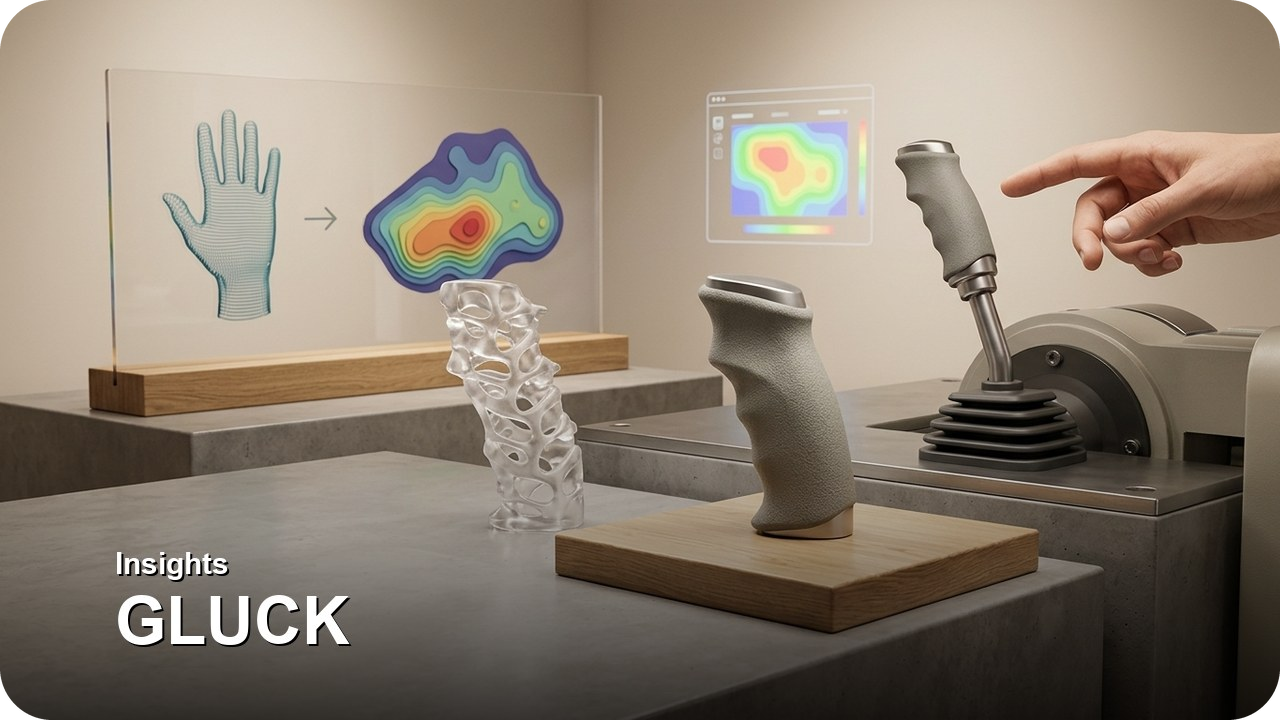
작업 현장을 오래 지켜보면, 생산성을 바꾸는 것은 거창한 설비가 아니라 아주 사소한 것일 때가 많습니다. 작업자의 손 모양에 맞춘 그립 하나, 특정 설비에만 딱 들어맞는 지그 하나가 반복 작업의 피로도와 불량률을 눈에 띄게 바꿔놓곤 합니다. 사람마다 손 크기가 다르고, 장갑을 낀 손과 맨손이 다르며, 젖은 손과 마른 손이 다르기 때문입니다.
최근 제조 업계에서는 이런 '인간공학(Human Factors)'을 다시 주목하고 있습니다. 3dprint.com은 지그·치구, 포카요케(poka-yoke) 같은 소량 제조 도구부터 개인에게 맞춘 마우스, 의료용 어플리케이터까지, 인간공학이 3D프린팅의 유력한 응용 분야로 떠오르고 있다고 짚었습니다. 노동력이 귀해지고 작업자 평균 연령이 높아지는 상황에서, 사람과 작업을 더 잘 맞추는 도구의 가치가 커지고 있기 때문입니다.
그렇다면 사람마다, 현장마다 다른 지그·핸들·그립을 어떻게 맞춤 양산할 수 있을까요? 이 질문은 곧 제조 방식의 문제로 이어집니다. 개별 사용자에 맞춘 도구를 소량으로, 그러나 반복 가능하게 공급하는 일은 기존 방식으로는 결코 간단하지 않았습니다.
지그·치구, 그리고 손에 맞춘 도구
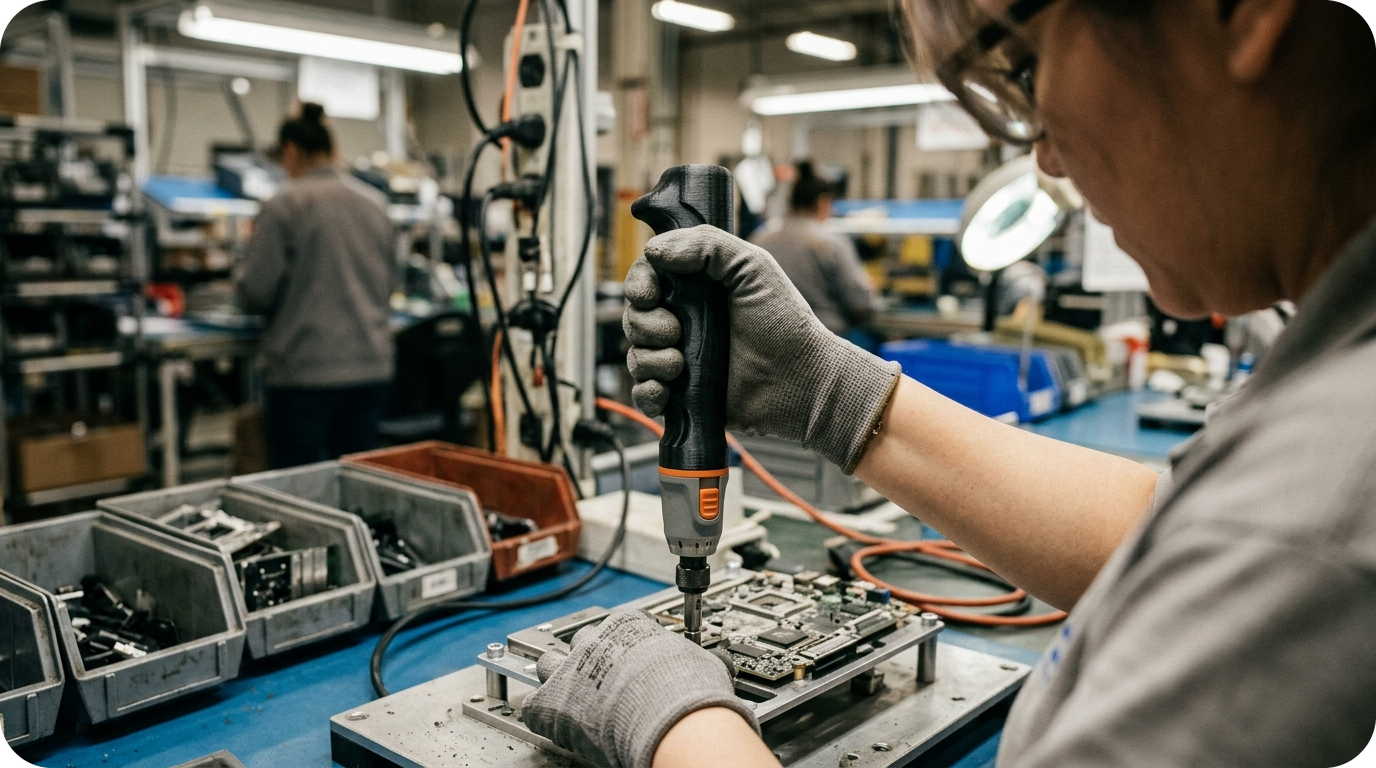
인간공학의 출발점은 "사람이 어떻게 일과 상호작용하는가"입니다. 책상에 앉는 자세부터 공압 드릴을 다루는 방식까지가 모두 여기에 포함됩니다. 소재 기사는 지그·치구, 포카요케 같은 저수량 제조 도구가 비용을 줄이고 오류를 낮추는 대표적 응용이며, 이들 상당수가 인간공학적 요소를 강하게 지닌다고 설명합니다.
문제는 이런 도구가 대부분 '소량'이고 '개별적'이라는 점입니다. 어떤 밀링 스테이션의 세팅은 다른 공장의 세팅과 완전히 다를 수 있고, 같은 도구라도 장갑을 낀 주조 현장, 손이 젖는 어선 작업 환경에서는 표면 텍스처를 다르게 손봐야 합니다. 기존 방식으로 이런 다품종 소량 도구를 만들려면 형상마다 별도의 금형이나 전용 가공이 필요했습니다. 문제는 금형비가 창의적인 시도를 가로막는 경제적 족쇄가 된다는 점, 그리고 도구 하나를 바꾸려 할 때마다 제작 시간과 비용이 다시 들어간다는 점입니다.
- 형상마다 다른 도구: 사람·설비·작업환경이 조금씩 달라, 하나의 표준 도구로는 현장을 다 덮지 못합니다.
- 잦은 설계 반복: 작은 변경이 큰 효과를 내기 때문에, 폼앤핏(form-and-fit) 시제품과 여러 차례 반복 개선이 필요합니다.
소재 기사가 짚듯, 이런 조건에서는 사용자 가까이에서 저렴하게 만들고 곧바로 함께 검증하는 방식이 훨씬 빠르고 저렴합니다. 3D프린팅이 이 지점에서 실질적인 강점을 갖는 이유입니다.
개별 사용자에 맞춘 디바이스와 의료 현장
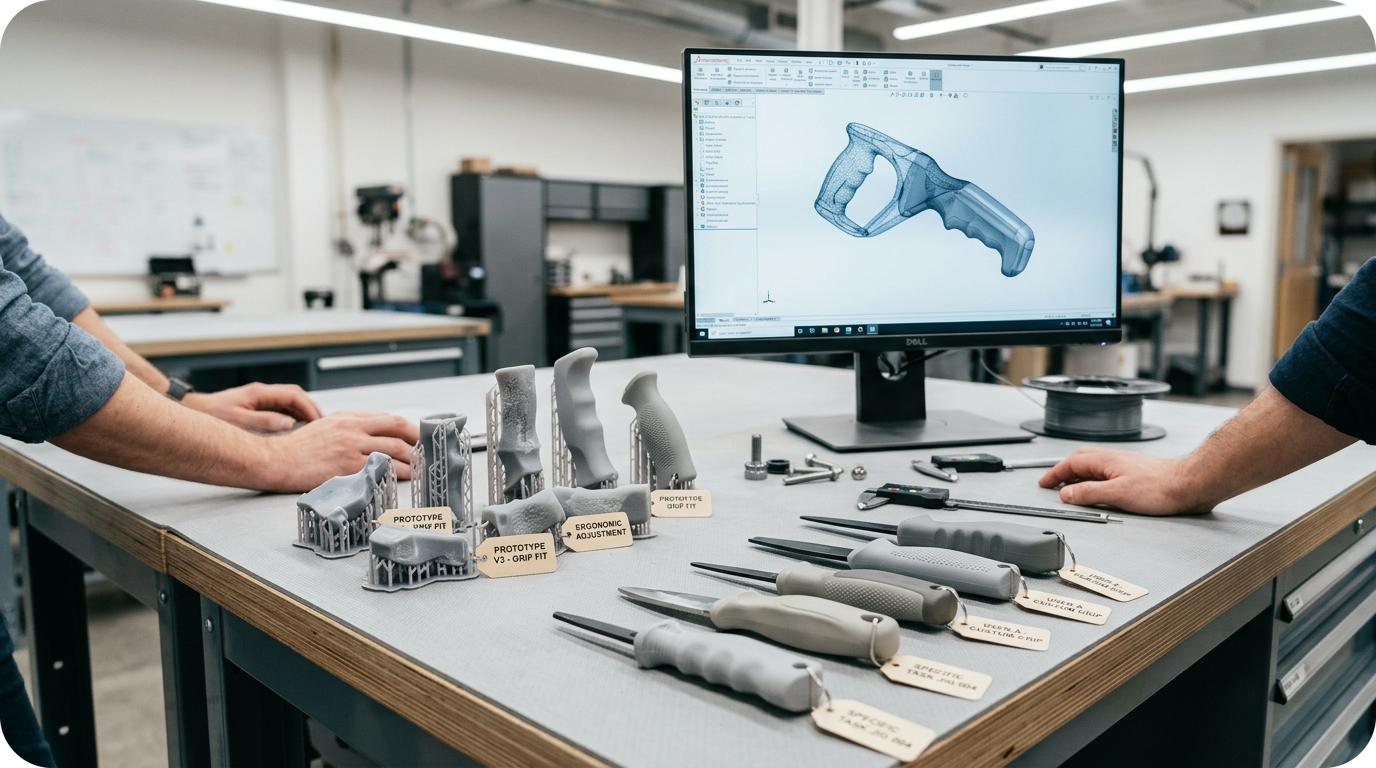
소재 기사는 인간공학이 앞으로 더 중요해질 것이라고 전망합니다. 여러 나라에서 노동력이 귀해지고, 건설 같은 직종은 작업자 평균 연령이 50세를 넘어 매년 높아지고 있습니다. 사람이 줄어들수록 한 사람 한 사람의 작업이 더 중요해지고, 각자에게 맞춘 도구의 필요성도 커집니다.
기사는 특히 디바이스 영역에서 3D프린팅의 역할이 가장 논리적이라고 봅니다. 개인의 손·환경·상황에 맞춰 손잡이 크기나 텍스처를 조정한 최종 사용 디바이스를 만들 수 있고, 치과 분야에서 이미 자리 잡은 스캔-투-워크플로 방식을 다른 디바이스로도 확장할 수 있다는 것입니다. 실제로 기사에는 구강의 세 부위에 맞춘 어플리케이터, 완전 조절식 마우스, 항공기 조종석의 컨트롤 패널 같은 사례가 인간공학적 적용 예로 등장합니다.
여기서 제조 문제는 두 가지로 요약됩니다. 첫째, 개별 사례에 맞춰 소량을 만들어야 하므로 대량 양산 논리가 통하지 않습니다. 둘째, 워크플로가 바뀌면 도구도 빠르게 바뀌어야 하는데, 금형 기반 방식은 이 유연성을 따라가기 어렵습니다. 병원 대기실의 점자 표지판을 만들었다가 잘 맞지 않으면 새 버전을 바로 만들고, 공사 중이면 상황에 맞게 임시로 바꾸는 식의 대응은, 형상을 자유롭게 반복 생산할 수 있을 때 비로소 가능해집니다.
이런 유연성은 개별 발명을 특정 상황에 더 확실하게 맞추는 힘이 됩니다. 하나의 핸드레일 부착물을 만들고, 같은 원리를 다른 난간이나 장갑 낀 현장, 젖은 손의 어선용으로 조금씩 변형해 적용하는 식입니다.
산업용 SLA 3D프린팅으로 잇는 지그·치구 맞춤 양산
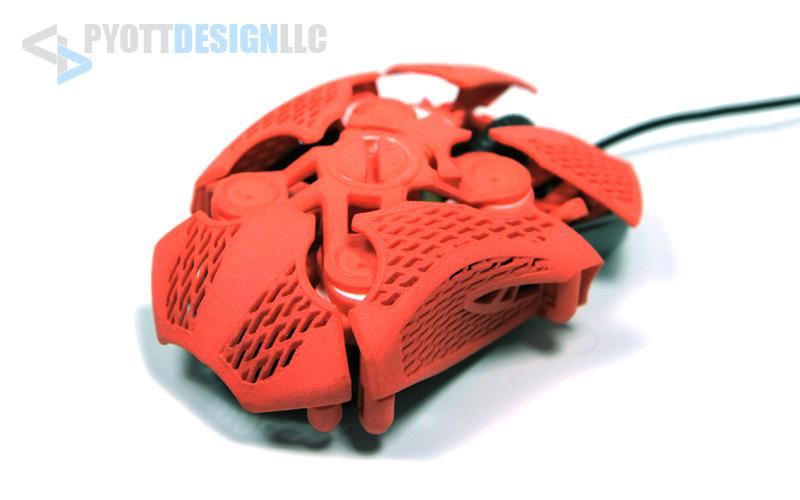
이렇게 사람과 현장에 맞춘 도구를 반복 가능하게 공급하는 일은, 실제 산업 현장에서는 산업용 SLA 3D프린팅을 통해 더 정밀하게 구현될 수 있습니다. 금형 없이 설계 데이터만으로 생산에 진입할 수 있어, 형상이 사람마다·현장마다 달라도 각 버전을 그대로 만들 수 있기 때문입니다.
바로 이 지점에서 산업용 SLA 3D프린팅이 인간공학적 도구 양산의 유력한 선택지로 부상합니다. GLUCK은 로봇 외장 커버 소량 양산, 생산라인 지그·치구·검사구, 의료기기 하우징·커버 같은 프로젝트에서 개별 형상을 반복 생산해 왔습니다.
- 금형 없는 반복생산: 설계 데이터를 교체하면 다음 생산분부터 변경이 반영되어, 설계 개선이 잦은 지그·그립에 적합합니다.
- 표면 품질과 정밀도: 최대 ±0.05mm 정밀도와 Ra 0.8 수준의 표면조도를 구현하며, 후가공 시 사출품과 구별이 어려운 마감이 가능해 그립·핸들처럼 손이 직접 닿는 부품에도 활용할 수 있습니다.
- 유연한 반복 소량~중량 생산: 개별 맞춤 형상 1개 단위부터, 검증을 거쳐 반복 생산으로 확장되는 Flexible Series Production을 지원합니다.
💡 핵심은, SLA가 모든 상황의 정답은 아니라는 점입니다. 완전히 동일한 형상을 초대량으로, 단순한 구조로, 최저 단가로 찍어야 한다면 기존 금형 방식이 여전히 유리합니다. 반면 사람·현장마다 형상이 달라지고, 설계 변경이 잦으며, 초도·브릿지부터 반복 소량~중량 생산으로 이어지는 다품종 도구 구간이라면 SLA가 조건상 잘 맞습니다.
인간공학은 상황을 평가하고 접근을 개선하는 과정에 가깝습니다. 적층 제조는 그 과정을 더 유연하고 국지적이며 지속적인 것으로 바꿉니다. 사람에게 딱 맞는 도구가 생산성을 바꾸듯, 그 도구를 필요한 만큼·필요할 때 반복 생산하는 능력이 제조사의 경쟁력을 바꾸는 셈입니다.
물론 어떤 방식이 맞는지는 형상·수량·설계 변경 빈도에 따라 달라집니다. 다품종 맞춤 지그·핸들·그립을 금형 부담 없이 반복 생산하고자 하는 제조사에게, 산업용 SLA는 현실적인 선택지입니다.
GLUCK은 반복 생산이 가능한 산업용 SLA 3D프린팅 인프라를 기반으로
지그·치구·핸들 등 인간공학적 맞춤 도구 개발과 양산 전환 과정에 필요한 3D프린팅 제조 솔루션을 지원하고 있습니다.
지금 글룩을 확인해보세요!
📩 글룩 홈페이지 & 온라인 견적: https://www.glucklab.com
📂 글룩 포트폴리오: 글룩 포트폴리오 확인하기 (https://glucklab.com/bbs/bbs_list.php?code=portfolio)
References
[1] 3DPrint.com, "Killer 3D Printing Applications: Human Factors," 3DPrint.com. Link: https://3dprint.com/330201/killer-3d-printing-applications-human-factors/
Made to Fit the Hand: How Human Factors Is Changing the Way Jigs and Grips Are Produced
Watch a shop floor long enough, and you realize productivity is often changed not by grand equipment but by something very small. A grip made to fit a worker's hand, or a jig that fits one specific machine, can noticeably change the fatigue and defect rate of repetitive work. Hands differ in size, a gloved hand differs from a bare one, and a wet hand differs from a dry one.
Recently, the manufacturing industry has been paying renewed attention to "Human Factors." 3dprint.com noted that human factors—from low-volume tools like jigs, fixtures, and poka-yoke devices to personalized mice and medical applicators—is emerging as a strong application area for 3D printing. As labor grows scarce and the average age of workers rises, the value of tools that better fit people to their work is increasing.
So how do you custom-produce jigs, handles, and grips that differ from person to person and site to site? This question leads directly to a question of manufacturing method. Supplying individually fitted tools in small quantities—yet repeatably—has never been simple with traditional methods.
Jigs, Fixtures, and Tools Made to Fit the Hand
Human factors starts from "how people interact with work"—from how you sit at a desk to how you handle a pneumatic drill. The source article explains that low-volume tools like jigs, fixtures, and poka-yoke devices are representative applications that cut costs and reduce errors, and that many of them carry strong ergonomic elements.
The problem is that such tools are mostly "small-batch" and "individual." One milling station's setup can be entirely different from another factory's, and even the same tool may need different surface textures for a gloved foundry floor or a wet-handed fishing boat. Making such multi-variant, small-batch tools traditionally required a separate mold or dedicated machining for each geometry. The issue is that tooling costs become a financial shackle on creativity, and changing a single tool incurs production time and cost all over again.
- A different tool for every geometry: People, equipment, and environments each differ, so a single standard tool cannot cover every site.
- Frequent design iteration: Because small changes yield big effects, form-and-fit prototypes and multiple rounds of refinement are needed.
As the article points out, under these conditions, making things cheaply near the user and validating them together is far faster and less expensive. This is why 3D printing holds a real edge here.
Personalized Devices and the Clinical Field
The source article foresees human factors becoming even more important. In many countries labor is growing scarce, and professions like construction have average worker ages over 50, rising each year. As people become fewer, each worker's task grows more critical, and so does the need for individually fitted tools.
The article sees the most logical role for 3D printing in the device sphere. End-use devices can adjust handle sizing or texture to an individual's hand, environment, and situation, and the scan-to-workflow approach already established in dental can be replicated across other devices. Indeed, the article cites examples such as applicators for three oral regions, a fully adjustable mouse, and aircraft cockpit control panels as ergonomic applications.
Here the manufacturing challenge boils down to two points. First, tools must be made in small quantities for individual cases, so mass-production logic does not apply. Second, when the workflow changes, the tool must change quickly—something mold-based methods struggle to keep up with. Making Braille signs for a hospital waiting room, quickly remaking them if they don't work, or temporarily changing them during construction—such responsiveness becomes possible only when geometries can be produced freely and repeatedly.
This flexibility becomes the power to fit individual inventions more surely to specific situations—making one handrail add-on, then adapting the same principle for other rails, gloved sites, or wet-handed fishing boats.
Connecting Ergonomic Jig and Fixture Production Through Industrial SLA 3D Printing
Supplying such people- and site-specific tools repeatably can, in actual industrial settings, be realized more precisely through industrial SLA 3D printing. Because production can begin from design data alone without a mold, each version can be made as is—even when geometries differ from person to person and site to site.
This is precisely where industrial SLA 3D printing emerges as a strong option for producing ergonomic tools. GLUCK has repeatedly produced individual geometries across projects such as low-volume robot exterior covers, production-line jigs, fixtures, and inspection tools, and medical device housings and covers.
- Mold-free repeatable production: Swapping the design data applies changes from the next run onward, ideal for jigs and grips undergoing frequent design improvement.
- Surface quality and precision: Up to ±0.05mm precision and Ra 0.8 surface roughness, with finishes hard to distinguish from injection-molded parts after post-processing—usable even for grips and handles that hands touch directly.
- Flexible low-to-mid-volume production: Supporting Flexible Series Production that starts from a single custom geometry and scales, after validation, into repeatable runs.
💡 The key point is that SLA is not the answer for every situation. If you must produce an identical geometry in very high volumes, with simple structure, at the lowest unit cost, traditional mold-based methods still hold the advantage. Conversely, when geometries vary by person and site, design changes are frequent, and production runs from initial and bridge stages into repeatable low-to-mid volumes of multi-variant tools, SLA fits the conditions well.
Human factors is closer to a process of assessing situations and improving approaches. Additive manufacturing makes that process more fluid, local, and ongoing. Just as a tool made to fit a person changes productivity, the ability to repeatedly produce that tool—in the amount needed, when needed—changes a manufacturer's competitiveness.
Of course, which method suits you depends on geometry, quantity, and how often designs change. For manufacturers seeking to repeatedly produce multi-variant, custom jigs, handles, and grips without the burden of tooling, industrial SLA is a realistic option.
GLUCK supports the 3D printing manufacturing solutions needed for the development and mass-production transition of ergonomic custom tools such as jigs, fixtures, and handles, based on an industrial SLA 3D printing infrastructure capable of repeatable production.
Check out GLUCK now!
📩 GLUCK Website & Online Quote: https://www.glucklab.com
📂 GLUCK Portfolio: View the GLUCK Portfolio (https://glucklab.com/bbs/bbs_list.php?code=portfolio)
References
[1] 3DPrint.com, "Killer 3D Printing Applications: Human Factors," 3DPrint.com. Link: https://3dprint.com/330201/killer-3d-printing-applications-human-factors/
#글룩 #GLUCK #3D프린팅 #산업용3D프린팅 #SLA3D프린팅 #지그치구 #인간공학 #맞춤양산 #DfAM #반복생산 #온디맨드 #3DPrinting #IndustrialSLA #SLA3DPrinting #HumanFactors #Ergonomics #JigsAndFixtures #AdditiveManufacturing #FlexibleSeriesProduction #OnDemandManufacturing
원문 기사 이미지 출처
운영자가 최종 선택한 원문 이미지입니다. 발행 시 아래 출처를 함께 표시합니다.
- [본문] 3D printed fully adjustable mouse. Image courtesy of Charlie Pyott Design LLC. — 출처: 3dprint.com — https://3dprint.com/330201/killer-3d-printing-applications-human-factors/
- [본문] 3D Schematics and photographs of the applicators for three different regions in the mouth. The photographs showcase the integrated unit with the applicator (1), bite wing (2), and endoscope (3) used in the ergonomics cli — 출처: 3dprint.com — https://3dprint.com/330201/killer-3d-printing-applications-human-factors/
- [본문] Aircraft cockpit control panel showing the landing gear and wing flap controls. Image courtesy of UIUX.pt — 출처: 3dprint.com — https://3dprint.com/330201/killer-3d-printing-applications-human-factors/
'인사이트 (Insights)' 카테고리의 다른 글
| AM 업계 매출 지도가 바뀌었다 : 3D프린팅 제조 파트너를 고를 때 봐야 할 진짜 기준 (0) | 2026.09.01 |
|---|---|
| 시속 320km 고속열차 앞부분을 금형 없이 만든 철도 회사 (0) | 2026.08.31 |
| 3D프린팅 격자 패딩으로 뇌진탕 위험 77% 감소 (0) | 2026.08.31 |
| 오픈소스 휴머노이드 : 로봇 부품을 금형 없이 양산한다는 것 (0) | 2026.08.31 |
| 3D프린팅으로 배포된, 영화 '프로젝트 헤일메리' 외계인 로키! (3) | 2026.04.30 |