
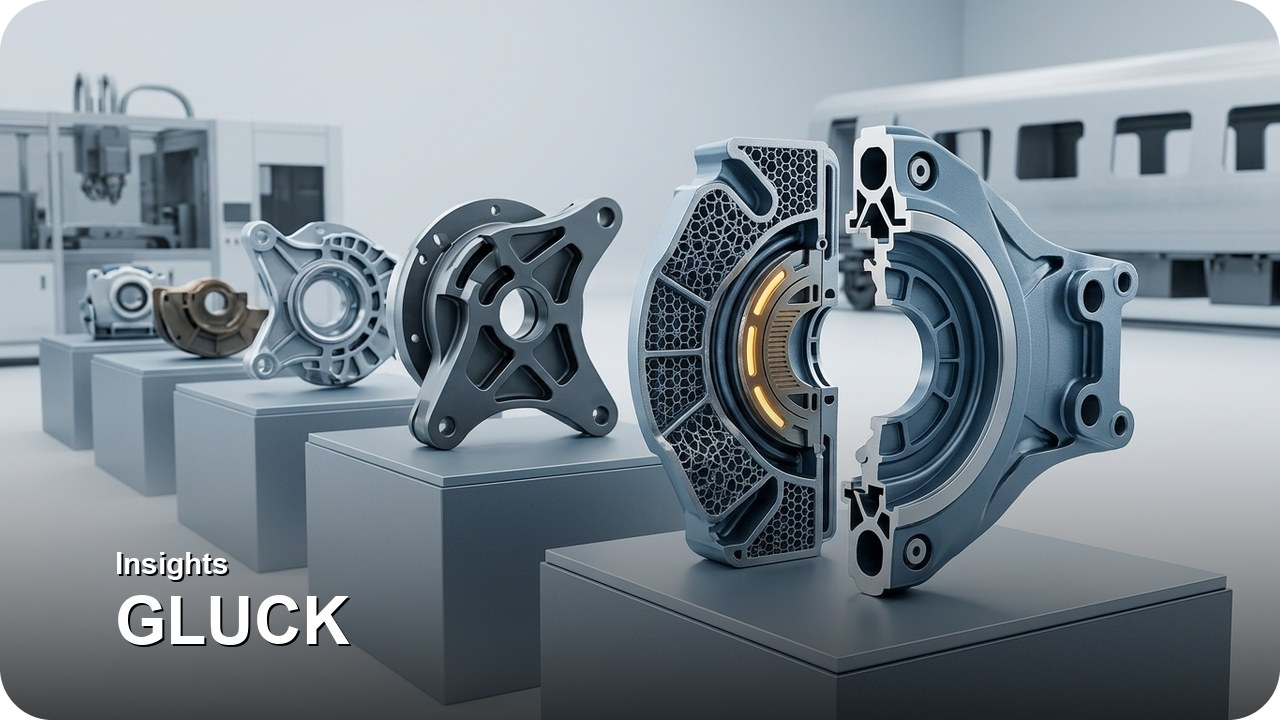
시속 320km 고속열차 앞부분을 금형 없이 만든 철도 회사
100년 넘는 역사를 가진 철도 산업은 제조업에서 가장 보수적인 분야 중 하나로 꼽힙니다. 안전 기준이 까다롭고 부품 수명이 길며, 한 번 검증된 공정을 좀처럼 바꾸지 않습니다. 그런 철도 산업조차 최근 부품 조달 방식에서 흥미로운 변화를 보이기 시작했습니다. 시속 320km로 달리는 고속열차의 외장 부품을, 금형 없이 만들어낸 것입니다.
독일의 HÖRMANN Vehicle Engineering(HVE)과 연구 파트너들은 34개월에 걸친 '3D-FiberTrain' 프로젝트를 통해, 대형 중하중 철도 차량 부품을 금형 없이 제작하는 공정을 완성했다고 밝혔습니다(3D Printing Industry 보도). 이들은 지멘스 모빌리티의 ICE 3neo 고속열차 앞부분(nose)과 프론트 스커트(front skirt)를 실증 부품으로 제작해 기술을 검증했습니다.
여기서 한 가지 질문이 자연스럽게 떠오릅니다. 생산량이 적고 종류가 많은 부품은 금형 없이 어떻게 양산할까요? 이 질문은 단순한 철도 산업의 이야기가 아니라, 소량 다품종 부품을 다루는 모든 제조사가 마주하는 경제성의 문제로 이어집니다.
HVE의 무금형 공정 : 왜 철도가 금형을 버렸나
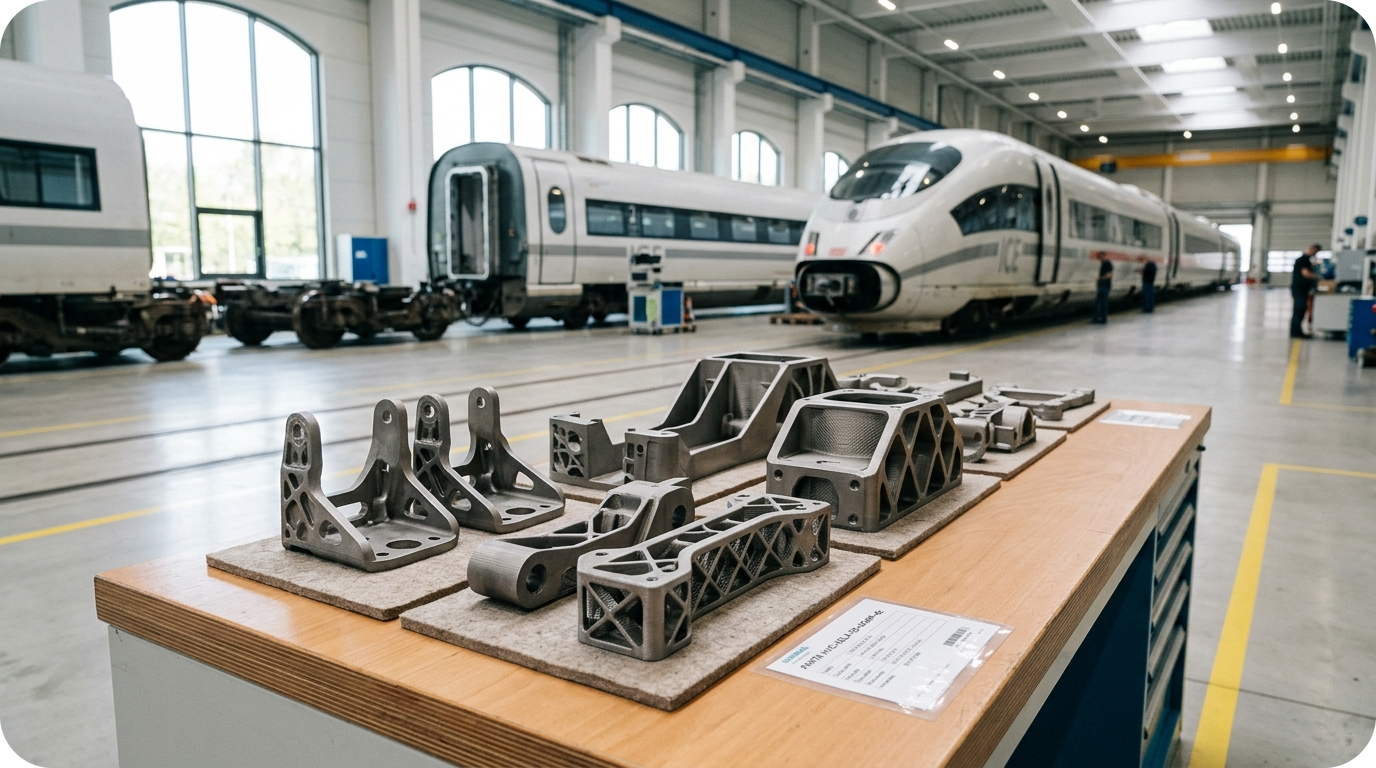
철도 차량의 외피 부품은 지금까지 열경화성 복합재 방식으로 만들어져 왔습니다. 핸드 레이업(hand lay-up)이나 진공 함침(vacuum infusion) 같은 공정입니다. 문제는 이 방식이 안고 있는 구조적 한계입니다.
- 비싼 금형과 긴 준비 시간: 열경화성 복합재 공정은 값비싼 금형(tooling)을 필요로 하고, 준비에 상당한 시간이 걸립니다. 부품 종류가 많아지면 금형 종류도 함께 늘어납니다.
- 수요 불규칙·단종 리스크: 철도 부품은 수요가 불규칙하고 단종이 잦습니다. 이런 구간에서는 한 번 만든 금형의 감가상각을 회수하기가 어렵습니다. 팔릴 수량이 적은데 초기 투자만 크게 들어가는 구조입니다.
HVE 컨소시엄은 세 가지 기술을 하나의 공정 사슬로 묶어 이 문제에 접근했습니다. 대형 과립 기반 압출 프린팅으로 금형 없이 복잡한 형상을 만들고, 새로 개발한 3D 테이프 레이잉으로 하중이 집중되는 부위에 연속섬유를 보강한 뒤, 자동 밀링으로 치수 정밀도와 표면 품질을 맞추는 방식입니다. 전 공정이 열가소성 소재를 쓰기 때문에 완성 부품을 재활용할 수 있다는 점도 기존 열경화성 복합재와 구분되는 특징입니다.
컨소시엄은 이 공정이 소량·중량 생산 구간에서 제조 비용을 낮추고, 금형 단계를 없앤 만큼 생산 시간을 단축하며, 새 금형 투자 없이 설계와 부품 변형을 유연하게 바꿀 수 있다고 설명했습니다. 이는 철도뿐 아니라 소량 다품종 부품을 다루는 제조 현장 전반에 그대로 적용될 수 있는 논리입니다.
열가소성이라는 공통 흐름 : 산업 전반의 전환
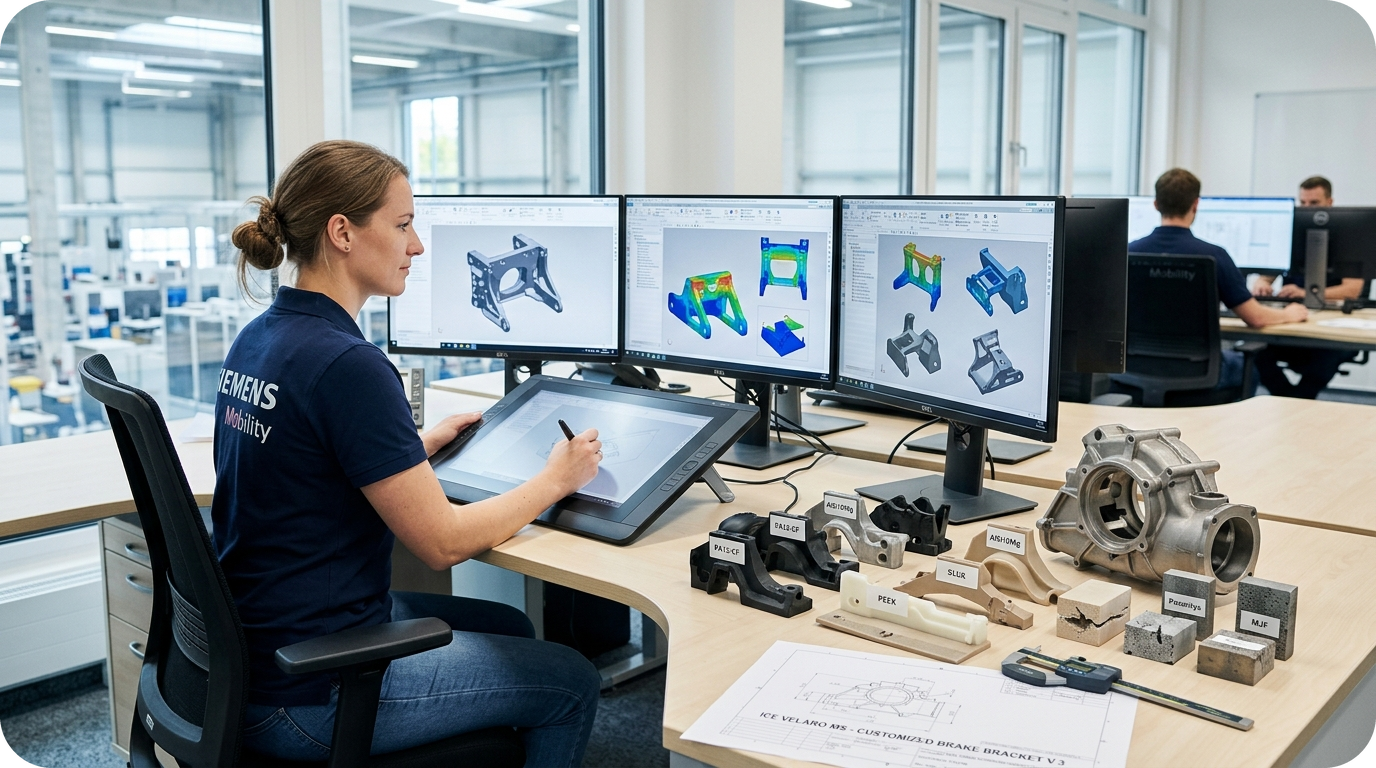
3D-FiberTrain이 흥미로운 이유는 이것이 단발성 실험이 아니라는 점입니다. 철도 산업 곳곳에서 비슷한 방향의 시도가 동시에 진행되고 있습니다.
보도에 따르면 Stratasys는 철도 최종 양산용으로 개발한 난연성 유리섬유 강화 나일론 소재를 선보였으며, 이는 알스톰·지멘스 모빌리티와의 협업을 통해 EN 45545-2 화재 안전 기준을 충족하면서도 재활용 가능한 열가소성 워크플로와 호환되도록 만들어졌습니다. 또 도이치반(Deutsche Bahn)은 Essentium의 난연성 열가소성 소재를 고속 압출 3D프린터용으로 인증해, 수만 개 규모의 교체 부품 생산에 활용하고 있다고 전해집니다.
이 사례들을 관통하는 공통점은 분명합니다. 적층제조가 구조적으로 더 까다로운 철도 부품으로 확장되면서, 재활용성과 수리 가능성을 처음부터 부품에 내장하기 위해 열가소성 소재가 전략의 기반으로 선택되고 있다는 점입니다. 다만 이들은 대형 복합재·금속·압출 등 서로 다른 공정을 쓰며, 부품의 크기·하중·기능에 따라 적합한 방식이 각각 다릅니다.
소량 다품종 양산, 산업용 SLA는 어디에 적합한가
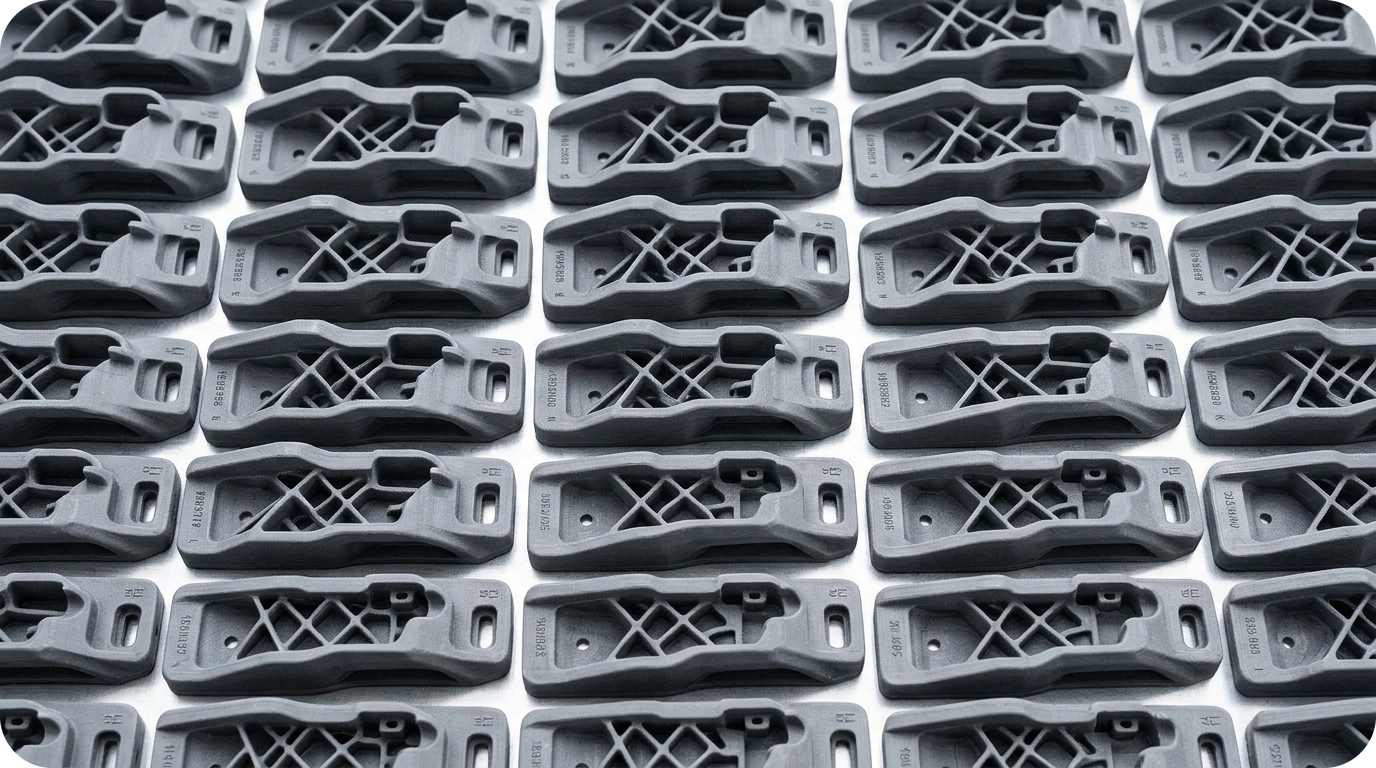
HVE 사례가 던지는 핵심 메시지는 소재나 공정 그 자체가 아니라, "수요가 적고 종류가 많은 부품일수록 금형이라는 초기 투자가 부담이 된다"는 제조 경제학입니다. 바로 이 지점에서, 폴리머 하우징·커버·외장 부품 영역에서는 산업용 SLA 3D프린팅이 유력한 선택지로 부상합니다.
산업용 SLA는 매끄러운 표면 품질과 복잡 형상 구현에 강점이 있습니다. GLUCK의 경우 최대 ±0.05mm 정밀도와 Ra 0.8 수준의 표면조도를 구현하며, 후가공 시 사출품과 구별이 어려운 마감이 가능합니다. 금형 없이 디지털 데이터만으로 반복 생산하기 때문에, 설계 변경이 잦거나 부품 변형이 많은 프로젝트에서 초도·브릿지·반복 소량~중량 생산으로 자연스럽게 이어질 수 있습니다. 이것이 GLUCK이 지향하는 Flexible Series Production의 핵심입니다.
💡 다만 SLA가 모든 경우의 정답은 아닙니다. 동일한 형상을 수만 개 이상 반복 생산하는 대량 구간이라면 사출 성형의 개당 단가가 여전히 유리합니다. 또한 대형 구조 하중을 직접 받는 부품이나 금속 고하중 영역은 SLA 폴리머의 영역 밖입니다(위 HVE·금속 사례는 각 기업의 별도 공정이며 GLUCK 역량과는 구분됩니다). GLUCK이 강한 지점은 로봇 외장 커버, 생산라인 지그·치구·검사구, 의료기기 하우징/커버처럼 소량 다품종이면서 표면·형상 요구가 높은 폴리머 부품의 반복 생산입니다.
정리하면, 무금형 양산은 만능 해법이 아니라 조건이 맞을 때 강력한 대안입니다. 수요가 불규칙하고 단종이 잦으며 설계 변경이 잦은 부품, 그러면서도 표면 품질과 복잡 형상이 중요한 부품이라면, 금형 없이 반복 생산하는 방식이 현실적인 경제성을 만들어냅니다.
100년 넘은 철도 산업조차 소량 다품종 부품에서 금형을 다시 생각하기 시작했다는 사실은, 다른 산업의 제조사에게도 시사하는 바가 큽니다. 물론 어떤 부품에 어떤 공정이 맞는지는 수량·형상·하중·변경 빈도를 함께 따져봐야 합니다. 그 판단을 함께 설계하는 것이 GLUCK이 하는 일입니다.
GLUCK은 반복 생산이 가능한 산업용 SLA 3D프린팅 인프라를 기반으로
소량 다품종 부품 개발과 양산 전환 과정에 필요한 3D프린팅 제조 솔루션을 지원하고 있습니다.
지금 글룩을 확인해보세요!
📩 글룩 홈페이지 & 온라인 견적: https://www.glucklab.com
📂 글룩 포트폴리오: 글룩 포트폴리오 확인하기 (https://glucklab.com/bbs/bbs_list.php?code=portfolio)
References
[1] 3D Printing Industry, "HVE Completes Tool-Free 3D Printing Process for Rail Components," 3dprintingindustry.com. Link: https://3dprintingindustry.com/news/hve-completes-tool-free-3d-printing-process-for-rail-components-254030/
A Rail Company Built the Front of a 320km/h High-Speed Train Without Any Mold
With over a century of history, the rail industry is considered one of the most conservative fields in manufacturing. Safety standards are strict, part lifespans are long, and once a process is validated it is rarely changed. Yet even this industry has recently shown an intriguing shift in how it sources parts: it built the exterior components of a train running at 320 km/h without any mold.
Germany's HÖRMANN Vehicle Engineering (HVE) and its research partners announced they had completed a tool-free process for manufacturing large-format heavy-duty rail vehicle components through the 34-month "3D-FiberTrain" project (reported by 3D Printing Industry). They validated the technology by producing the nose section and front skirt of Siemens Mobility's ICE 3neo high-speed train as demonstrator parts.
One question naturally arises here. How do you mass-produce low-volume, high-variety parts without a mold? This is not merely a rail industry story—it leads to a question of economics that every manufacturer handling low-volume, high-variety parts faces.
HVE's Tool-Free Process: Why Rail Abandoned the Mold
Rail vehicle outer skin components have long been made using thermoset composite methods such as hand lay-up or vacuum infusion. The problem lies in the structural limits of this approach.
- Expensive tooling and long preparation: Thermoset composite processes require costly tooling and take significant preparation time. As the number of part types grows, the number of molds grows with it.
- Irregular demand and discontinuation risk: Rail parts have irregular demand and are frequently discontinued. In such cases it is hard to recover the depreciation of a mold once made—a structure where the quantity sold is small but the initial investment is large.
The HVE consortium approached this by combining three technologies into a single process chain. Large-format granule-based extrusion printing creates complex geometries without tooling, a newly developed 3D tape-laying process reinforces high-stress areas with continuous fiber, and automated milling finishes the parts to the required dimensional accuracy and surface quality. Because every stage uses thermoplastic materials, the finished parts are recyclable—a distinction from conventional thermoset composites.
The consortium reported that the process lowers manufacturing costs for small and medium production runs, shortens production time by removing tooling steps, and allows designs and component variants to be adapted flexibly without new tooling investment. This logic applies not only to rail but to manufacturing floors handling low-volume, high-variety parts in general.
A Shared Thermoplastic Trend: A Sector-Wide Shift
What makes 3D-FiberTrain interesting is that it is not a one-off experiment. Similar directions are being pursued simultaneously across the rail industry.
According to reports, Stratasys introduced a flame-retardant glass-fiber-reinforced nylon developed for end-use rail production, created through collaboration with Alstom and Siemens Mobility to meet EN 45545-2 fire safety standards while staying compatible with recyclable thermoplastic workflows. Deutsche Bahn certified Essentium's flame-retardant thermoplastic materials for its high-speed extrusion 3D printer, which it now uses to produce tens of thousands of replacement parts.
The common thread across these cases is clear: as additive manufacturing moves into more structurally demanding rail applications, thermoplastic materials are increasingly chosen as the foundation, specifically to build recyclability and repairability into the part from the start. That said, these use different processes—large composites, metal, extrusion—and the suitable method varies by the size, load, and function of each part.
Low-Volume, High-Variety Production: Where Is Industrial SLA a Good Fit?
The key message of the HVE case is not the material or process itself, but the manufacturing economics: the lower the demand and the greater the variety, the heavier the burden of a mold's initial investment. It is exactly at this point that, in the domain of polymer housings, covers, and exterior parts, industrial SLA 3D printing emerges as a strong option.
Industrial SLA excels at smooth surface quality and complex geometry. GLUCK, for instance, achieves precision up to ±0.05mm and surface roughness around Ra 0.8, with a finish hard to distinguish from injection-molded parts after post-processing. Because it repeats production from digital data alone without a mold, projects with frequent design changes or many part variants can naturally extend into initial, bridge, and repeat low-to-medium volume production. This is the core of GLUCK's Flexible Series Production.
💡 That said, SLA is not the answer in every case. For high-volume runs repeating an identical shape in the tens of thousands or more, injection molding's per-unit cost remains advantageous. Parts bearing large structural loads or metal high-load applications are outside the domain of SLA polymers (the HVE and metal cases above are each company's separate processes, distinct from GLUCK's capabilities). Where GLUCK is strong is the repeat production of low-volume, high-variety polymer parts with high surface and geometric demands—such as robot exterior covers, production-line jigs/fixtures/inspection tools, and medical device housings/covers.
In short, tool-free production is not a cure-all but a powerful alternative when conditions align. For parts with irregular demand, frequent discontinuation, and frequent design changes—yet where surface quality and complex geometry matter—repeat production without a mold creates real economic value.
The fact that even the century-old rail industry has begun rethinking molds for low-volume, high-variety parts holds significant implications for manufacturers in other industries as well. Of course, which process fits which part must be judged by weighing quantity, geometry, load, and change frequency together. Designing that judgment with you is what GLUCK does.
GLUCK supports the manufacturing solutions needed for developing low-volume, high-variety parts and transitioning to production, based on an industrial SLA 3D printing infrastructure capable of repeat production.
Check out GLUCK now!
📩 GLUCK Website & Online Quote: https://www.glucklab.com
📂 GLUCK Portfolio: View the GLUCK Portfolio (https://glucklab.com/bbs/bbs_list.php?code=portfolio)
References
[1] 3D Printing Industry, "HVE Completes Tool-Free 3D Printing Process for Rail Components," 3dprintingindustry.com. Link: https://3dprintingindustry.com/news/hve-completes-tool-free-3d-printing-process-for-rail-components-254030/
#글룩 #GLUCK #3D프린팅 #산업용3D프린팅 #SLA3D프린팅 #무금형양산 #소량다품종 #철도부품 #FlexibleSeriesProduction #DfAM #3DPrinting #IndustrialSLA #SLA3DPrinting #ToolFreeManufacturing #AdditiveManufacturing #RailComponents #LowVolumeProduction #MassCustomization
'인사이트 (Insights)' 카테고리의 다른 글
| 프린터 39만 대의 시대, 중국이 완성한 'AM 스택' 다음에 온 진짜 승부처 (1) | 2026.09.02 |
|---|---|
| AM 업계 매출 지도가 바뀌었다 : 3D프린팅 제조 파트너를 고를 때 봐야 할 진짜 기준 (0) | 2026.09.01 |
| 손에 딱 맞는다는 것 : 인간공학이 지그·핸들·그립 양산을 바꾸는 방식 (0) | 2026.08.31 |
| 3D프린팅 격자 패딩으로 뇌진탕 위험 77% 감소 (0) | 2026.08.31 |
| 오픈소스 휴머노이드 : 로봇 부품을 금형 없이 양산한다는 것 (0) | 2026.08.31 |