
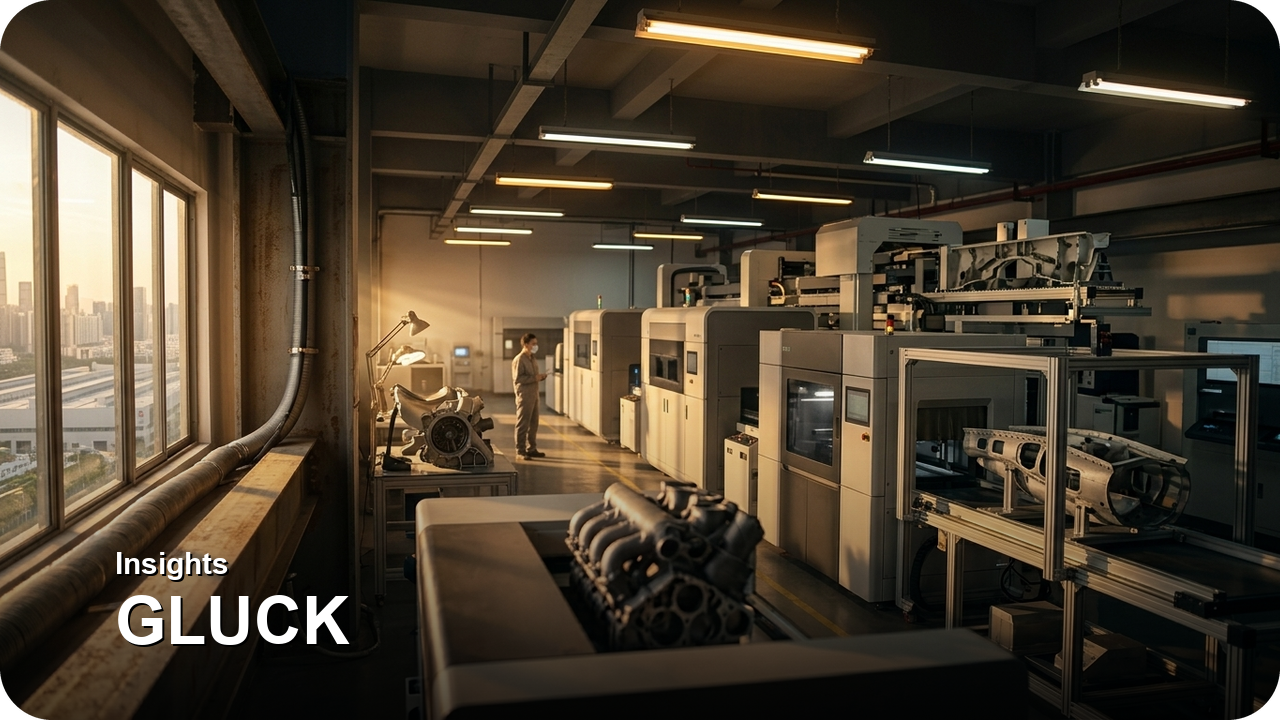
지난 몇 년간 3D프린팅 업계의 화두는 "누가 더 좋은 장비와 소재를 갖추느냐"였습니다. 정밀도가 높은 프린터, 새로운 레진과 파우더, 자동화된 슬라이서까지 — 이 '스택'을 얼마나 빨리 쌓느냐가 경쟁의 기준처럼 여겨졌습니다. 그런데 최근 열린 한 전시회는, 그 스택 자체가 더 이상 희소한 무기가 아니게 되었다는 신호를 보여주었습니다.
3dprint.com 보도에 따르면, 2026년 Formnext Asia Shenzhen에는 20,000㎡ 규모에 330개 기업이 참가해 역대 최대를 기록했습니다. 스캐너·레이저·모니터링·파우더 취급 장비·CT 검사·필라멘트 생산 라인까지, 하나의 응용 분야를 중심으로 장비·소재·소프트웨어·생산 능력을 놀라운 속도로 조립해내는 중국 제조 기반의 밀도가 그대로 드러났습니다. 한 프린트팜 운영자는 2026년 8월 기준 중국 내 프린트팜에서 약 39만 대의 프린터가 가동 중이며, 1,000대 이상을 갖춘 팜만 약 40곳으로 추정된다고 밝혔습니다.
여기서 자연스럽게 떠오르는 질문이 있습니다. 장비도, 소재도, 소프트웨어도 다 갖춰진 다음에는 제조 경쟁력이 어디서 갈릴까요? 이 글에서는 '스택 완성' 이후의 산업 변화를 제조 관점에서 짚어보려 합니다.
프린트팜 39만 대 : 장비가 흔해지면 무엇이 남는가
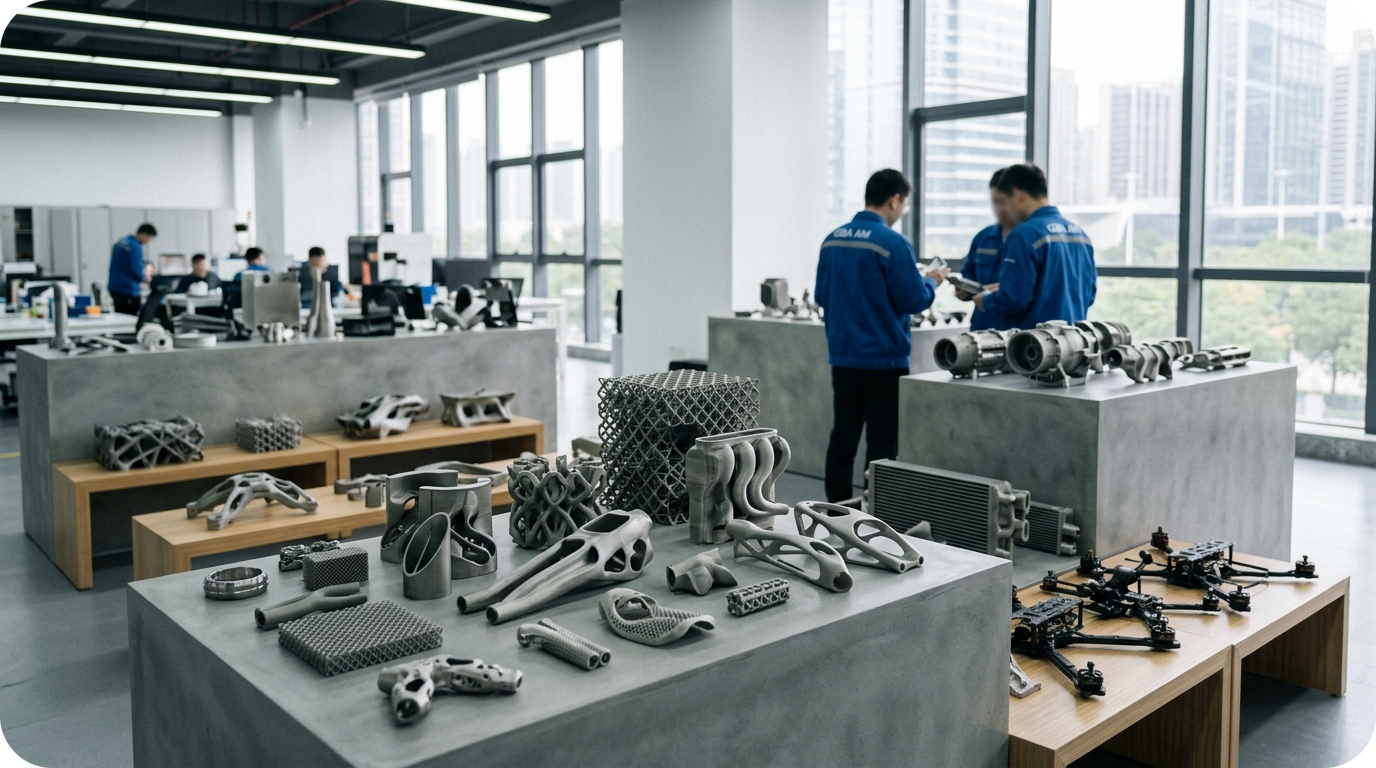
전시장에서 가장 인상적이었던 장면은 장비 그 자체가 아니라, 장비가 얼마나 흔해졌는가였습니다. 앞서 언급한 운영자에 따르면, 1,000대 규모 프린트팜을 구축하는 데 필요한 장비 투자는 2024년 약 500만 위안에서 2026년 약 100만 위안으로 떨어졌습니다. 대량 출력 주문은 그램당 0.10위안 이하로 견적되고, 잘 팔리는 제품은 며칠 안에 복제되어 더 낮은 가격에 시장에 풀린다고 합니다.
이 지점에서 제조업이 오래 알고 있던 문제가 다시 드러납니다. 장비 가격이 떨어지고 누구나 같은 출력물을 뽑을 수 있게 되면, 경쟁의 축은 '무엇을 찍을 수 있느냐'에서 '어떻게 안정적으로 반복 생산하느냐'로 이동합니다.
- 반복 품질의 문제: 프린터 한 대로 시제품 하나를 뽑는 것과, 같은 부품을 수천 개 균일한 품질로 반복 생산하는 것은 전혀 다른 과제입니다. 장비가 많다고 품질 편차가 저절로 잡히지는 않습니다.
- 실행 체계의 문제: 주문이 들어오는 대로 생산하고, 검사하고, 후가공하고, 납기를 맞추는 일관된 운영 체계가 없으면, 아무리 많은 장비도 '재고와 불량이 쌓이는 설비'로 남습니다.
결국 장비와 소재라는 '스택'은 진입 장벽을 낮추는 역할을 할 뿐입니다. 진짜 경쟁력은 그 스택 위에서 반복 양산을 실행해내는 힘에서 갈립니다.
소프트웨어까지 내려온 병목 : Meshy와 FastForm이 보여준 것
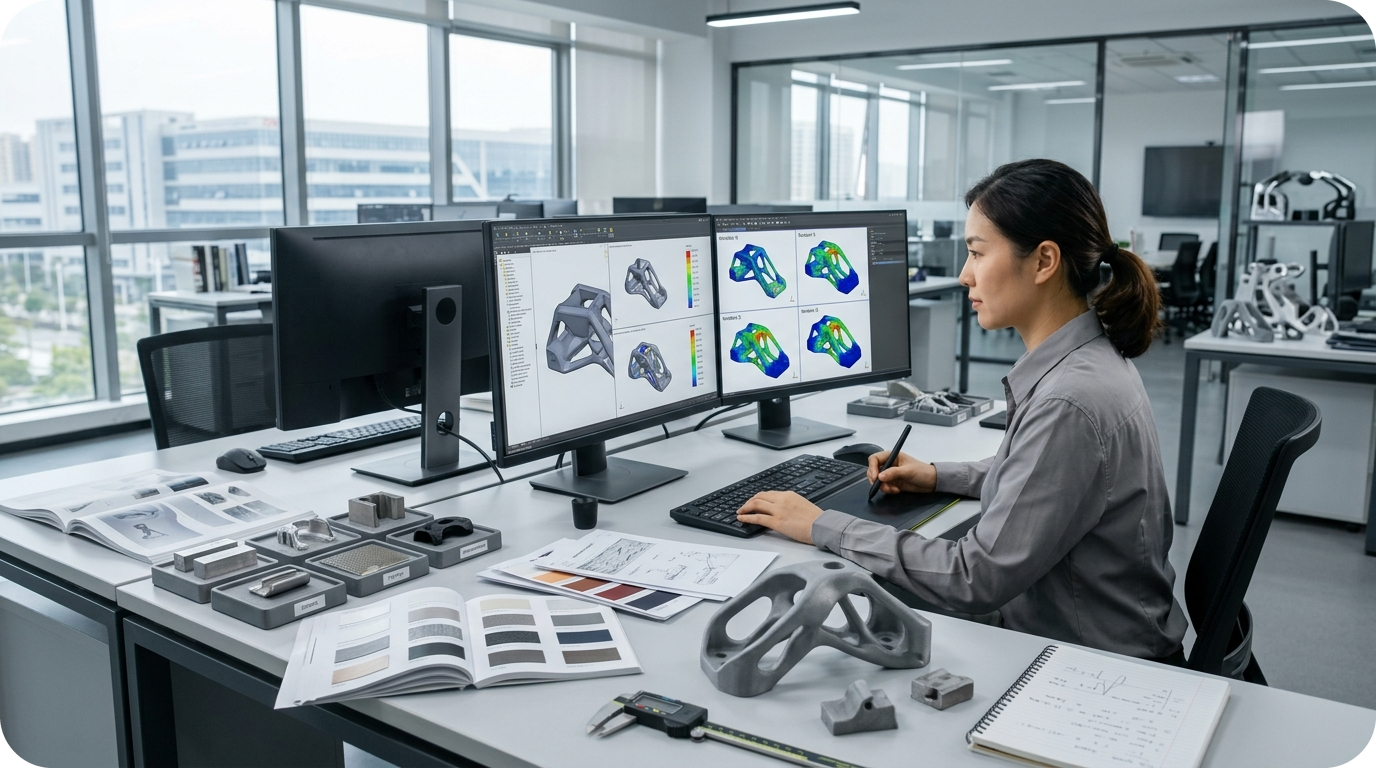
전시장에서는 하드웨어의 병목이 상당 부분 해소되자, 병목이 위쪽으로 이동하는 모습도 관찰됐습니다. Meshy는 방문자의 얼굴 사진을 스타일이 살아있는 3D 피규어로 변환하는 데모를 선보였고, 스타일 선택·편집·메시 검사·자동 수정·출력용 STL/3MF 내보내기까지 워크플로를 통합했습니다. 프린터가 저렴하고 쉬워질수록, 제약은 '어떤 아이디어를 어떻게 출력 가능한 모델로 만드느냐'라는 상류 공정으로 옮겨간 것입니다.
공정 쪽에서도 비슷한 신호가 있었습니다. FastForm은 서포트 소재와 수동 파라미터 작업을 줄이는 AM 공정 모델을 발표하며, 자사 테스트에서 한 사례 기준 서포트 파우더를 최대 98%까지 줄였다고 밝혔습니다. 흥미로운 점은 이 가치를 별도 소프트웨어 라이선스가 아니라 소재·인건비·후가공 절감으로 판매했다는 사실입니다.
이 두 사례가 공통으로 가리키는 방향은 분명합니다. 파일을 만드는 일과 부품을 뽑는 일은 쉬워지고 있지만, 그 사이에서 '출력 가능한 데이터를 요구 품질의 실제 부품으로 안정적으로 넘기는 실행력'은 여전히 어렵고, 오히려 더 중요해지고 있다는 점입니다.
저가 데스크톱과 산업 공정이 만나는 지점 : Makera와 HP
전시장에서는 디지털 제조의 양 끝이 서로를 향해 다가오는 모습도 뚜렷했습니다. Makera는 데스크톱 CNC를 AM 전시회에 들고 나와, 소형화·자동 셋업·소프트웨어 통합이라는 소비자 하드웨어 공식을 절삭 가공에 적용했습니다. 반대로 HP는 MJF 1200이라는 12리터급 소형 시스템으로, 대형 포트폴리오와 동일한 Multi Jet Fusion 기술을 엔지니어링 팀과 소규모 생산팀 규모로 내려보냈습니다.
3dprint.com은 이 흐름을 두고, 고객이 적층과 절삭의 경계를 지키는 것보다 "파일에서 쓸 만한 부품까지 가장 짧고 신뢰할 수 있는 경로"를 찾는 데 더 관심을 둔다고 짚었습니다. 데스크톱 프린터는 함대 규모의 생산 능력이 되고, 산업용 폴리머 공정과 CNC는 개별 엔지니어링 팀 가까이로 내려오고 있습니다.
여기서도 제조업의 본질적인 숙제는 그대로 남습니다. 장비의 종류와 가격이 다양해질수록, 남는 질문은 "그래서 이 부품을 요구 품질로, 필요한 수량만큼, 약속한 납기에 반복해서 만들 수 있는가"입니다. 이 질문에 답하지 못하면 어떤 장비 조합도 경쟁력이 되지 못합니다.
'스택 다음'의 승부처, 산업용 SLA는 어떤 조건에서 답이 되나
이렇게 장비·소재·소프트웨어가 흔해진 다음의 승부처는 결국 '양산 실행력'입니다. 그리고 이 지점은 산업 현장에서 산업용 SLA 3D프린팅을 통해 구체적으로 구현될 수 있습니다. 다만 여기서 분명히 해둘 것이 있습니다. SLA는 모든 부품에 유리한 만능 공법이 아니라, 조건이 맞을 때 유력한 선택지입니다.
SLA가 강점을 갖는 조건은 이렇습니다.
- 다품종을 반복 생산해야 할 때: 금형이 없기 때문에 설계 데이터만 있으면 여러 품종을 같은 라인에서 반복 생산할 수 있습니다. 로봇 외장 커버, 생산라인 지그·치구·검사구, 의료기기 하우징처럼 품종은 많고 형상이 복잡한 부품에 적합합니다.
- 설계 변경이 잦을 때: 변경 때마다 금형을 다시 만들 필요 없이 데이터만 수정하면 다음 생산에 바로 반영됩니다. 초도·브릿지 구간에서 개정이 잦은 부품에 유리합니다.
- 표면과 정밀도가 중요할 때: GLUCK의 산업용 SLA는 최대 ±0.05mm 정밀도와 Ra 0.8 수준의 표면조도를 구현하며, 후가공 시 사출품과 구별이 어려운 마감이 가능합니다.
반대로 기존 방식이 더 나은 경우도 분명합니다. 단순한 형상을 동일하게 초대량으로 찍는다면 사출의 개당 단가가 유리하고, 고하중을 견뎌야 하는 금속 부품은 SLA 폴리머의 영역을 벗어납니다. 경우에 따라서는 CNC나 사출을 함께 검토하는 편이 총비용에서 합리적입니다.
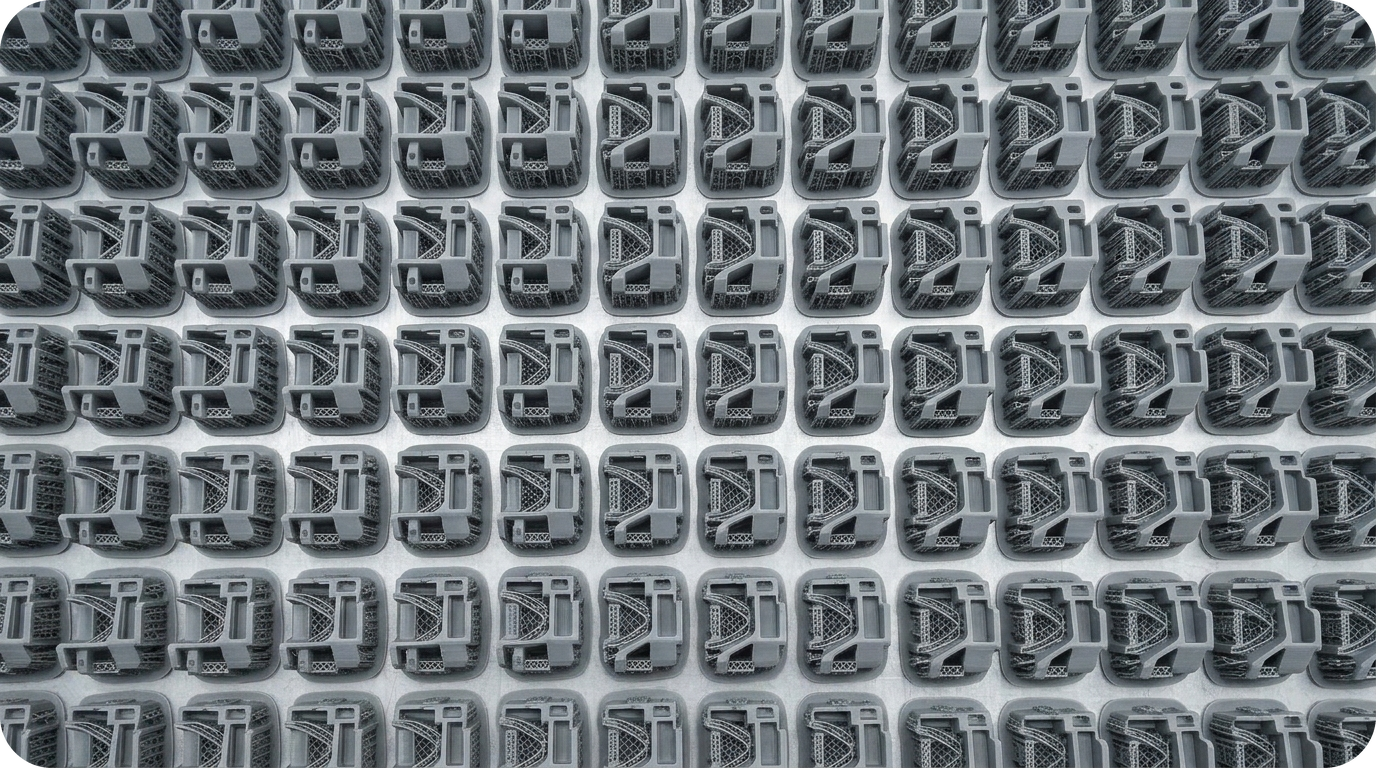
GLUCK이 운영하는 Flexible Series Production 체계가 보여주는 것은 바로 이 '스택 다음'의 실행력입니다. 약 45기의 산업용 SLA 장비, 365일 24시간 운용, 연 23만 개 이상의 생산 능력은 장비를 갖췄다는 사실 자체가 아니라, 다품종 부품을 요구 품질로 반복 생산하는 운영 체계에 방점이 있습니다.
장비와 소재가 흔해질수록, 제조 경쟁력은 '무엇을 살 수 있느냐'가 아니라 '무엇을 안정적으로 반복해서 만들 수 있느냐'로 이동합니다. 산업용 SLA는 그 답이 필요한 다품종·복잡 형상·잦은 변경 구간에서 조건부 대안으로 검토해볼 만합니다. 다만 모든 부품에 정답은 아니며, 형상과 수량, 하중 조건에 따라 기존 공법과 함께 저울질하는 판단이 필요합니다.
GLUCK은 반복 생산이 가능한 산업용 SLA 3D프린팅 인프라를 기반으로
다품종 부품 개발과 양산 전환 과정에 필요한 3D프린팅 제조 솔루션을 지원하고 있습니다.
지금 글룩을 확인해보세요!
📩 글룩 홈페이지 & 온라인 견적: https://www.glucklab.com
📂 글룩 포트폴리오: 글룩 포트폴리오 확인하기
References
[1] 3DPrint.com, "Formnext Asia Shenzhen 2026: China Has Built the AM Stack. What Comes Next?," 3DPrint.com. Link: https://3dprint.com/331443/formnext-asia-shenzhen-2026-china-has-built-the-am-stack-what-comes-next/
English Version
After 390,000 Printers: The Real Battleground Beyond China's Completed 'AM Stack'
For the past several years, the central question in 3D printing has been "who has the better equipment and materials." Higher-precision printers, new resins and powders, automated slicers—how fast you stacked these became the yardstick of competition. Yet a recent trade show signaled that the stack itself is no longer a scarce weapon.
According to 3dprint.com, Formnext Asia Shenzhen 2026 drew 330 exhibitors across 20,000 square meters, its largest edition yet. From scanners, lasers, monitoring and powder-handling equipment to CT inspection and filament production lines, the density of a Chinese manufacturing base that assembles equipment, materials, software and production capacity around a single application at remarkable speed was on full display. One print-farm operator estimated that as of August 2026, roughly 390,000 printers were operating in farms across the country, with around 40 farms holding more than 1,000 machines.
A natural question follows: once equipment, materials and software are all in place, where does manufacturing competitiveness get decided? This article examines the industry shift beyond the "completed stack" from a manufacturing perspective.
390,000 Printers: What Remains When Equipment Becomes Common
The most striking scene on the floor was not the equipment itself but how common it had become. According to the operator cited above, the equipment investment for a 1,000-machine farm fell from about RMB 5 million in 2024 to about RMB 1 million in 2026. Large printing orders were quoted below RMB 0.10 per gram, and successful products were reportedly copied and offered at lower prices within days.
Here, a problem manufacturing has long known resurfaces. When equipment prices fall and anyone can produce the same output, the axis of competition shifts from "what can you print" to "how reliably can you produce it repeatedly."
- The repeatable-quality problem: Printing one prototype on a single machine is entirely different from producing thousands of the same part at uniform quality. Having many machines does not automatically resolve quality variation.
- The execution-system problem: Without a consistent operation to produce on order, inspect, finish, and meet deadlines, even a large fleet of machines remains "equipment that accumulates inventory and defects."
Ultimately, the "stack" of equipment and materials only lowers the barrier to entry. Real competitiveness is decided by the ability to execute repeatable production on top of that stack.
Bottlenecks Reaching Software: What Meshy and FastForm Showed
At the show, as the hardware bottleneck was largely resolved, the bottleneck was observed moving upstream. Meshy demonstrated turning a visitor's face photo into a stylized 3D figure that retained recognizable features, integrating style selection, editing, mesh checks, automatic repair, and STL/3MF export into one workflow. As printers grow cheaper and easier, the constraint moves to the upstream question of "how do you turn an idea into a printable model."
On the process side, there were similar signals. FastForm announced an AM process model that reduces support material and manual parameter work, reporting up to a 98% reduction in support powder in one test example. What was interesting is that this value was sold not as a separate software license but through savings in material, labor and post-processing.
What both cases point to is clear. Making files and printing parts is getting easier, but the execution of reliably transferring printable data into required-quality real parts remains hard—and, if anything, more important.
Where Low-Cost Desktop and Industrial Processes Meet: Makera and HP
The show also clearly showed the two ends of digital manufacturing moving toward each other. Makera brought desktop CNC into an AM show, applying the consumer-hardware formula of miniaturization, automated setup and integrated software to machining. HP moved the opposite way, bringing the same Multi Jet Fusion technology as its larger portfolio down to engineering and small production teams with the 12-liter MJF 1200.
3dprint.com noted that customers care less about protecting the additive-subtractive boundary than about finding "the shortest reliable route from a file to a usable part." Desktop printers are becoming fleet capacity, while industrial polymer processes and CNC are moving closer to individual engineering teams.
Here too, manufacturing's essential homework remains unchanged. The more equipment types and prices diversify, the remaining question is "can you repeatedly make this part at required quality, in the needed quantity, by the promised deadline." Without answering this, no combination of equipment becomes competitive.
The Battleground "Beyond the Stack": Under What Conditions Is Industrial SLA the Answer?
After equipment, materials and software have become common, the battleground is ultimately "production execution." This is where industrial SLA 3D printing can be concretely realized in the field. One thing must be clear, however: SLA is not a universal method advantageous for every part, but a strong option when conditions fit.
The conditions where SLA excels are as follows.
- When you must repeatedly produce multiple varieties: With no mold, you can repeatedly produce several variety on the same line with only design data. It suits complex, multi-variety parts such as robot exterior covers, production-line jigs/fixtures/inspection tools, and medical device housings.
- When design changes are frequent: Instead of remaking a mold for each change, edits to data are reflected in the next run. This is advantageous for frequently revised parts in early and bridge phases.
- When surface and precision matter: GLUCK's industrial SLA achieves up to ±0.05mm precision and Ra 0.8 surface roughness, with a finish hard to distinguish from injection-molded parts after post-processing.
Conversely, there are clear cases where conventional methods are better. For simple shapes produced identically at very high volume, injection molding's per-unit cost wins, and metal parts bearing high loads fall outside SLA polymer's domain. In some cases, reviewing CNC or injection molding together is more reasonable in total cost.
The Flexible Series Production system GLUCK operates demonstrates exactly this "beyond the stack" execution. About 45 industrial SLA machines, 365-day 24-hour operation, and annual production capacity of over 230,000 units emphasize not the mere fact of owning equipment, but the operating system that repeatedly produces multi-variety parts at required quality.
As equipment and materials become common, manufacturing competitiveness shifts from "what you can buy" to "what you can reliably produce repeatedly." Industrial SLA is worth reviewing as a conditional option in the multi-variety, complex-geometry, frequent-change range that needs this answer. Still, it is not the answer for every part, and a judgment that weighs it against conventional methods based on geometry, quantity and load conditions is necessary.
GLUCK supports the 3D printing manufacturing solutions needed for multi-variety part development and the transition to production, based on an industrial SLA 3D printing infrastructure capable of repeatable production.
Check out GLUCK now!
📩 GLUCK Website & Online Quote: https://www.glucklab.com
📂 GLUCK Portfolio: View GLUCK Portfolio
'인사이트 (Insights)' 카테고리의 다른 글
| 발 하나하나가 다르다 : 맞춤 보조기 스타트업이 2,250만 달러를 받은 진짜 이유 (0) | 2026.09.08 |
|---|---|
| 200kg 셸을 70kg으로 : 3륜 이탈리아 캠퍼가 노르카프까지 간 경량화 설계의 비밀 (0) | 2026.09.02 |
| AM 업계 매출 지도가 바뀌었다 : 3D프린팅 제조 파트너를 고를 때 봐야 할 진짜 기준 (0) | 2026.09.01 |
| 시속 320km 고속열차 앞부분을 금형 없이 만든 철도 회사 (0) | 2026.08.31 |
| 손에 딱 맞는다는 것 : 인간공학이 지그·핸들·그립 양산을 바꾸는 방식 (0) | 2026.08.31 |