
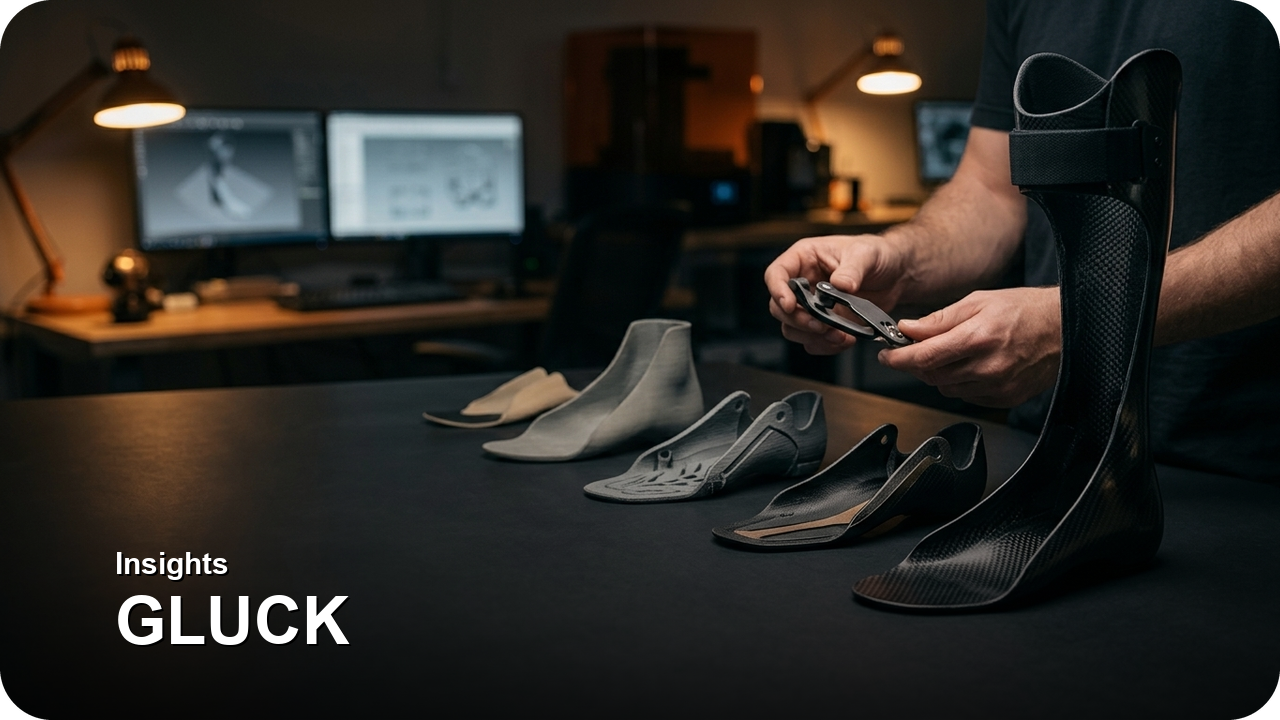
의료기기 시장에서 가장 어려운 제품군 중 하나는 '환자마다 다른' 제품입니다. 발 모양이 사람마다 다르듯, 맞춤 보조기(orthotics)는 애초에 표준 규격이라는 개념이 성립하지 않습니다. 그동안 이 분야는 폼 인상 박스로 발을 뜨고, 기공소가 손으로 다듬는 방식에 오래 의존해 왔습니다. 느리고, 오차가 잦고, 규모를 키우기 어려운 구조였습니다.
그런데 최근 3D프린팅 산업 매체 3DPrintingIndustry의 보도에 따르면, 샌프란시스코 기반 의료기기 스타트업 Hike Medical이 시드·시리즈A로 총 2,250만 달러를 유치했습니다. 이들은 임상 소프트웨어와 자체 생산을 수직 통합한 맞춤 보조기 플랫폼을 확장하고 있으며, 일리노이주 피오리아에 600대 이상의 3D프린터를 24시간 가동하는 시설을 운영한다고 밝혔습니다. 흥미로운 점은 투자자들이 산 것이 '기술'이 아니라 개별 맞춤 제품을 규모 있게 반복 생산하는 실행력이었다는 사실입니다.
여기서 자연스럽게 떠오르는 질문이 있습니다. 환자마다 형상이 다 다른 맞춤 의료기기를, 어떻게 양산 규모로 안정적으로 생산할 수 있을까요? 이 글에서는 Hike Medical의 사례를 개별 맞춤(Mass Customization) 양산이라는 제조 관점에서 짚어봅니다.
Hike Medical : 스캔부터 생산까지, 개별 형상을 흐름으로 묶다
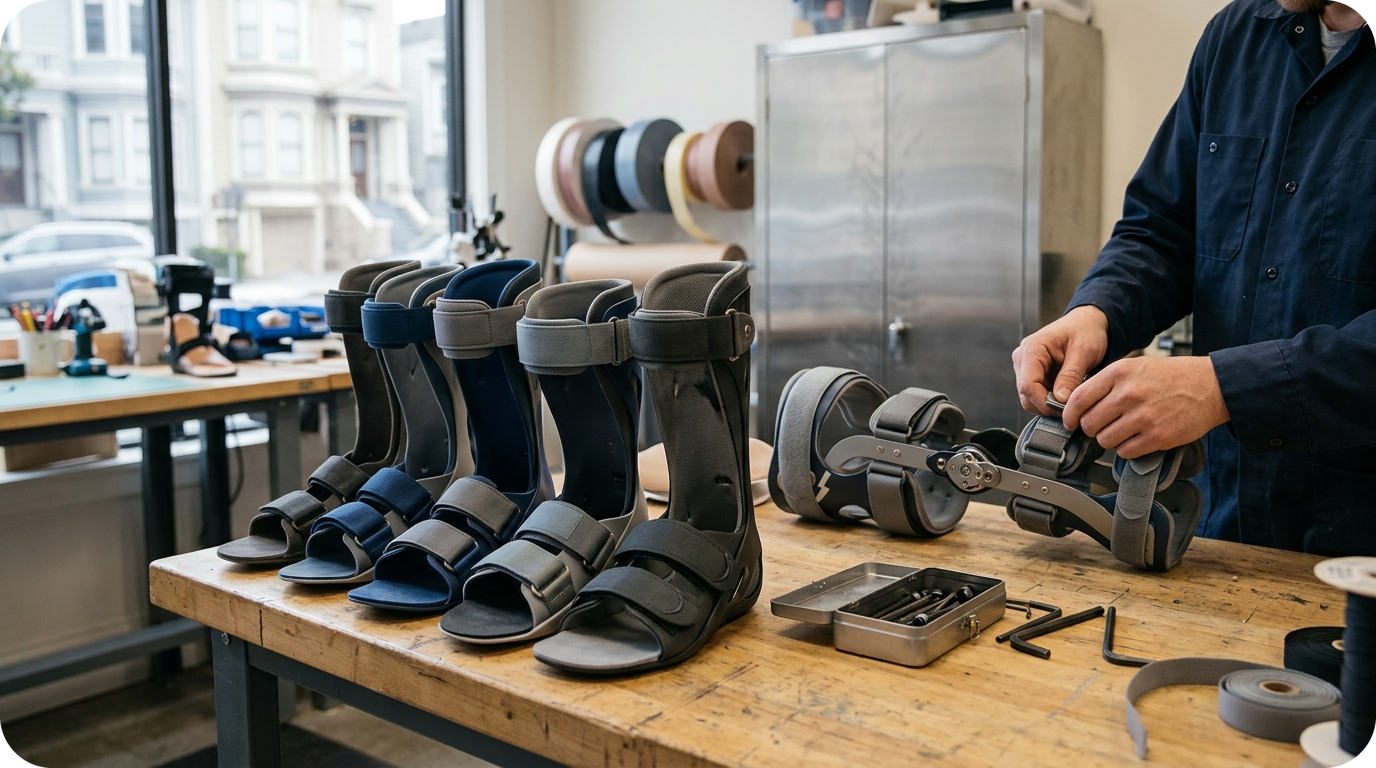
Hike Medical의 접근은 제품 하나가 아니라 '흐름'입니다. 보도에 따르면 이들은 진료 의뢰 처리, 보험 승인, 임상 평가, 기기 생산을 세 축(Hike Intelligence·Hike Clinical·Hike Lab)으로 연결합니다. 특히 모바일 기기로 뜬 스캔 한 번이면 맞춤 인솔 제작에 필요한 데이터를 확보할 수 있어, 폼 인상 박스나 별도 라이다 스캐너에 의존하던 방식을 대체한다고 설명합니다.
문제는 이 흐름의 마지막 단계, 즉 생산이었습니다. 맞춤 보조기 제조가 어려운 이유는 두 가지가 겹치기 때문입니다.
- 형상이 매번 다르다: 환자 한 명 한 명의 발 형상이 모두 다르므로, 같은 금형으로 대량을 찍는 전통 방식이 애초에 성립하지 않습니다. 개별 데이터를 매번 개별 제품으로 바꿔야 합니다.
- 재작업(remake)이 품질과 비용을 좌우한다: 손 작업 기반 공정은 오차가 잦아 다시 만드는 비율이 높습니다. 재작업은 리드타임을 늘리고 원가를 갉아먹는 가장 큰 요인입니다.

Hike은 이 두 문제를 생산 자동화로 풀었다고 밝힙니다. 보도에 따르면 맞춤 인솔의 제작 리드타임을 수 주에서 약 5영업일로 줄였고, 재작업 비율을 약 15개당 1개에서 400개당 1개 수준으로 낮췄다고 합니다. 다만 이들은 구체적인 적층 방식·프린터 모델·소재는 공개하지 않았습니다. 수치는 회사 자체 발표 기준이라는 점을 감안해 볼 필요가 있습니다.
왜 '더 빠른 생산'만으로는 부족할까요?
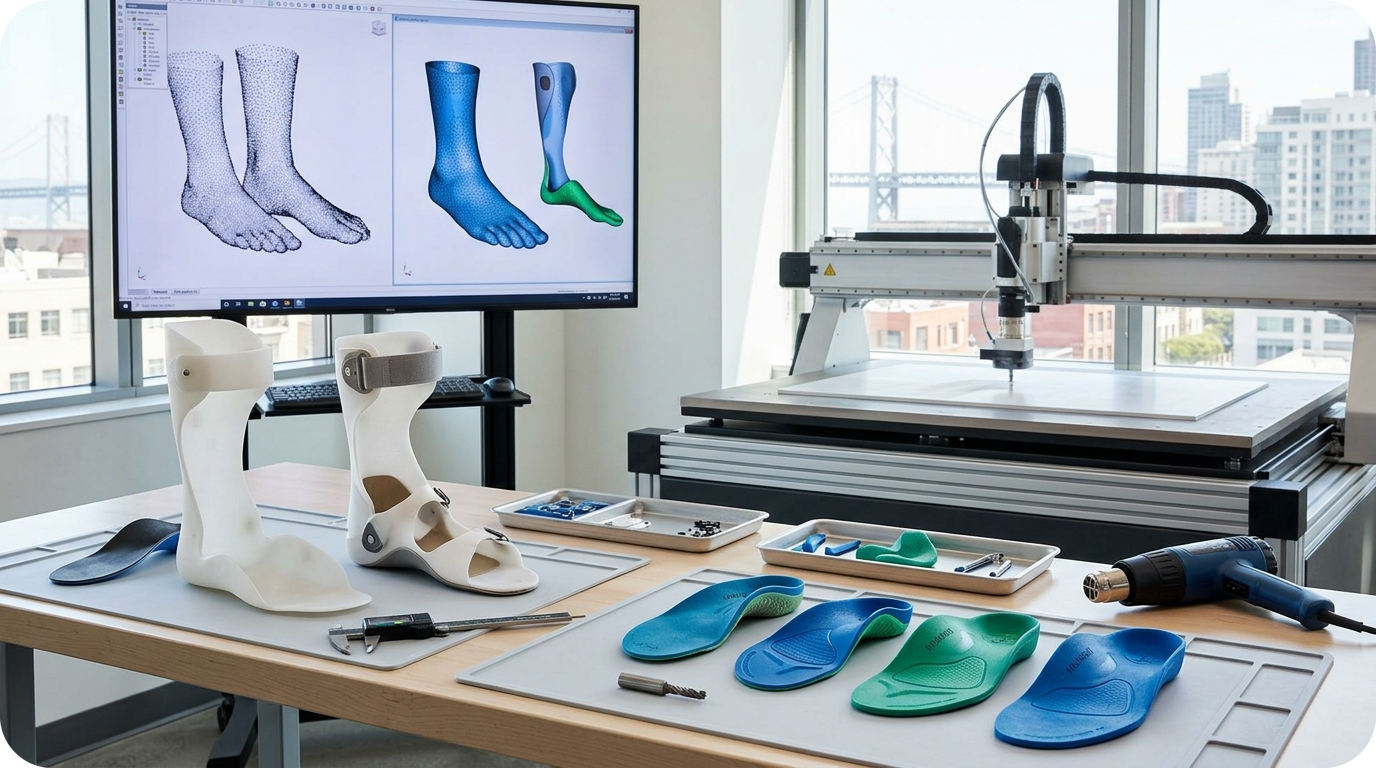
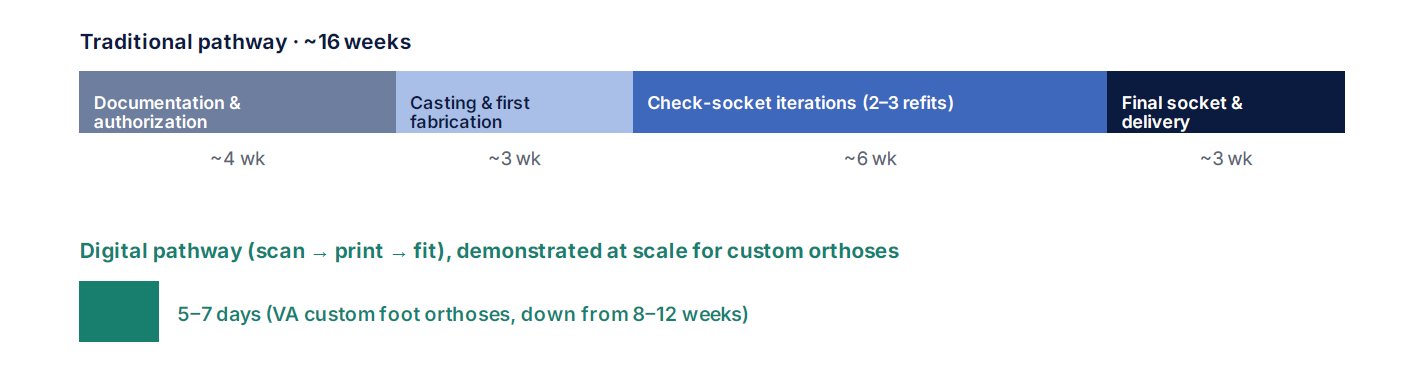
같은 보도에서 Hike의 공동창업자 Aadi Bhanti는 "환자가 몇 주씩 기다리는 이유는 뒤에 있는 시스템들이 서로 대화하지 않기 때문"이라고 말합니다. 즉 생산 속도만 올린다고 개별 맞춤 사업이 완성되지 않는다는 뜻입니다. 이는 제조를 이해할 때 중요한 관점입니다.
개별 맞춤 양산이 어려운 진짜 이유는 '속도'가 아니라 일관성에 있습니다. 3D프린팅 장비 기업 EOS가 같은 보도에서 지적하듯, 맞춤 보조기·의족의 대량 생산을 막는 장벽은 이제 기술보다 운영 쪽에 가깝습니다. 처리량, 인력, 품질 문서화, 후가공 같은 요소가 실제 배치를 좌우한다는 것입니다. EOS는 또한 일부 보조기 응용에서는 진료 현장 생산보다 중앙집중식 생산이 여전히 유리할 수 있다고도 봅니다.
같은 보도에 인용된 PioCreat의 사례는 기술이 얼마나 빨리 성숙하는지를 보여줍니다. 스캔·보행 분석·다중소재 FDM을 통합한 이 시스템은 성인용 인솔 한 켤레를 약 35분에 출력한다고 합니다. 다만 이는 현장 배치형 모델로, Hike 같은 중앙집중식 팜과는 겨냥하는 맥락이 다릅니다. 정리하면, 개별 맞춤 의료기기 양산의 승부처는 '한 개를 얼마나 빨리 찍느냐'가 아니라 수천·수만 개의 서로 다른 형상을 얼마나 일관된 품질로 반복해 내느냐입니다.
개별 형상을 반복 양산하려면 : 산업용 SLA가 맞는 조건
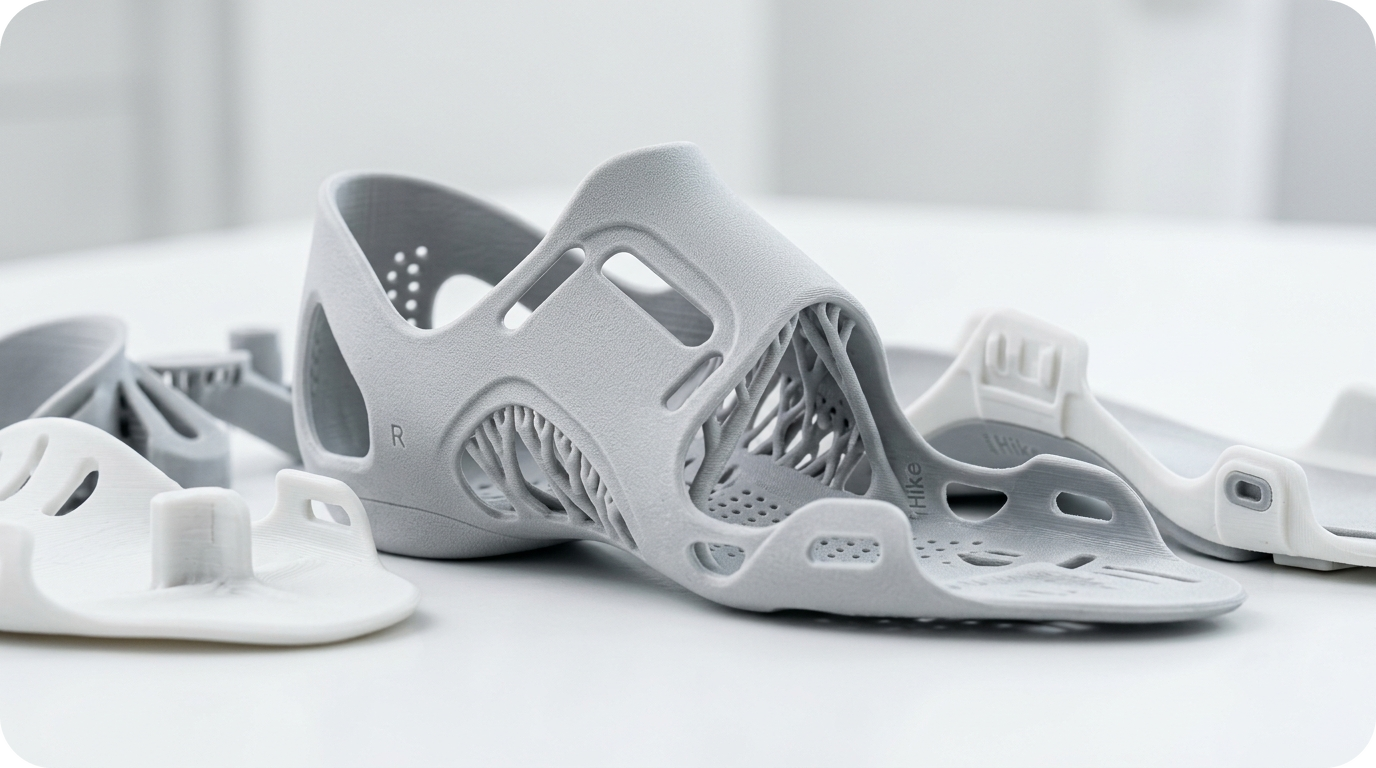
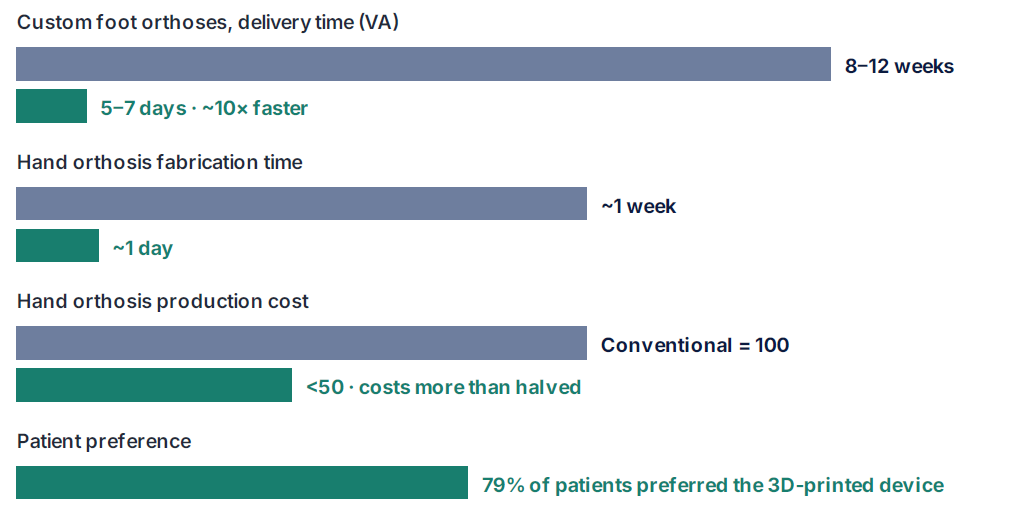
이 지점을 제조 방식으로 바꿔 생각해 보면 방향이 분명해집니다. 형상이 매번 다른 제품은 금형을 만들 수 없습니다. 금형은 같은 형상을 반복해 찍을 때 초기 투자를 회수하는 방식이기 때문입니다. 개별 데이터를 받아 그대로 제품으로 바꿔야 하는 맞춤 보조기·하우징 같은 제품군에서는, 금형이 필요 없는 3D프린팅이 자연스러운 선택지가 됩니다.
바로 이 지점에서 산업용 SLA 3D프린팅이 유력한 선택지로 부상합니다. SLA는 다음 조건에서 개별화 양산에 잘 맞습니다.
- 개별 형상을 금형 없이 반복 생산: 스캔·설계 데이터가 매번 달라도 곧바로 출력에 들어갈 수 있어, 개별 맞춤부터 반복 소량·중량 생산까지 이어집니다.
- 매끄러운 표면과 정밀도: 💡 피부·발에 닿는 의료기기 표면은 마감이 곧 품질입니다. GLUCK의 산업용 SLA는 최대 ±0.05mm 정밀도와 Ra 0.8 수준 표면조도로, 후가공 시 사출품과 구별이 어려운 마감을 구현합니다.
- 안정적 반복 가동: 45기 규모의 장비와 365일 24시간 운용 체계로, 서로 다른 형상을 일관된 품질로 반복해 내는 데 강점이 있습니다.
물론 SLA가 모든 경우의 정답은 아닙니다. 동일한 형상을 수십만 개 이상 찍는 초대량 표준품이라면 여전히 사출 성형이 원가 면에서 유리합니다. SLA가 진짜 힘을 발휘하는 구간은 형상이 저마다 다르거나, 설계 변경이 잦거나, 금형 투자 회수가 어려운 다품종·개별 맞춤 영역입니다. 이런 조건은 맞춤 보조기뿐 아니라 의료기기 하우징·커버, 로봇 외장 커버, 생산라인 지그·치구·검사구 같은 실제 부품군에도 그대로 적용됩니다.
Hike Medical의 투자 유치가 던지는 시사점은 결국 하나입니다. '개별 맞춤'은 더 이상 소량·수작업의 영역이 아니라, 데이터와 반복 생산 인프라가 뒷받침되면 사업으로 성립하는 양산 영역이 되었다는 점입니다. 다만 그 성패는 화려한 기술 자체가 아니라, 서로 다른 형상을 얼마나 일관되게 반복해 내느냐라는 제조 실행력에 달려 있습니다. 개별화된 최종부품을 안정적으로 생산하고자 하는 제조사에게, 산업용 SLA는 현실적인 선택지 중 하나입니다.
GLUCK은 반복 생산이 가능한 산업용 SLA 3D프린팅 인프라를 기반으로
개인 맞춤 의료기기·산업 부품 개발과 양산 전환 과정에 필요한 3D프린팅 제조 솔루션을 지원하고 있습니다.
지금 글룩을 확인해보세요!
📩 글룩 홈페이지 & 온라인 견적: https://www.glucklab.com
📂 글룩 포트폴리오: 글룩 포트폴리오 확인하기
GLUCK | 산업용 SLA 3D프린팅 양산 전문
글룩(GLUCK)은 산업용 SLA 3D프린팅 기술을 기반으로 한 대량 맞춤형 제조 서비스를 제공합니다. 소량 시제품부터 수천 개 단위 양산까지 금형 없이 정밀하게 구현하며, 국내 최대 규모 자동화 스마
glucklab.com
References
[1] 3DPrintingIndustry, "Hike Medical raises $22.5M to expand vertically integrated orthotics platform," 3D Printing Industry. Link: https://3dprintingindustry.com/news/hike-medical-raises-22-5m-to-expand-vertically-integrated-orthotics-platform-254433/
Every Foot Is Different: Why a Custom Orthotics Startup Raised $22.5M
One of the hardest product categories in medical devices is the kind that is "different for every patient." Just as feet vary from person to person, custom orthotics have no meaningful standard specification. This field has long relied on foam impression boxes and hand-finishing by labs—slow, error-prone, and hard to scale.
Recently, according to 3D Printing Industry, San Francisco–based medical device startup Hike Medical raised a total of $22.5 million across seed and Series A rounds. The company is expanding a vertically integrated orthotics platform combining clinical software with in-house manufacturing, and reports operating a facility in Peoria, Illinois running more than 600 3D printers around the clock. What is notable is that investors bought not "technology" but the execution capability to repeatably produce individualized products at scale.
A natural question follows: How can custom medical devices—each with a different geometry—be produced reliably at production scale? This article examines Hike Medical's case from the manufacturing perspective of Mass Customization series production.
Hike Medical: Linking Scan to Production as One Flow
Hike Medical's approach is a "flow," not a single product. Per the report, they connect referral processing, insurance authorization, clinical evaluation, and device production through three components (Hike Intelligence, Hike Clinical, Hike Lab). A single scan from a mobile device can capture the data needed to manufacture a custom insole, replacing workflows based on foam impression boxes and standalone LiDAR scanners.
The challenge was the final stage—production. Custom orthotics manufacturing is difficult because two problems overlap.
- Every shape differs: Each patient's foot geometry is unique, so the traditional method of stamping high volumes from one mold simply does not apply. Individual data must be turned into an individual product every time.
- Remakes drive quality and cost: Hand-based processes are error-prone, leading to high remake rates. Remakes are the biggest factor extending lead time and eroding margins.
Hike states it solved both through production automation. Per the report, it reduced custom insole turnaround from several weeks to around five business days, and cut remake rates from roughly one in 15 to one in 400. However, the company has not disclosed the specific additive process, printer models, or materials. These figures are based on the company's own statements and should be read with that in mind.
Why Isn't "Faster Production" Enough?
In the same report, Hike co-founder Aadi Bhanti says patients wait weeks "because the systems behind their care don't talk to each other." In other words, raising production speed alone does not complete an individualized-custom business. This is an important lens for understanding manufacturing.
The real difficulty of individualized series production lies not in "speed" but in consistency. As additive equipment maker EOS notes in the same report, the barriers to mass-producing custom orthotics and prosthetics are now operational rather than technical—throughput, labor, qualification documentation, and post-processing shape deployment. EOS also suggests that for some orthotic applications, centralized production can remain preferable.
The PioCreat case cited in the report shows how fast the technology is maturing—an integrated system combining scanning, gait analysis, and multi-material FDM producing a pair of adult insoles in about 35 minutes. That said, it is a point-of-care model, targeting a different context than centralized farms like Hike's. In short, the decisive point in individualized medical device production is not "how fast you print one," but how consistently you can repeat thousands of different geometries at reliable quality.
Repeatably Producing Individual Geometries: Where Industrial SLA Fits
Recast as a manufacturing method, the direction becomes clear. Products whose shape differs each time cannot use molds—molds recover their initial investment by stamping the same shape repeatedly. For product categories like custom orthotics and housings, where individual data must become the product directly, mold-free 3D printing is the natural option.
This is exactly where industrial SLA 3D printing emerges as a strong option. SLA suits individualized series production under these conditions:
- Repeatable production of individual geometries without molds: Even when scan/design data changes each time, printing can start immediately—spanning individual customization to repeatable low-to-mid volume production.
- Smooth surfaces and precision: 💡 For medical devices touching skin or feet, finish is quality. GLUCK's industrial SLA delivers up to ±0.05mm precision and Ra 0.8 surface roughness, with finishing hard to distinguish from injection-molded parts.
- Stable, repeatable operation: With around 45 machines and 365-day, 24-hour operation, it excels at repeating varied geometries at consistent quality.
Of course, SLA is not the answer in every case. For standard parts stamped in the hundreds of thousands with identical geometry, injection molding remains more cost-effective. SLA truly shines in high-mix, individualized domains where shapes vary, design changes are frequent, or mold investment is hard to recover. These conditions apply not only to custom orthotics but to real part families like medical device housings and covers, robot exterior covers, and production-line jigs, fixtures, and inspection tools.
The takeaway from Hike Medical's funding is singular: "individualized custom" is no longer the realm of small-batch handwork—backed by data and repeatable production infrastructure, it becomes a viable series-production business. Yet success rests not on flashy technology itself, but on the manufacturing execution of repeating different geometries consistently. For manufacturers seeking to reliably produce individualized end-use parts, industrial SLA is one realistic option.
GLUCK supports the 3D printing manufacturing solutions needed for developing and transitioning personalized medical devices and industrial parts into production, based on an industrial SLA 3D printing infrastructure capable of repeatable production.
Check out GLUCK now!
📩 GLUCK Website & Online Quote: https://www.glucklab.com
📂 GLUCK Portfolio: View the GLUCK Portfolio
References
[1] 3DPrintingIndustry, "Hike Medical raises $22.5M to expand vertically integrated orthotics platform," 3D Printing Industry. Link: https://3dprintingindustry.com/news/hike-medical-raises-22-5m-to-expand-vertically-integrated-orthotics-platform-254433/
#글룩 #GLUCK #3D프린팅 #산업용3D프린팅 #SLA3D프린팅 #맞춤의료기기 #보조기 #개인맞춤양산 #MassCustomization #의료기기제조 #DfAM #3DPrinting #SLA3DPrinting #AdditiveManufacturing #Orthotics #CustomMedicalDevices #FlexibleSeriesProduction
'인사이트 (Insights)' 카테고리의 다른 글
| Figure가 AI 컴퓨팅에 수억 달러를 쏟는 동안, 로봇 '외피'는 누가 만드나 (0) | 2026.09.08 |
|---|---|
| 만지는 순간 완성되는 전시 : 아이들이 만든 3D프린팅 로봇 동물원이 브랜드 오브제에 남긴 힌트 (0) | 2026.09.08 |
| 200kg 셸을 70kg으로 : 3륜 이탈리아 캠퍼가 노르카프까지 간 경량화 설계의 비밀 (0) | 2026.09.02 |
| 프린터 39만 대의 시대, 중국이 완성한 'AM 스택' 다음에 온 진짜 승부처 (1) | 2026.09.02 |
| AM 업계 매출 지도가 바뀌었다 : 3D프린팅 제조 파트너를 고를 때 봐야 할 진짜 기준 (0) | 2026.09.01 |