
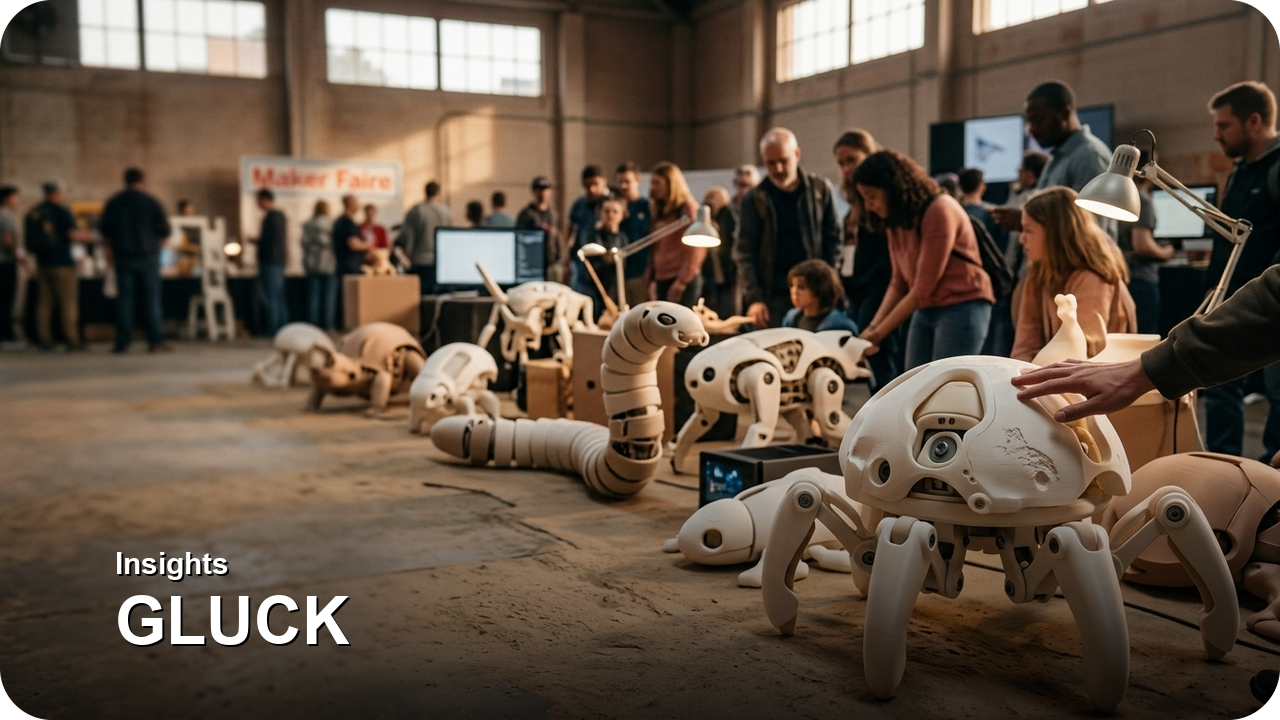
전시장이나 브랜드 팝업을 다녀보면 최근 분위기가 조금씩 달라지고 있음을 느낍니다. 예전에는 유리 진열장 너머로 완성된 제품을 바라보는 것이 전부였다면, 요즘은 관람객이 직접 만지고 버튼을 누르고 움직이게 하는 '핸즈온(hands-on)' 경험이 콘텐츠의 중심으로 올라오고 있습니다. 오브제가 단순한 구경거리가 아니라 만지는 순간 완성되는 경험이 되는 셈입니다.
미국 캘리포니아 밸레이오에서 열리는 메이커 페어(Maker Faire Bay Area)에 등장할 '3D프린팅 로봇 동물원'이 딱 그런 사례입니다. 3dprint.com에 따르면, 7세부터 13세까지의 아이들이 3D프린터와 LED·모터·기어를 이용해 20종 넘는 동물을 만들었고, 관람객은 이들을 직접 만지고 작동시킬 수 있습니다. 흥미로운 점은 아이들이 완성품 옆에 실패한 출력물, 녹아버린 부품, 이전 버전까지 함께 전시한다는 것입니다. 아르마딜로 '플레이트(Plate)'를 공처럼 말리게 하는 데 11번의 출력이 필요했다는 이야기가, 그 자체로 전시의 콘텐츠가 됩니다.
여기서 자연스럽게 떠오르는 질문이 있습니다. 프린팅 조형물로 브랜드 체험·오브제를 실제로 어떻게 만들 수 있을까요? 이 동물원은 어린이 교육 프로젝트지만, '만지는 오브제'가 부딪히는 제조 과제와 그것을 푸는 방식은 브랜드 굿즈·아트토이·전시물 제작과 놀랍도록 닮아 있습니다. 이 글에서는 그 지점을 제조 관점에서 짚어봅니다.
오류마저 매력이 된 동물원, 'Plate the Armadillo'와 11번의 출력
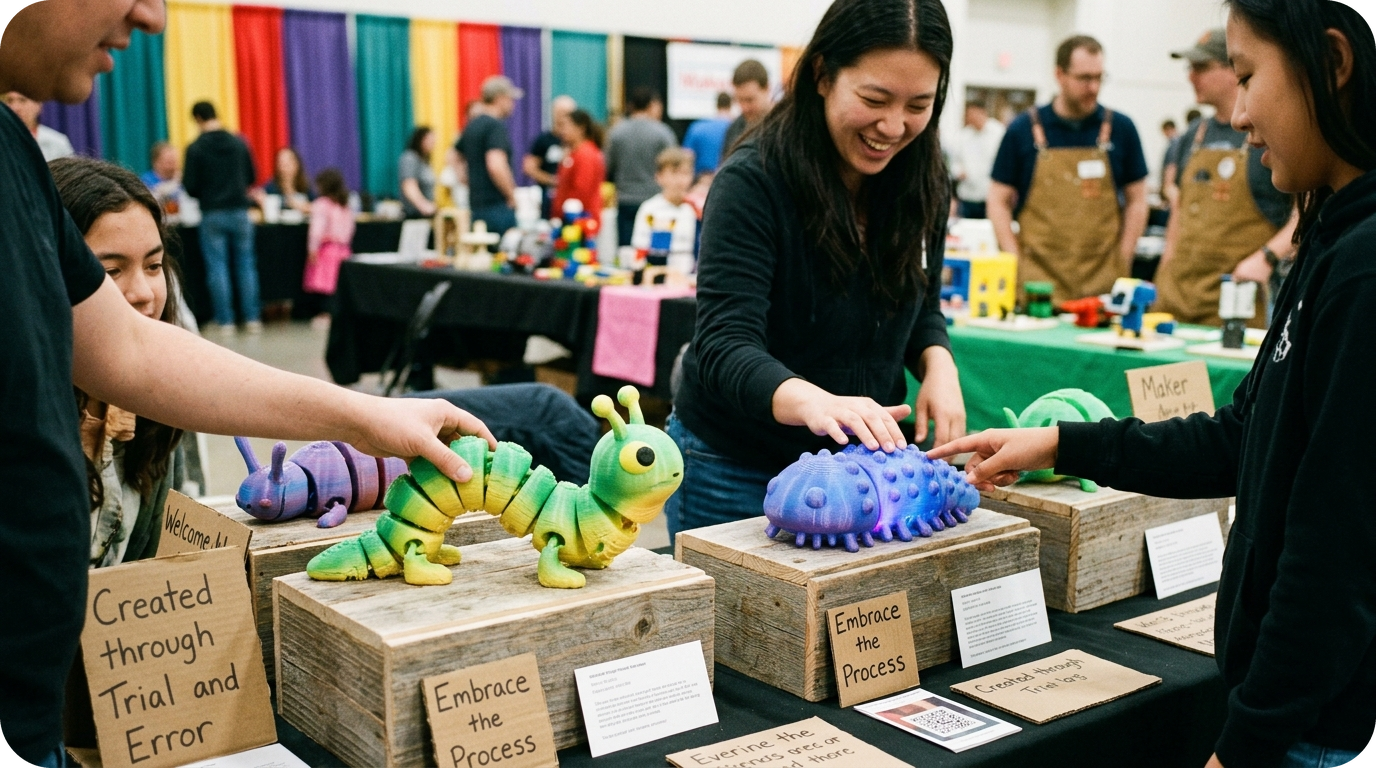
이 동물원의 주민들은 저마다 하나의 '트릭'을 가지고 있습니다. 발을 누르면 귀가 움직이는 토끼 '핍(Pip)', 손뼉을 치면 기어가는 애벌레 '인치(Inchy)', 배터리 없이 손 크랭크로 가슴 속 기어를 돌리는 부엉이 '코그(Cog)'까지, 정적인 프린팅 출력물에 움직임을 더한 결과물들입니다. 인치는 12개의 출력 조각과 아두이노 나노, 소형 서보, 사운드 센서로 이루어졌다고 소개됩니다.
문제는 이런 체험형 오브제가 겉모습만으로 완성되지 않는다는 점입니다. 관람객이 만지고 작동시키는 것을 전제로 하면, 제조 과정에서 두 가지 벽에 동시에 부딪힙니다.
- 표면 완성도와 내부 부품 통합의 충돌: 겉은 보기 좋게 매끄러워야 하지만, 안에는 모터·기어·배선·전자부품이 들어갈 공간이 필요합니다. 모델을 잘라 열리게 만들고, 부품 자리를 내기 위해 구조를 다시 설계하는 과정이 반복됩니다.
- 작동 재현성의 확보: 아르마딜로 플레이트가 몸을 마는 캠-레버 구조를 안정적으로 구현하기까지 11번을 다시 출력했다는 대목이 이를 잘 보여줍니다. 한 번 잘 나오는 것과, 여러 번 같은 품질로 나오는 것은 전혀 다른 문제입니다.
아이들의 프로젝트에서는 이 '실패와 반복'이 교육적 매력이 됩니다. 하지만 브랜드가 오브제를 상품으로 만들 때는, 바로 이 반복을 양산 재현성으로 전환하는 능력이 관건이 됩니다.
체험형 오브제가 상품이 될 때, 무엇이 달라지는가
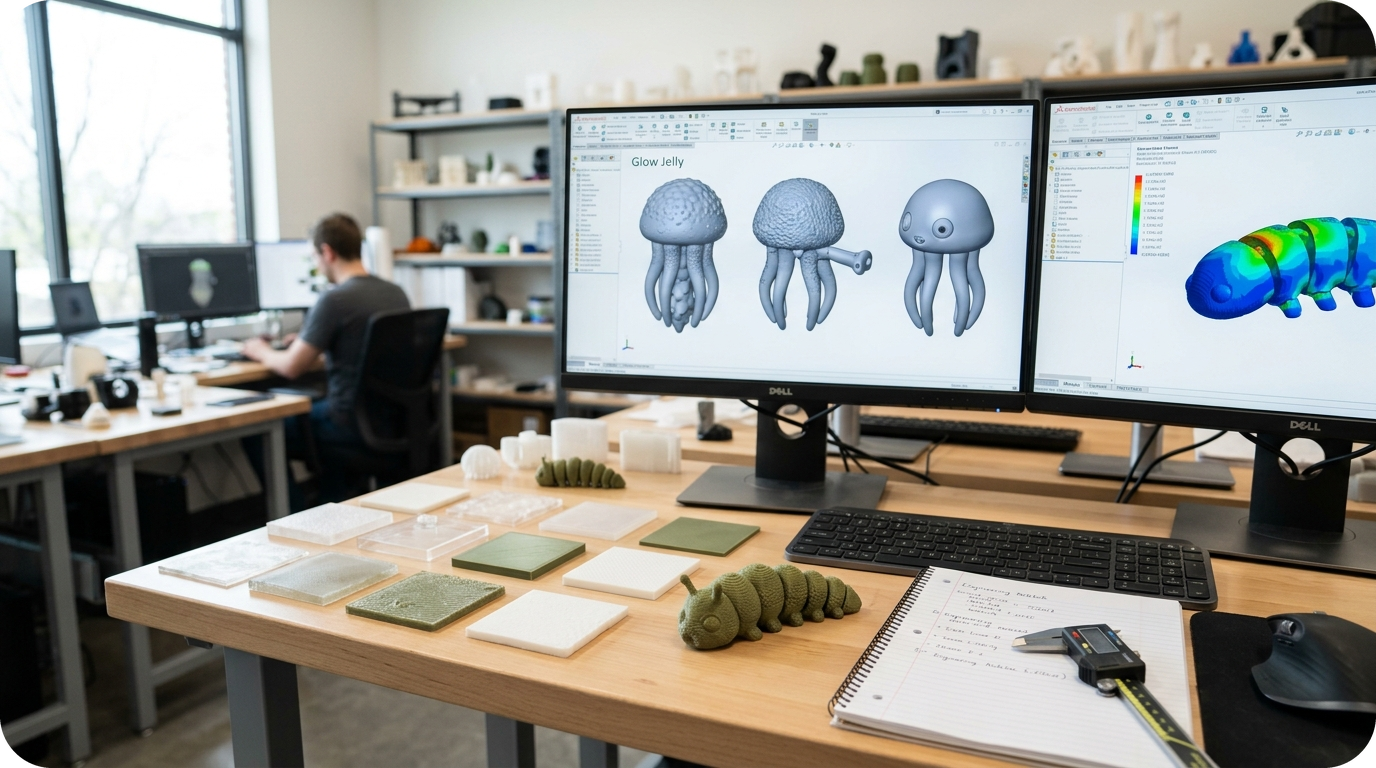
전시 하나에 20종을 만드는 것과, 인기 오브제를 브랜드 굿즈로 수백·수천 개 반복 생산하는 것은 제조 난이도가 다릅니다. 개별 완성도만 맞추면 되는 단계에서, '개별 완성도를 유지한 채 다품종을 반복 생산하는' 단계로 넘어가야 하기 때문입니다.
이때 기존 제조 방식은 두 방향 모두에서 부담을 줍니다. 사출 성형으로 만들려면 형상마다 금형을 파야 하는데, 동물원처럼 종류가 다양하고 형태가 저마다 다른 오브제에서는 초기 금형비 회수가 어렵습니다. 게다가 손뼉·크랭크·발 누름 같은 작동 구조를 담으려면 부품 통합과 복잡한 내부 형상이 필요한데, 이는 절삭 가공으로 구현하기 까다롭고 단가도 올라갑니다.
- 다품종·소량 구간의 금형 부담: 형태가 자주 바뀌고 종류가 많을수록, 형상마다 드는 금형비와 리드타임이 프로젝트의 발목을 잡습니다.
- 설계 변경의 비용: 체험형 오브제는 실제 관람객 반응을 보고 구조를 다듬는 경우가 많습니다. 금형 기반에서는 변경 한 번에 다시 비용과 시간이 발생합니다.
물론 동일한 오브제를 수십만 개 이상 대량으로 찍어야 한다면, 개당 단가 측면에서 사출 방식이 여전히 유리합니다. 관건은 '어떤 수량과 어떤 다양성'을 다루느냐입니다.
산업용 SLA 3D프린팅으로 재해석하는 브랜드 오브제 양산
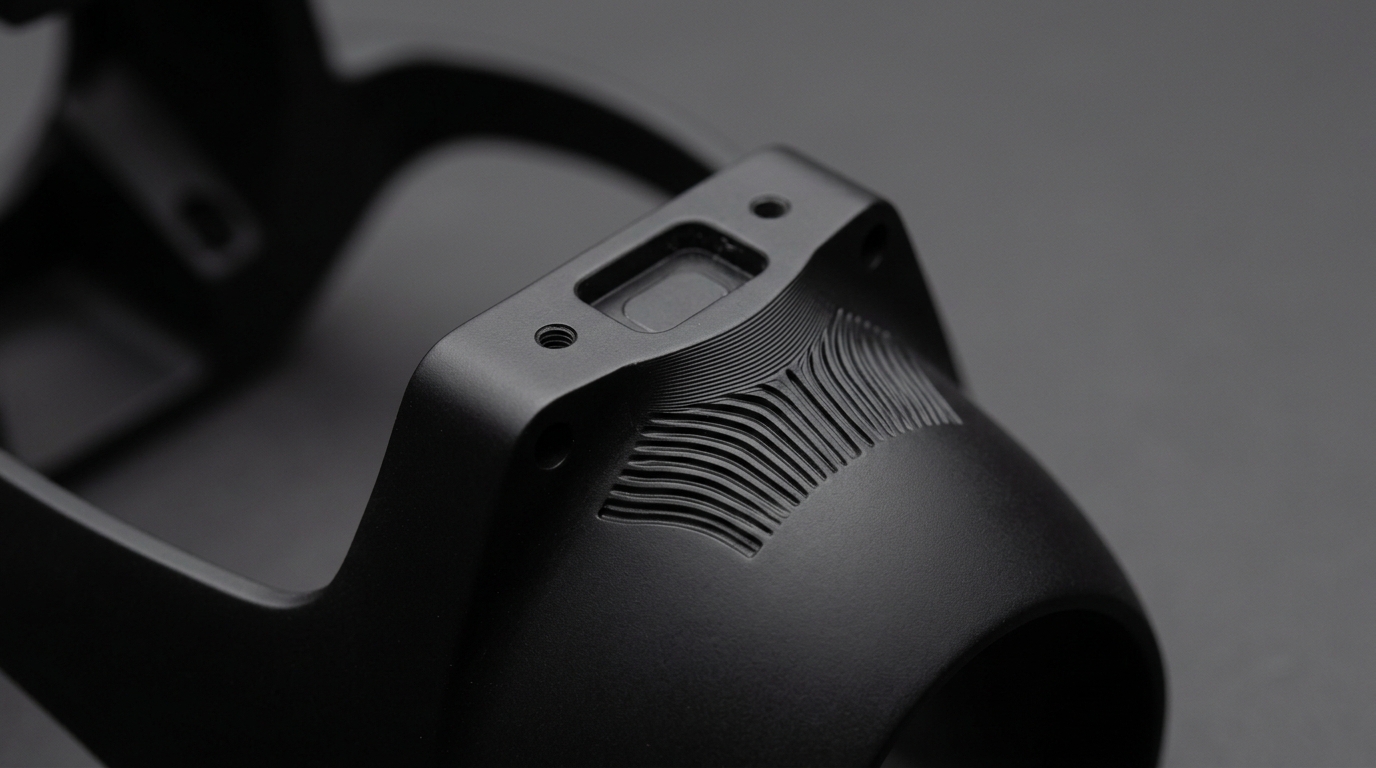
💡 핵심은 '만지고 싶은 표면'과 '여러 번 같은 품질'을 동시에 잡는 것입니다.
바로 이 지점에서 산업용 SLA 3D프린팅이 조건부 대안으로 부상합니다.
동물원 사례가 보여준 과제 — 매끄러운 외장, 부품이 들어갈 복잡한 내부, 그리고 반복 재현성 — 는 실제 산업 현장에서 산업용 SLA 3D프린팅을 통해 더 정밀하게 풀어낼 수 있습니다. SLA는 적층 결이 거의 보이지 않는 매끄러운 표면을 구현하며, GLUCK 기준 최대 ±0.05mm 정밀도와 Ra 0.8 표면조도, 후가공 시 사출품과 구별이 어려운 마감을 확보합니다. 관람객이 직접 만지는 오브제에서 표면 품질은 곧 브랜드 경험의 질이 됩니다.
- 금형 없는 반복생산: 형상마다 금형을 파지 않아도 되므로, 다양한 종류의 오브제를 초도부터 반복 소량·중량 생산까지 유연하게 이어갈 수 있습니다. 낮은 MOQ로 시작해 반응을 본 뒤 반복 생산으로 확장하는 흐름에 맞습니다.
- 복잡한 내부 형상과 부품 통합: 전자부품·기어가 들어갈 자리를 포함한 복잡 형상을 한 번에 구현하고, 여러 조각으로 나뉘던 구조를 통합 설계할 수 있습니다.
- 잦은 설계 변경 대응: 디지털 파일만 수정하면 곧바로 다시 생산할 수 있어, 관람객 반응을 반영해 오브제를 다듬는 과정에 부담이 적습니다.
다만 SLA가 모든 경우의 정답은 아닙니다. 형태가 단일하고 작동 구조도 없는 단순 오브제를 초대량으로 찍는다면 사출이 더 경제적입니다. GLUCK의 강점은 로봇 외장 커버 소량 양산, 생산라인 지그·치구·검사구, 의료기기 하우징·커버처럼 다품종을 매끄러운 표면 품질로 반복 생산하는 구간에 있습니다. 브랜드 오브제·굿즈·전시물 역시 이 '개별 맞춤~반복 소량·중량' 구간에 정확히 맞닿아 있습니다.
결국 이 어린이 동물원이 던진 힌트는 명확합니다. 관람객이 만지는 오브제일수록 표면 완성도와 작동 재현성이 함께 필요하고, 이를 다품종으로 반복 생산하려면 금형에 얽매이지 않는 제조 방식이 유리합니다. 산업용 SLA 3D프린팅은 이 조건을 갖춘 브랜드에게 현실적인 선택지가 됩니다. 물론 수량과 형상 다양성에 따라 기존 방식이 나은 경우도 있으므로, 프로젝트 특성에 맞춰 판단하는 것이 먼저입니다.
📩 글룩 홈페이지 & 온라인 견적: https://www.glucklab.com
📂 글룩 포트폴리오: 글룩 포트폴리오 확인하기
References
[1] 3DPrint.com, "At This 3D Printed Petting Zoo, the Mistakes Are Part of the Fun," 3DPrint.com. Link: https://3dprint.com/332130/at-this-3d-printed-petting-zoo-the-mistakes-are-part-of-the-fun/
The Exhibit That's Completed the Moment You Touch It: What a Kids' 3D Printed Robot Zoo Teaches Us About Brand Objects
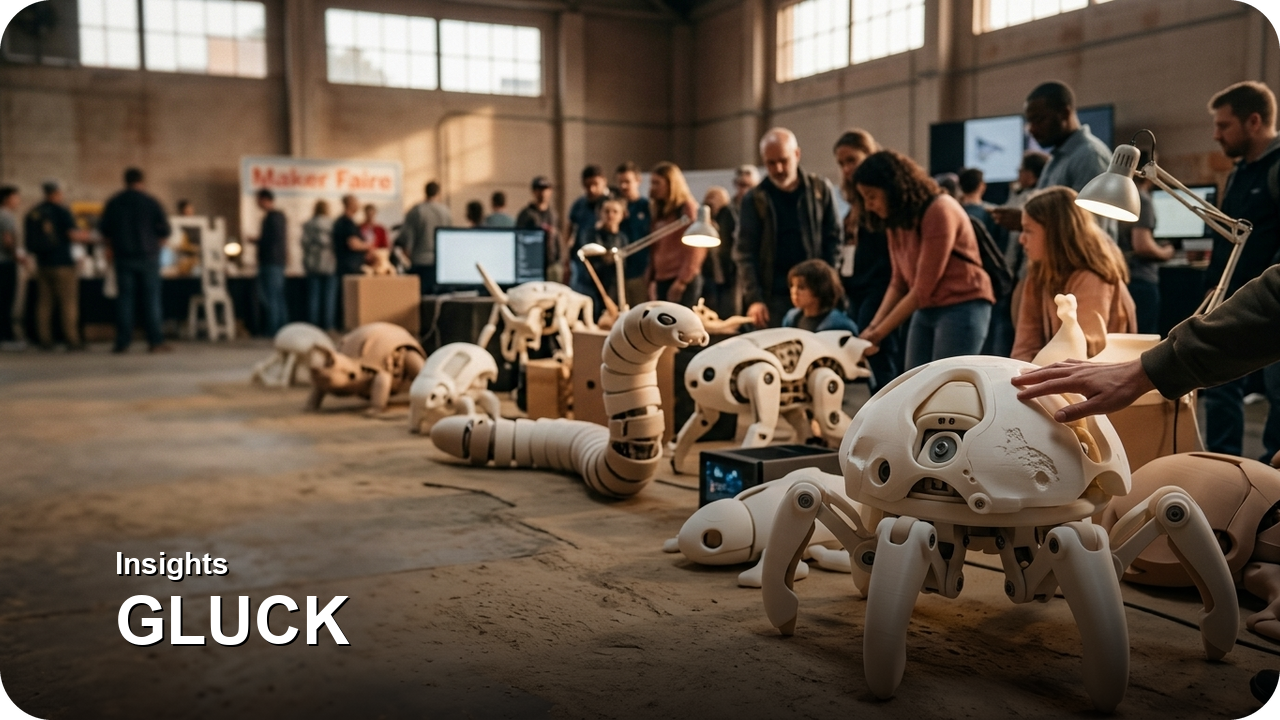
Visiting exhibitions or brand pop-ups lately, you can feel the atmosphere slowly changing. Where once it was all about gazing at finished products behind glass cases, "hands-on" experiences—where visitors touch, press buttons, and make things move—are now taking center stage as content. The object is no longer just something to look at; it becomes an experience completed the moment you touch it.
The "3D Printed Robot Petting Zoo" appearing at Maker Faire Bay Area in Vallejo, California, is exactly such a case. According to 3dprint.com, children aged 7 to 13 built more than 20 animals using 3D printers, LEDs, motors, and gears, and visitors can touch and operate them directly. What's intriguing is that the kids display their failed prints, melted parts, and earlier versions right alongside the finished animals. The story that it took 11 prints to make the armadillo "Plate" curl into a ball becomes content in itself.
A natural question arises here. How do you actually create brand experiences and objects with 3D printed sculptures? This zoo is a children's education project, but the manufacturing challenges that "touchable objects" face—and how they are solved—are strikingly similar to producing brand merchandise, art toys, and exhibition pieces. In this article, we examine that point from a manufacturing perspective.
The Zoo Where Even Mistakes Became Charming: 'Plate the Armadillo' and 11 Prints
The residents of this zoo each have their own "trick." There's Pip the Rabbit, whose ears move when you press its paw; Inchy the Caterpillar, which crawls when you clap; and Cog the Owl, whose chest gears turn via a hand crank without any batteries—all results of adding movement to static printed outputs. Inchy is described as being made from 12 printed sections, an Arduino Nano, a small servo, and a sound sensor.
The challenge is that such interactive objects aren't completed by appearance alone. Once you assume visitors will touch and operate them, the manufacturing process runs into two walls simultaneously.
- Conflict between surface completeness and internal component integration: The exterior must look smooth, yet the interior needs space for motors, gears, wiring, and electronics. The process of cutting models open and redesigning structures to make room for parts repeats over and over.
- Securing operational repeatability: The fact that it took 11 prints to stably implement the cam-and-lever mechanism for Plate to curl up illustrates this well. Producing something well once and producing it repeatedly at the same quality are entirely different problems.
In the kids' project, this "failure and repetition" becomes an educational charm. But when a brand turns an object into a product, the ability to convert that very repetition into production repeatability becomes the key.
When an Interactive Object Becomes a Product, What Changes?
Making 20 types for a single exhibit and repeatedly producing hundreds or thousands of a popular object as brand merchandise present different manufacturing difficulties. You must move from a stage where matching individual completeness is enough, to a stage of "repeatedly producing diverse variants while maintaining individual completeness."
Here, conventional manufacturing methods impose burdens in both directions. To make them by injection molding, you must cut a mold for each shape—but for objects as diverse and differently shaped as a zoo, recovering the initial mold cost is difficult. Moreover, to embody operating mechanisms like clapping, cranking, or paw-pressing, you need part integration and complex internal shapes, which are tricky to implement with machining and drive up costs.
- Mold burden in the high-mix, low-volume range: The more the shapes change and the more types there are, the more the per-shape mold costs and lead times hold the project back.
- Cost of design changes: Interactive objects are often refined based on actual visitor reactions. In mold-based methods, each change incurs cost and time again.
Of course, if you need to produce hundreds of thousands or more of the same object, injection molding remains advantageous in terms of per-unit cost. The key is which quantity and which diversity you are dealing with.
Reinterpreting Brand Object Production Through Industrial SLA 3D Printing
💡 The key is capturing both a "surface you want to touch" and "the same quality every time" at once. This is precisely where industrial SLA 3D printing emerges as a conditional alternative.
The challenges the zoo case revealed—a smooth exterior, complex interiors for parts, and repeatable reproducibility—can be solved more precisely in actual industrial settings through industrial SLA 3D printing. SLA achieves smooth surfaces with barely visible layer lines, and by GLUCK standards secures up to ±0.05mm precision, Ra 0.8 surface roughness, and a finish hard to distinguish from injection-molded parts after post-processing. For objects that visitors touch directly, surface quality becomes the quality of the brand experience itself.
- Mold-free repeat production: Since you don't need a mold per shape, you can flexibly carry diverse objects from initial through repeat low-to-mid volume production. It fits the flow of starting with a low MOQ, gauging reactions, and then scaling to repeat production.
- Complex internal shapes and part integration: You can implement complex shapes—including space for electronics and gears—in one go, and integrate structures that were once split into multiple pieces.
- Response to frequent design changes: Simply modifying the digital file allows immediate reproduction, reducing the burden of refining objects based on visitor reactions.
That said, SLA is not the answer in every case. If you print a simple object with a single form and no operating mechanism in ultra-high volumes, injection molding is more economical. GLUCK's strength lies in the range of repeatedly producing diverse variants with smooth surface quality—like low-volume robot exterior covers, production-line jigs, fixtures, and inspection tools, and medical device housings and covers. Brand objects, merchandise, and exhibition pieces align precisely with this "custom-to-repeat, low-to-mid volume" range.
Ultimately, the hint this children's zoo offers is clear. The more an object is meant to be touched, the more it needs both surface completeness and operational repeatability—and to repeatedly produce these in high mix, a manufacturing method free from molds is advantageous. Industrial SLA 3D printing becomes a realistic option for brands meeting these conditions. Of course, conventional methods may be better depending on quantity and shape diversity, so judging by project characteristics comes first.
📩 GLUCK Website & Online Quote: https://www.glucklab.com
📂 GLUCK Portfolio: View GLUCK Portfolio
References
[1] 3DPrint.com, "At This 3D Printed Petting Zoo, the Mistakes Are Part of the Fun," 3DPrint.com. Link: https://3dprint.com/332130/at-this-3d-printed-petting-zoo-the-mistakes-are-part-of-the-fun/
#글룩 #GLUCK #3D프린팅 #산업용3D프린팅 #SLA3D프린팅 #브랜드오브제 #굿즈제작 #아트토이 #체험형전시 #조형물제작 #온디맨드 #DfAM #3DPrinting #SLA3DPrinting #AdditiveManufacturing #BrandObjects #CustomMerchandise #ExhibitionDesign #MakerFaire
'인사이트 (Insights)' 카테고리의 다른 글
| 수술실의 진짜 비용 : 의료 3D프린팅이 '시제품'을 넘어 양산으로 가야 하는 이유 (0) | 2026.09.08 |
|---|---|
| Figure가 AI 컴퓨팅에 수억 달러를 쏟는 동안, 로봇 '외피'는 누가 만드나 (0) | 2026.09.08 |
| 발 하나하나가 다르다 : 맞춤 보조기 스타트업이 2,250만 달러를 받은 진짜 이유 (0) | 2026.09.08 |
| 200kg 셸을 70kg으로 : 3륜 이탈리아 캠퍼가 노르카프까지 간 경량화 설계의 비밀 (0) | 2026.09.02 |
| 프린터 39만 대의 시대, 중국이 완성한 'AM 스택' 다음에 온 진짜 승부처 (1) | 2026.09.02 |