
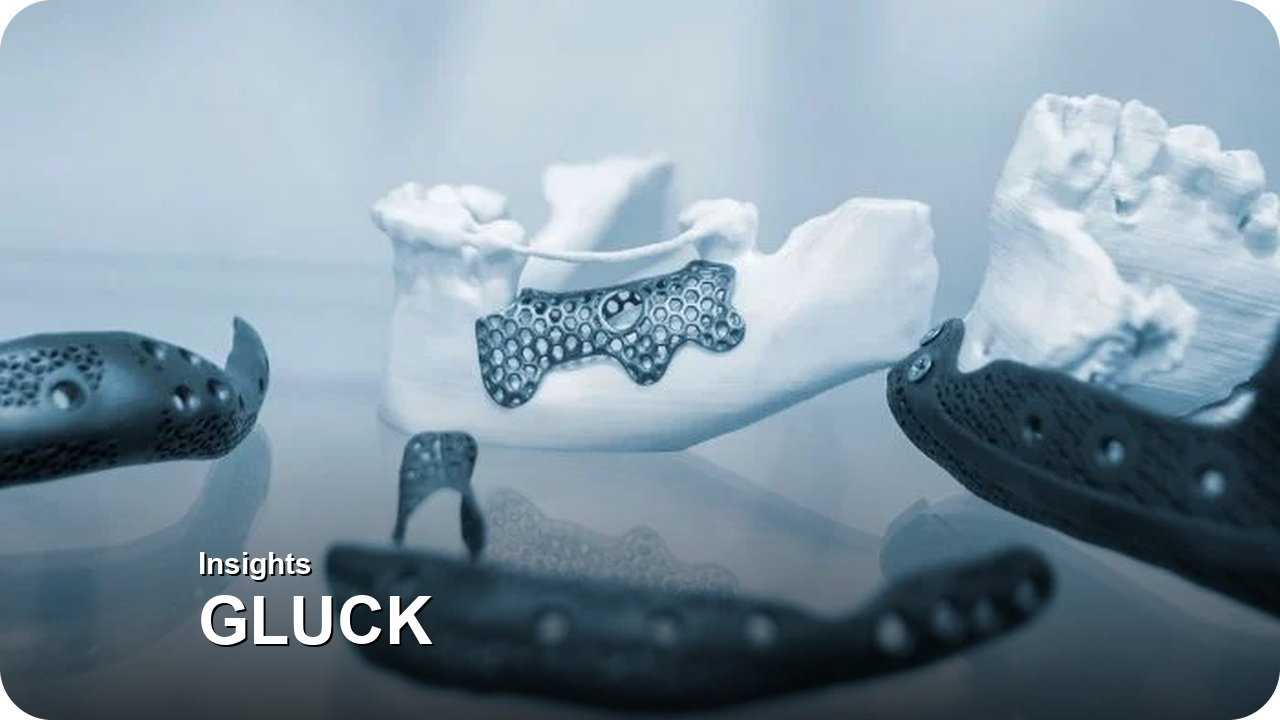
의료기기 산업에서 3D프린팅은 더 이상 낯선 기술이 아닙니다.
수술 전 계획을 세우기 위한 해부학 모델, 환자 맞춤형 수술 가이드, 개인화된 보형물까지 이미 병원과 제조 현장에서 폭넓게 쓰이고 있습니다. 그런데 최근 업계의 대화가 미묘하게 바뀌고 있습니다. "만들 수 있는가"에서 "이걸로 지속 가능한 사업이 되는가"로 질문이 옮겨간 것입니다.
2026년 열리는 온라인 컨퍼런스 ADDITIV Medical 2026은 아예 'AI, ROI, 그리고 수술실(OR)'을 주제로 내걸고 글로벌 전문가들을 한자리에 모읍니다. 흥미로운 지점은 행사의 부제가 "3D프린팅의 격차를 잇는다(Bridge 3D Printing Gaps)"라는 것입니다. 기술은 이미 존재하는데, 그 사이에 여전히 메워야 할 '격차'가 있다는 뜻입니다.
여기서 자연스럽게 떠오르는 질문이 있습니다. 의료기기 3D프린팅에서 소량 시제품과 반복 양산의 경계는 대체 어디일까요? 이 글에서는 컨퍼런스가 던진 화두를 제조 관점에서 다시 읽어보며, 의료 프린팅이 '만들 수 있다'를 넘어 '반복해서 팔 수 있다'로 넘어가는 지점을 짚어보겠습니다.
ADDITIV Medical 2026이 'ROI'를 전면에 내건 이유
ADDITIV Medical 2026이 ROI(투자수익률)를 제목에 넣었다는 사실 자체가 업계의 성숙 단계를 보여줍니다. 초기 의료 3D프린팅 담론은 "이런 복잡한 형상도 만들 수 있다"는 가능성의 언어에 머물렀습니다. 그러나 병원과 의료기기 제조사가 실제로 예산을 집행하려면, 가능성만으로는 부족하고 '수익이 나는 구조'가 필요합니다.
문제는 여기서 발생합니다. 많은 의료 프린팅 프로젝트가 시제품과 임상 검증 단계까지는 성공적으로 도달하지만, 정작 반복 양산으로 넘어가는 순간 벽에 부딪힙니다. 이유는 두 가지입니다.
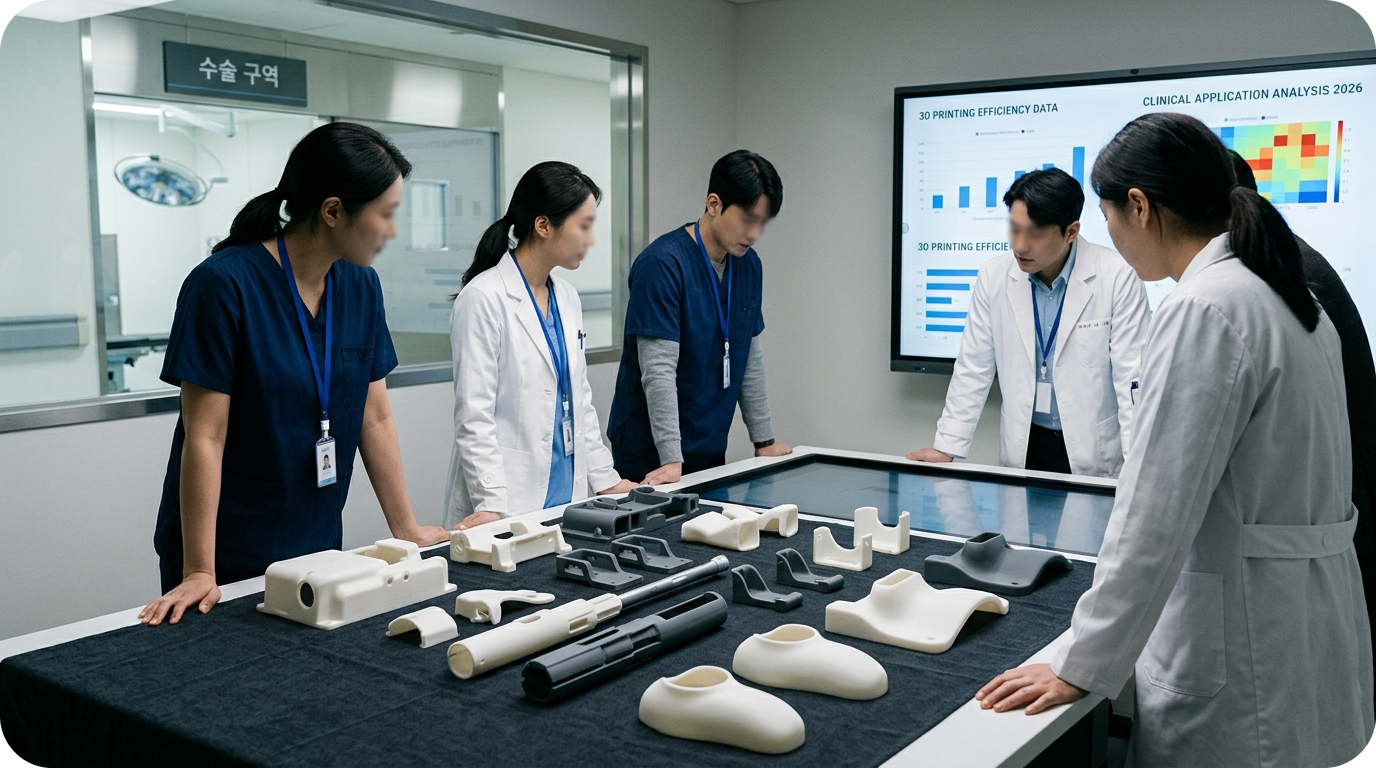
- 재현성의 벽: 환자 맞춤형 제품은 형상이 매번 달라지지만, 의료기기는 개별 형상이 달라도 품질·정밀도·안전 기준은 항상 동일하게 유지되어야 합니다. 한 개를 잘 만드는 것과, 형상이 다른 수백 개를 균일하게 만드는 것은 전혀 다른 문제입니다.
- ROI 입증의 벽: 소량 시제품 단가는 감당하더라도, 이 방식이 규모가 커졌을 때도 경제성을 유지하는지 증명되지 않으면 제조사는 양산 전환을 결정하기 어렵습니다.
결국 컨퍼런스가 말하는 '격차'는 기술의 격차가 아니라 시제품과 양산 사이의 제조 격차입니다. 이 지점이 바로 의료 3D프린팅이 넘어야 할 진짜 관문입니다.
'몇 개'가 아니라 '얼마나 자주 바뀌는가'의 문제
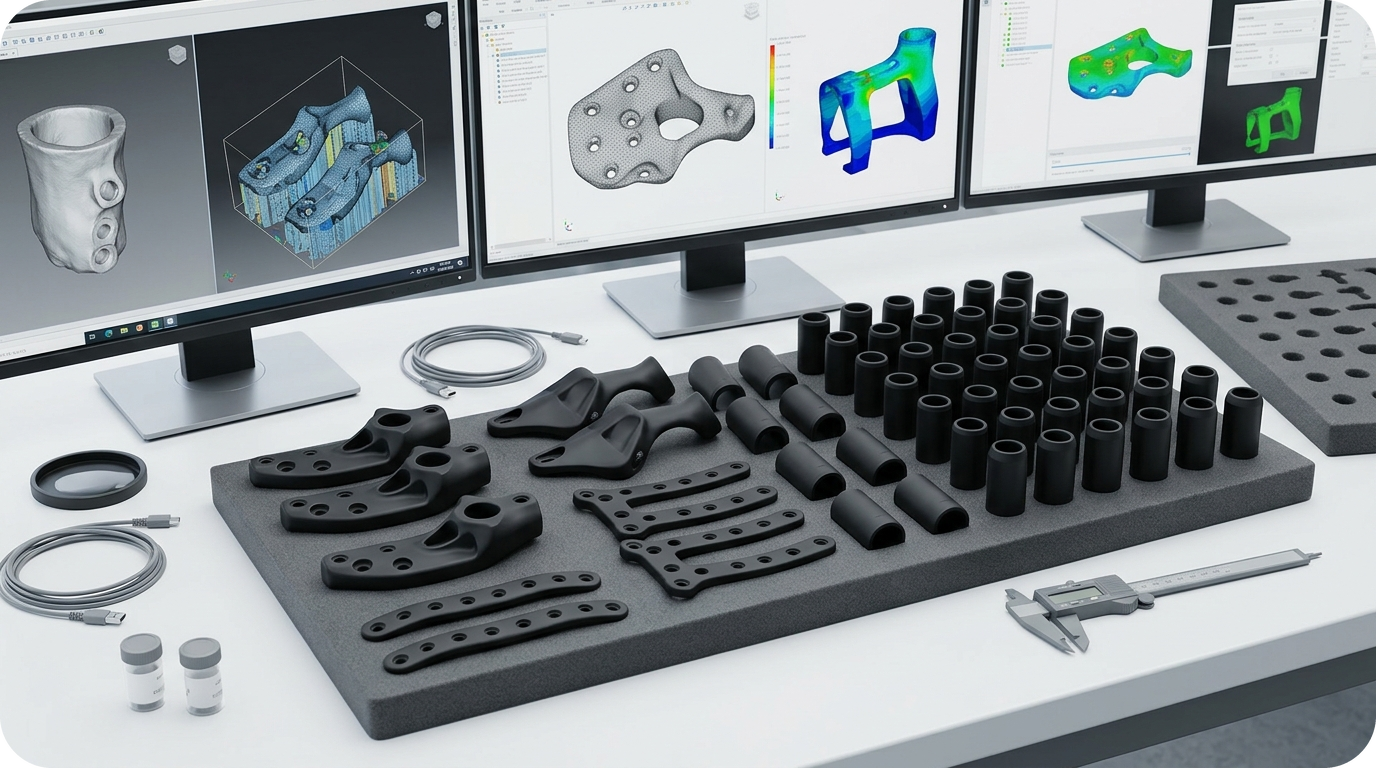
소량과 양산의 경계를 이야기할 때 많은 분들이 "몇 개부터 양산인가요?"라고 묻습니다. 하지만 의료 분야에서는 이 질문의 축이 조금 다릅니다. 진짜 기준은 절대 수량이 아니라 형상이 얼마나 자주 바뀌는가입니다.
일반 소비재라면 하나의 형상을 대량으로 찍는 것이 자연스럽습니다. 이런 경우에는 초기 금형비를 투자하더라도 개당 단가가 낮아지는 사출 성형이 여전히 가장 합리적입니다. 문제는 의료기기의 상당수가 이 전제와 맞지 않는다는 점입니다. 환자 맞춤형 가이드나 보형물은 정의상 매번 형상이 달라집니다.
이런 다품종·개별 형상 제품을 기존 금형 방식으로 대응하려면, 형상이 바뀔 때마다 새 금형을 제작해야 합니다. 금형 제작에는 상당한 비용과 시간이 들고, 개별 환자마다 금형을 만드는 것은 현실적으로 불가능합니다. CNC 절삭 역시 내부 유기적 구조나 복잡한 곡면이 많은 의료 부품에서는 형상 제약과 가공 시간이라는 한계에 부딪힙니다.
💡 즉 의료 프린팅의 양산 경계는 '수량의 문턱'이 아니라 '다품종을 균일하게 반복 재현할 수 있는가'라는 재현성의 문턱에서 갈립니다. 형상이 자주 바뀌면서도 안정적으로 반복 생산해야 하는 구간, 바로 이 지점이 3D프린팅 양산이 의미를 갖는 영역입니다.
산업용 SLA와 GLUCK의 맞춤 양산 관점
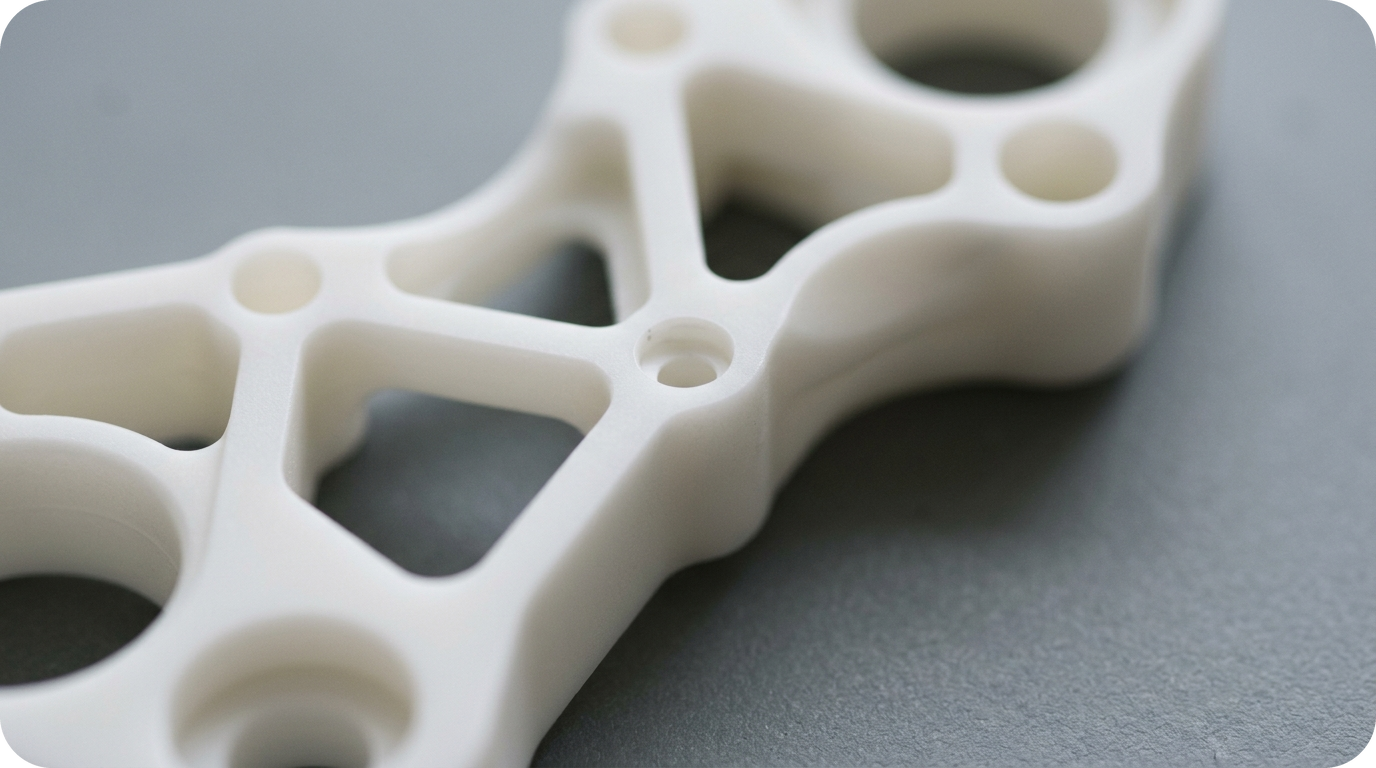
바로 이 지점에서 산업용 SLA 3D프린팅이 조건부 대안으로 부상합니다. SLA는 금형 없이 디지털 데이터에서 곧바로 부품을 생산하기 때문에, 형상이 매번 달라지는 다품종 제품을 반복 재현하는 데 구조적으로 유리합니다. 환자별로 형상이 다르더라도 각 파일을 개별 생산하면 되므로, GLUCK이 지향하는 Mass Customization(맞춤 양산)과 Flexible Series Production의 접근이 그대로 성립합니다.
의료 부품에서 특히 중요한 표면 품질과 정밀도 측면에서도 SLA는 강점을 가집니다. GLUCK의 산업용 SLA는 최대 ±0.05mm 수준의 정밀도와 Ra 0.8 수준의 매끄러운 표면을 구현하며, 후가공을 거치면 사출품과 구별이 어려운 마감까지 가능합니다. 하우징·커버·핸들처럼 표면이 곧 완성도인 부품을 별도의 복잡한 후가공 없이 최종 부품으로 활용할 수 있다는 뜻입니다.
- 금형 없는 반복생산: 설계 변경이 잦은 의료 부품도 디지털 파일 수정만으로 다음 생산에 즉시 반영되어, 초기 리드타임과 변경 비용을 크게 줄입니다.
- 다품종 반복 양산: 개별 형상을 균일한 품질로 반복 생산하는 디지털 파운드리 방식으로, 환자 맞춤 제품의 초도 검증부터 중·대량 반복 양산까지 이어집니다.
다만 SLA가 모든 경우의 정답은 아닙니다. 단일 형상을 수십만 개 이상 찍는 초대량 표준품이라면 개당 단가 측면에서 사출 성형이 여전히 유리하고, 고하중을 견뎌야 하는 금속 구조 부품은 금속 가공이 적합합니다. GLUCK의 영역은 SLA 폴리머 기반의 하우징·커버·가이드류이며, 금속·바이오프린팅은 다른 공정의 몫입니다. 중요한 것은 어떤 조건에서 SLA가 유리한지를 정확히 구분해 적용하는 것입니다.
의료 3D프린팅이 시제품의 성공에 머물지 않고 지속 가능한 사업으로 자리 잡으려면, 결국 '반복해서 균일하게 만들 수 있는가'라는 양산 질문에 답해야 합니다. ADDITIV Medical 2026이 ROI와 수술실을 나란히 놓은 이유도 여기에 있습니다. 다품종·개별 형상을 안정적으로 반복 재현해야 하는 의료 부품 양산을 고민하는 제조사라면, 산업용 SLA는 검토해볼 만한 현실적인 선택지입니다.
GLUCK은 반복 생산이 가능한 산업용 SLA 3D프린팅 인프라를 기반으로
의료기기 하우징·커버 등 맞춤 양산 개발과 양산 전환 과정에 필요한 3D프린팅 제조 솔루션을 지원하고 있습니다.
지금 글룩을 확인해보세요!
📩 글룩 홈페이지 & 온라인 견적: https://www.glucklab.com
📂 글룩 포트폴리오: 글룩 포트폴리오 확인하기
References
[1] 3Dnatives, "AI, ROI, and the OR: ADDITIV Medical 2026 Unites Global Experts to Bridge 3D Printing Gaps," 3Dnatives. Link: https://www.3dnatives.com/en/additiv-medical-2026-28082026/
English Version
The Real Cost in the OR: Why Medical 3D Printing Must Move Beyond Prototypes to Production
In the medical device industry, 3D printing is no longer unfamiliar. Anatomical models for surgical planning, patient-specific surgical guides, and personalized implants are already widely used in hospitals and manufacturing. Yet recently the industry's conversation has shifted subtly. The question has moved from "Can we make it?" to "Can this become a sustainable business?"
According to specialist media 3Dnatives, the online conference ADDITIV Medical 2026 gathers global experts under the very theme of "AI, ROI, and the OR." What's notable is the event's subtitle: "Bridge 3D Printing Gaps." The technology already exists, yet there remains a "gap" still to be closed.
A natural question arises here. In medical device 3D printing, where exactly is the boundary between small-batch prototyping and repeatable production? In this article, we re-read the conference's theme from a manufacturing perspective, examining the point where medical printing moves from "we can make it" to "we can sell it repeatedly."
Why ADDITIV Medical 2026 Puts "ROI" Front and Center
The fact that ADDITIV Medical 2026 placed ROI (return on investment) in its title itself signals the industry's stage of maturity. Early medical 3D printing discourse stayed in the language of possibility—"we can even make complex shapes like this." But for hospitals and medical device makers to actually commit budgets, possibility alone is not enough; a "profitable structure" is required.
The problem arises here. Many medical printing projects successfully reach the prototype and clinical validation stages, but hit a wall the moment they try to move to repeatable production. There are two reasons.
- The wall of reproducibility: Patient-specific products change shape every time, yet a medical device must maintain identical quality, precision, and safety standards regardless of geometry. Making one well and making hundreds of differently-shaped units uniformly are entirely different problems.
- The wall of proving ROI: Even if small-batch prototype costs are bearable, unless it is proven that the method retains economics at scale, manufacturers find it hard to decide on a production transition.
Ultimately, the "gap" the conference refers to is not a technology gap but a manufacturing gap between prototype and production. This is precisely the real gateway medical 3D printing must pass through.
It's Not "How Many" but "How Often It Changes"
When discussing the boundary between small-batch and production, many ask, "From how many units does it become production?" But in the medical field, the axis of this question is a little different. The real criterion is not absolute quantity but how often the geometry changes.
For general consumer goods, mass-producing a single geometry is natural. In such cases, even with an upfront tooling investment, injection molding—where per-unit cost drops—remains the most rational choice. The problem is that many medical devices do not fit this premise. Patient-specific guides and implants, by definition, change shape every time.
To handle such high-mix, individually-shaped products with traditional mold methods, a new mold must be made each time the geometry changes. Mold fabrication requires substantial cost and time, and making a mold for each patient is practically impossible. CNC machining, too, hits the limits of geometric constraints and processing time for medical parts full of organic internal structures and complex curves.
💡 In other words, the production boundary in medical printing is decided not by a "quantity threshold" but by the reproducibility threshold of "can we uniformly and repeatedly reproduce a high mix?" The zone that must reliably reproduce frequently-changing geometries—this is precisely where 3D printing production carries meaning.
Industrial SLA and GLUCK's Custom Production Perspective
It is exactly at this point that industrial SLA 3D printing emerges as a conditional alternative. Because SLA produces parts directly from digital data without molds, it is structurally advantageous for repeatedly reproducing high-mix products whose shape changes each time. Even when geometry differs per patient, each file can be produced individually, so GLUCK's approach of Mass Customization and Flexible Series Production holds directly.
SLA also has strengths in surface quality and precision, which are especially critical for medical parts. GLUCK's industrial SLA achieves precision up to ±0.05mm and smooth surfaces around Ra 0.8, and with post-processing can reach finishes hard to distinguish from injection-molded parts. This means parts where the surface is the finish itself—housings, covers, handles—can be used as end-use parts without complex additional post-processing.
- Mold-free repeatable production: Even medical parts with frequent design changes are reflected in the next run through a simple digital file edit, greatly reducing initial lead time and change costs.
- High-mix repeatable production: As a digital foundry approach that repeatedly produces individual geometries at uniform quality, it connects patient-specific products from initial validation to mid-to-high-volume repeatable production.
That said, SLA is not the answer in every case. For standard products of a single geometry produced in hundreds of thousands or more, injection molding still wins on per-unit cost, and metal structural parts bearing high loads suit metal processing. GLUCK's domain is SLA polymer-based housings, covers, and guides; metal and bioprinting belong to other processes. What matters is precisely distinguishing under what conditions SLA is advantageous and applying it accordingly.
For medical 3D printing to become a sustainable business rather than stopping at prototype success, it must ultimately answer the production question of "can we make it repeatedly and uniformly?" This is why ADDITIV Medical 2026 placed ROI and the OR side by side. For manufacturers grappling with producing high-mix, individually-shaped medical parts that must be reliably reproduced, industrial SLA is a realistic option worth reviewing.
Based on its industrial SLA 3D printing infrastructure capable of repeatable production,
GLUCK supports the 3D printing manufacturing solutions needed for developing custom-produced parts such as medical device housings and covers and transitioning them to production.
Check out GLUCK now!
📩 GLUCK Website & Online Quote: https://www.glucklab.com
📂 GLUCK Portfolio: View the GLUCK Portfolio
References
[1] 3Dnatives, "AI, ROI, and the OR: ADDITIV Medical 2026 Unites Global Experts to Bridge 3D Printing Gaps," 3Dnatives. Link: https://www.3dnatives.com/en/additiv-medical-2026-28082026/
#글룩 #GLUCK #3D프린팅 #산업용3D프린팅 #SLA3D프린팅 #의료3D프린팅 #맞춤양산 #의료기기제조 #반복생산 #DfAM #3DPrinting #SLA3DPrinting #MedicalManufacturing #MassCustomization #FlexibleSeriesProduction #AdditiveManufacturing #ADDITIVMedical2026 #DigitalFoundry
'인사이트 (Insights)' 카테고리의 다른 글
| 애플이 새 아이폰 힌지 커버를 금형 없이 찍어낸 이유 (0) | 2026.09.11 |
|---|---|
| ICON은 하나의 건설 시스템으로 전혀 다른 집을 찍어낸다 : '같은 공정, 다른 결과물'의 원리 (0) | 2026.09.11 |
| Figure가 AI 컴퓨팅에 수억 달러를 쏟는 동안, 로봇 '외피'는 누가 만드나 (0) | 2026.09.08 |
| 만지는 순간 완성되는 전시 : 아이들이 만든 3D프린팅 로봇 동물원이 브랜드 오브제에 남긴 힌트 (0) | 2026.09.08 |
| 발 하나하나가 다르다 : 맞춤 보조기 스타트업이 2,250만 달러를 받은 진짜 이유 (0) | 2026.09.08 |