
새 스마트폰이 공개될 때마다 사람들의 관심은 카메라 화소나 칩 성능에 쏠립니다. 그런데 이번에는 조금 다른 곳에서 제조 업계가 술렁였습니다. 세계에서 가장 많이 팔리는 소비자 전자제품을 만드는 애플이, 새 아이폰의 한 부품을 3D프린팅으로 대량생산해 적용했다는 소식 때문입니다.
화제가 된 부품은 폴더블 계열 힌지 커버였습니다. 손톱만 한 크기에 내부 구조가 복잡한 이 커버가, 시제품이 아니라 실제 판매되는 완제품에 3D프린팅으로 찍혀 들어간 것입니다. 과거 3D프린팅이 '목업 만드는 기술'로만 여겨졌던 것을 떠올리면, 이는 분명한 전환점입니다.
여기서 자연스럽게 떠오르는 질문이 있습니다. 글로벌 대량생산 제품에 3D프린팅 부품이 정식으로 채택될 수 있을까요? 그리고 그것이 가능하다면, 복잡하고 작은 커버 부품을 금형 없이 대량으로 반복생산하는 일은 어떻게 현실이 되었을까요. 이번 글은 애플의 사례를 '금형 없는 반복생산의 대중화'라는 제조 관점에서 풀어봅니다.
애플이 힌지 커버를 3D프린팅으로 양산한 배경
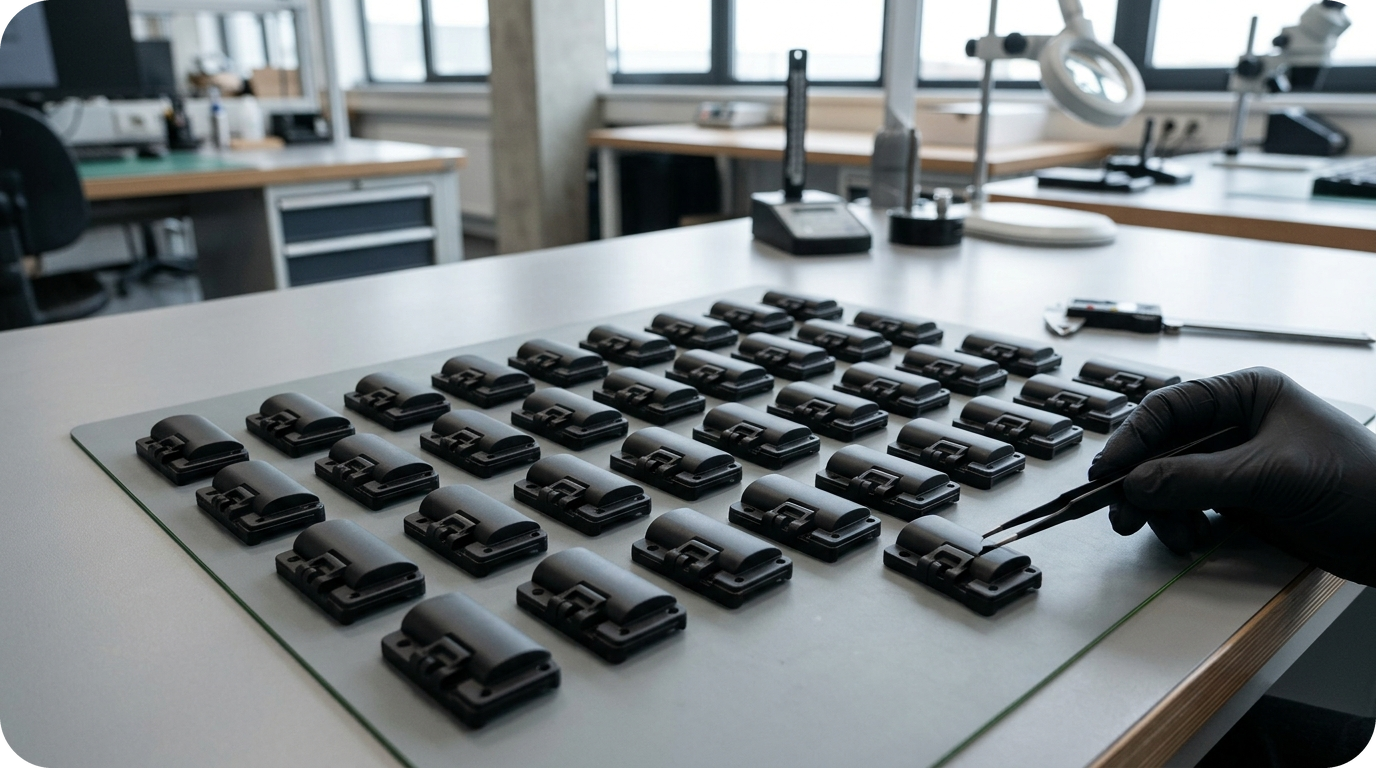
폴더블 스마트폰의 힌지 커버는 제조 관점에서 까다로운 부품입니다. 크기는 작지만 내부에 곡면과 얇은 벽, 미세한 결합 구조가 얽혀 있어 형상이 복잡합니다. 게다가 접히는 구조 특성상 설계가 계속 다듬어지기 때문에, 초기 양산 단계에서 형상 변경이 빈번하게 일어납니다.
기존 방식으로 이런 부품을 만들려면 정밀 금형을 제작해야 했습니다. 문제는 여기서 시작됩니다. 소형·복잡 부품용 금형은 제작비가 크고, 제작에만 수 주에서 수 개월이 걸립니다. 그런데 설계가 한 번 바뀌면 금형을 수정하거나 새로 파야 하고, 그때마다 비용과 시간이 다시 발생합니다. 설계 반복이 잦은 초기 구간에서 이 경직성은 개발 속도를 크게 떨어뜨립니다.
- 금형 없는 반복생산: 디지털 설계 파일만 있으면 곧바로 생산에 들어갈 수 있어, 금형 제작 기간과 초기 투자 부담이 사라집니다.
- 복잡 형상 대응: 사출로는 언더컷(금형에서 빠지지 않는 안쪽 형상)이 문제가 되는 구조도, 적층 방식에서는 별도 제약 없이 구현됩니다.
이런 이유로 소형·복잡 커버 부품을 대량으로 반복생산하는 구간에서 3D프린팅이 유력한 선택지로 떠오릅니다. 애플의 채택은 이 방식이 이제 실험이 아니라 실제 양산 라인에서 작동한다는 신호로 읽힙니다.
'금형 없는 반복생산'이 대중화되는 흐름
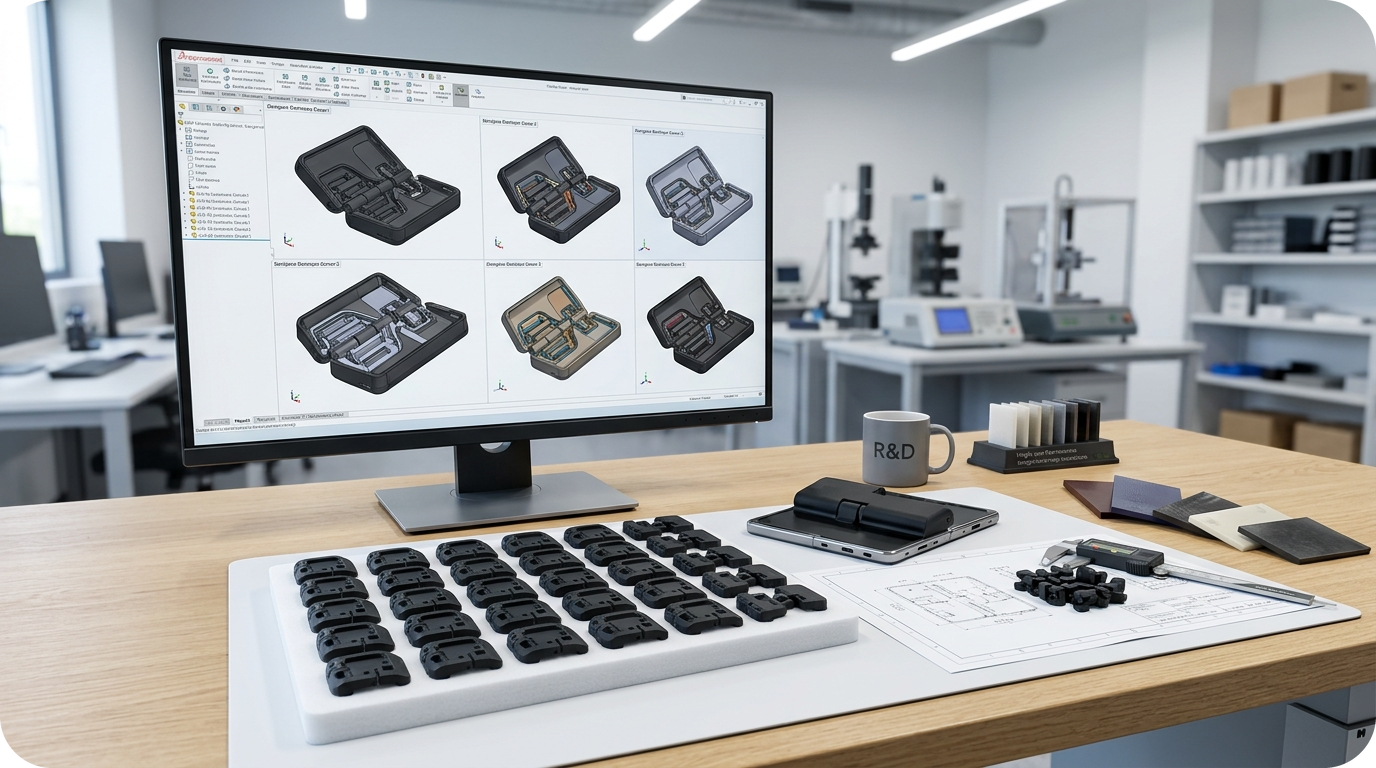
애플의 사례가 특별한 것은 규모 때문입니다. 세계에서 가장 물량이 많은 제품군 중 하나에 프린팅 부품이 들어갔다는 것은, 동일한 품질의 부품을 대규모로 균일하게 찍어낼 수 있는 시스템이 뒷받침된다는 뜻입니다. 한두 개 만드는 것과, 균일한 품질로 반복해 찍어내는 것은 완전히 다른 문제이기 때문입니다.
소비자 전자 산업이 겪는 두 가지 벽이 여기서 드러납니다. 하나는 짧아지는 제품 수명 주기입니다. 신제품 출시 주기가 빨라질수록, 수 개월짜리 금형 리드타임은 부담이 됩니다. 다른 하나는 다양해지는 형태입니다. 폴더블·롤러블처럼 형상이 복잡해질수록 금형 설계의 난이도와 비용이 함께 올라갑니다.
이 두 벽 앞에서 '금형 없이, 설계를 바꾸며, 곧바로 찍는' 방식은 매력적인 대안이 됩니다. 다만 이 흐름을 3D프린팅이 모든 부품을 대체한다는 뜻으로 읽으면 곤란합니다. 형상이 단순하고 물량이 수백만 개 단위로 완전히 동일한 부품이라면, 여전히 사출이 개당 단가 면에서 유리합니다. 핵심은 '어떤 부품을, 어떤 구간에서' 프린팅으로 가져가느냐입니다.
산업용 SLA 3D프린팅으로 구현하는 커버·하우징 양산
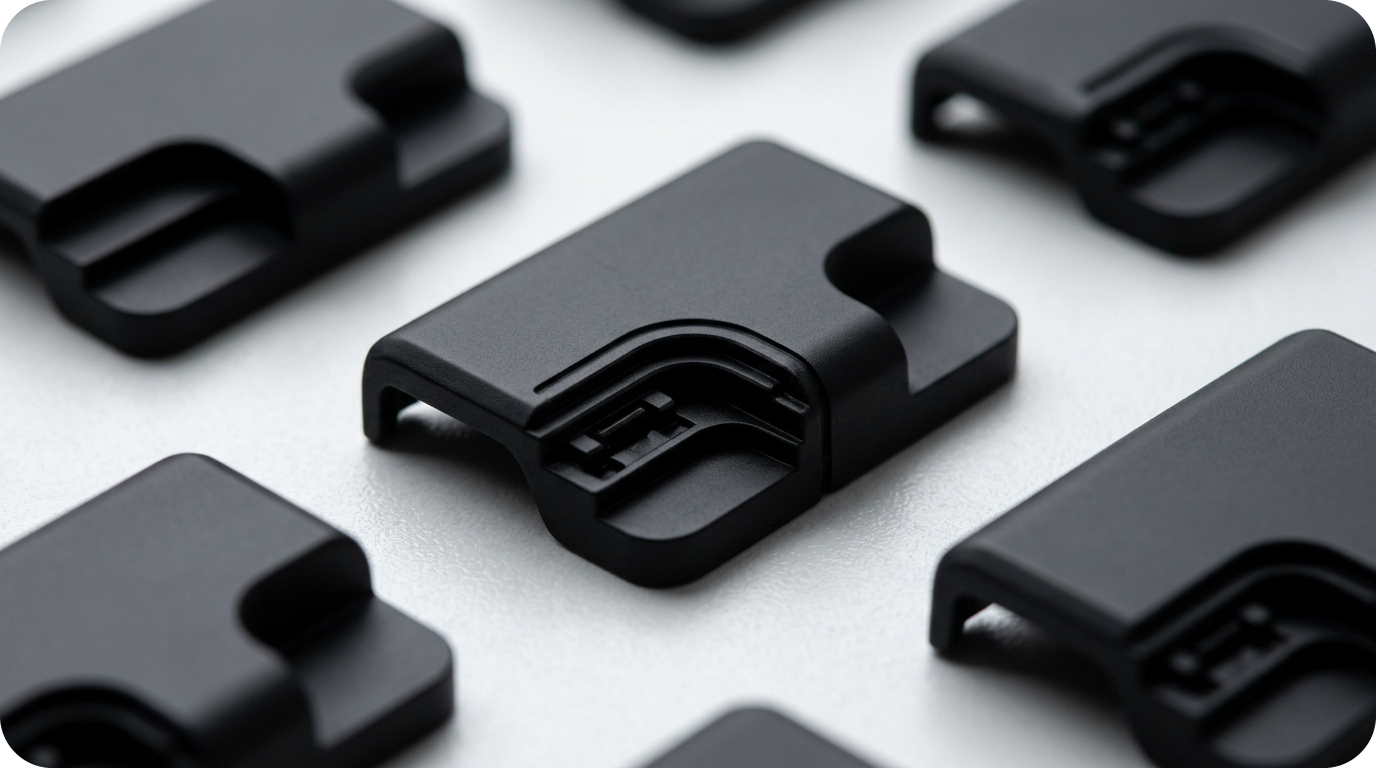
애플의 힌지 커버가 보여준 가능성은, 산업 현장에서는 산업용 SLA 3D프린팅을 통해 더 정밀하게 구현될 수 있습니다. SLA는 표면 품질이 매끄러워 외장 커버나 하우징처럼 마감이 중요한 부품에 특히 잘 맞습니다. 복잡한 내부 구조와 얇은 벽을 정밀하게 재현하면서도, 금형 없이 같은 형상을 반복해 찍어낼 수 있기 때문입니다.
GLUCK은 약 45기의 산업용 SLA 장비로 365일 24시간 운용 체계를 갖추고, 연 23만 개 이상의 부품을 반복생산하고 있습니다. 최대 ±0.05mm 정밀도와 Ra 0.8 수준의 표면조도를 유지하며, 후가공을 거치면 사출품과 구별이 어려운 마감까지 구현합니다. 로봇 외장 커버, 생산라인 지그·치구·검사구, 의료기기 하우징/커버처럼 형상이 복잡하고 마감이 중요한 커버·하우징 부품군이 실제 반복 양산되고 있습니다.
물론 SLA가 만능은 아닙니다. 형상이 단순하고 완전히 동일한 부품을 수백만 개 찍는다면 사출이 더 경제적입니다. 반대로 형상이 복잡하거나, 설계 반복이 잦은 초기 양산에서 중·대량 반복생산으로 이어지는 구간, 다품종을 동시에 다뤄야 하는 상황이라면 SLA가 유력한 선택지가 됩니다. 애플의 채택 사례는 바로 그 조건이 맞아떨어진 지점을 보여준 것입니다.
결국 이번 사례가 던지는 메시지는 분명합니다. 3D프린팅 부품은 더 이상 시제품에 머물지 않고, 글로벌 대량생산 제품의 정식 부품으로 채택되는 단계에 들어섰습니다. 다만 그것이 모든 부품을 대체한다는 뜻은 아니며, 복잡한 커버·하우징을 금형 없이 빠르게, 반복해서 양산하려는 제조사에게 현실적인 선택지가 되었다는 뜻입니다.
GLUCK은 반복 생산이 가능한 산업용 SLA 3D프린팅 인프라를 기반으로
소비자 전자 부품 개발과 양산 전환 과정에 필요한 3D프린팅 제조 솔루션을 지원하고 있습니다.
지금 글룩을 확인해보세요!
📩 글룩 홈페이지 & 온라인 견적: https://www.glucklab.com
📂 글룩 포트폴리오: 글룩 포트폴리오 확인하기
References
[1] VoxelMatters, "Apple releases new iPhone Duo with mass produced 3D printed hinge covers," voxelmatters.com. Link: https://www.voxelmatters.com/apple-releases-new-iphone-duo-with-mass-produced-3d-printed-hinge-covers/
English Version
Why Apple Printed Its New iPhone's Hinge Cover Without a Mold
Each time a new smartphone launches, attention focuses on camera megapixels or chip performance. This time, however, the manufacturing industry buzzed over something different. Apple, maker of the world's best-selling consumer electronics, reportedly mass-produced and applied one part of its new iPhone using 3D printing.
The part in question was a hinge cover for the foldable lineup. Barely the size of a fingernail with a complex internal structure, this cover was printed via 3D printing into an actual retail product, not a prototype. Considering 3D printing was once seen merely as a "mockup technology," this marks a clear turning point.
A natural question arises here. Can 3D-printed parts be officially adopted in global mass-produced products? And if so, how did reliably reproducing a complex, tiny cover part without molds become reality? This article interprets Apple's case from a manufacturing perspective: the popularization of mold-free repeatable production.
The Background of Apple's 3D-Printed Hinge Cover Production
A foldable smartphone's hinge cover is a demanding part from a manufacturing standpoint. Though small, its interior interweaves curved surfaces, thin walls, and fine coupling structures, making the geometry complex. Furthermore, because the folding structure means the design keeps being refined, shape changes occur frequently in early production stages.
Traditional methods require precision molds for such parts. The problem begins here. Molds for small, complex parts are costly to produce and take weeks to months to fabricate. Yet once the design changes, the mold must be modified or recut, incurring cost and time each time. In early stages with frequent design iterations, this rigidity significantly slows development.
- Mold-free repeat production: With only a digital design file, production can begin immediately, eliminating mold fabrication time and upfront investment.
- Complex geometry support: Structures with undercuts (inner shapes that cannot be released from a mold) that trouble injection molding are realized without such constraints in additive methods.
For these reasons, 3D printing emerges as a strong option for repeat production of small, complex cover parts. Apple's adoption signals that this method now works not as an experiment but on actual production lines.
The Trend Toward Popularized "Mold-Free Repeat Production"
What makes Apple's case remarkable is its scale. Printed parts entering one of the highest-volume product categories in the world means a system capable of uniformly producing identical-quality parts at large scale backs it up. Making one or two units and repeatedly printing them at uniform quality are entirely different challenges.
Two walls the consumer electronics industry faces surface here. One is shortening product life cycles. As launch cycles accelerate, months-long mold lead times become a burden. The other is diversifying forms. As shapes grow more complex like foldables and rollables, mold design difficulty and cost rise together.
Before these two walls, the approach of "printing immediately, changing the design, without a mold" becomes an attractive alternative. However, reading this trend as 3D printing replacing all parts would be a mistake. For simple shapes produced completely identically at millions of units, injection molding still wins on per-unit cost. The key is which parts, in which segments, to take to printing.
Producing Cover and Housing Parts With Industrial SLA 3D Printing
The possibility shown by Apple's hinge cover can be realized more precisely on the industrial floor through industrial SLA 3D printing. SLA's smooth surface quality suits exterior covers and housings where finishing matters. It precisely reproduces complex internal structures and thin walls while repeatedly printing the same shape without molds.
GLUCK operates around 45 industrial SLA machines under a 365-day, 24-hour system, repeatedly producing over 230,000 parts annually. It maintains up to ±0.05mm precision and Ra 0.8 surface roughness, achieving finishing hard to distinguish from injection-molded parts after post-processing. Cover and housing part families where geometry is complex and finishing matters—such as robot exterior covers, production-line jigs/fixtures/inspection tools, and medical device housings/covers—are already in repeat production.
Of course, SLA is not a cure-all. Printing millions of completely identical simple-shape parts is more economical with injection molding. Conversely, when shapes are complex, when early production with frequent design iterations extends into mid-to-high-volume repeat production, or when multiple part types must be handled simultaneously, SLA becomes a strong option. Apple's adoption shows exactly the point where those conditions aligned.
Ultimately, the message this case delivers is clear. 3D-printed parts no longer stay at the prototype stage—they have entered a phase of being adopted as official parts in global mass-produced products. This does not mean replacing all parts, but rather that it has become a realistic option for manufacturers seeking to mass-produce complex covers and housings quickly and repeatedly without molds.
GLUCK supports the 3D printing manufacturing solutions needed for consumer electronics part development and mass-production transition, based on industrial SLA 3D printing infrastructure capable of repeat production.
Check out GLUCK now!
📩 GLUCK Homepage & Online Quote: https://www.glucklab.com
📂 GLUCK Portfolio: View GLUCK Portfolio
References
[1] VoxelMatters, "Apple releases new iPhone Duo with mass produced 3D printed hinge covers," voxelmatters.com. Link: https://www.voxelmatters.com/apple-releases-new-iphone-duo-with-mass-produced-3d-printed-hinge-covers/
#글룩 #GLUCK #3D프린팅 #산업용3D프린팅 #SLA3D프린팅 #아이폰 #소비자전자 #힌지커버 #금형없는양산 #반복생산 #대량생산 #커버하우징 #3DPrinting #IndustrialSLA #SLA3DPrinting #AdditiveManufacturing #MassProduction #ConsumerElectronics #Apple #HingeCover
'인사이트 (Insights)' 카테고리의 다른 글
| 난초 한 송이를 위한 AI 로봇, 감성 오브제가 된 로봇의 외장은 어떻게 만들까 (0) | 2026.09.15 |
|---|---|
| 접착제 없이 조립되는 스니커즈 : 3D프린팅 밑창과 전통 갖신의 결합 (0) | 2026.09.14 |
| ICON은 하나의 건설 시스템으로 전혀 다른 집을 찍어낸다 : '같은 공정, 다른 결과물'의 원리 (0) | 2026.09.11 |
| 수술실의 진짜 비용 : 의료 3D프린팅이 '시제품'을 넘어 양산으로 가야 하는 이유 (0) | 2026.09.08 |
| Figure가 AI 컴퓨팅에 수억 달러를 쏟는 동안, 로봇 '외피'는 누가 만드나 (0) | 2026.09.08 |