
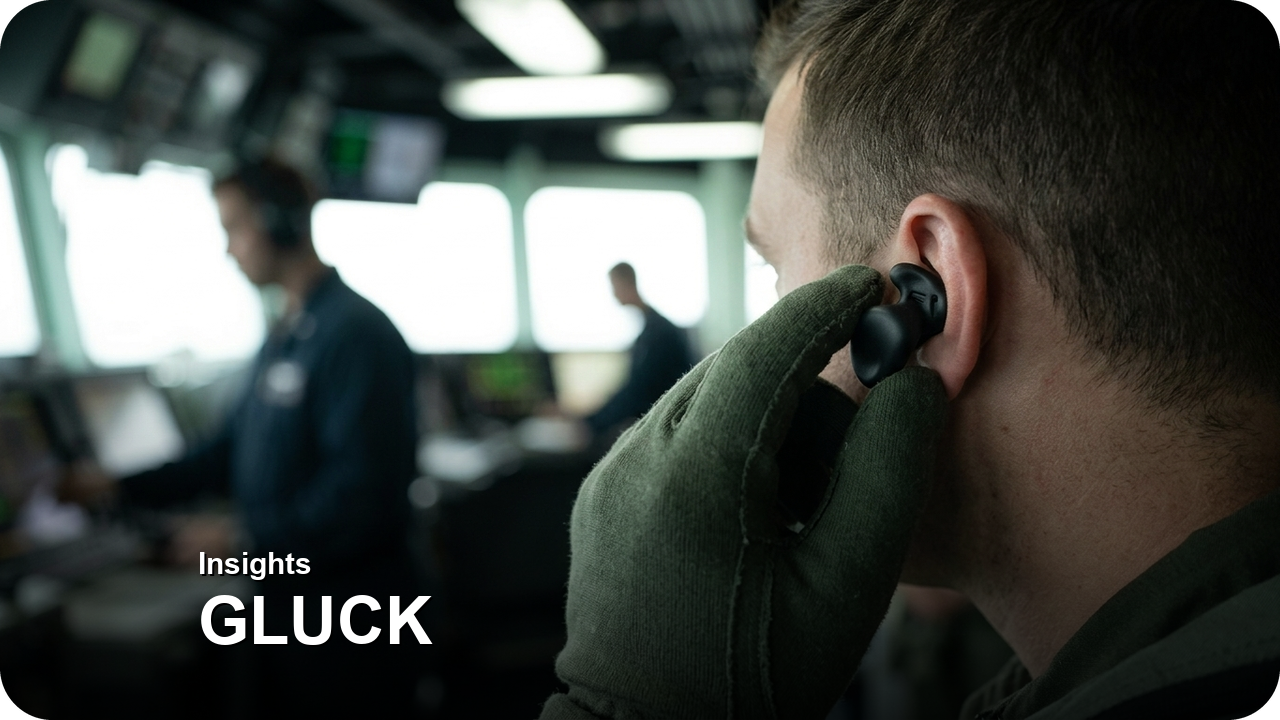
군에서 청력 손상은 가장 흔한 직무 관련 장애 중 하나로 꼽힙니다. 특히 항공모함 갑판이나 활주로처럼 소음이 극심한 환경에서 근무하는 인원에게 청력보호구는 필수 장비입니다. 그런데 문제는, 귀 모양이 사람마다 다르다는 점입니다. 잘 맞지 않는 보호구는 결국 착용하지 않게 되고, 착용하지 않는 장비는 아무리 좋아도 사람을 지켜주지 못합니다.
최근 미 해군은 이 문제를 정면으로 다룬 조달 계약을 체결했습니다. Aware Defense가 해군 항공 인력을 위한 맞춤형 청력보호구와 통신용 이어플러그를 5년간 단독 공급하는 계약을 따냈고, 이 장비들은 개인의 귀를 3D로 스캔한 데이터를 바탕으로 적층제조 방식으로 제작됩니다. 초기 단계에서 2025년 9월부터 2026년 7월까지 6,373개의 맞춤 장비를 납품했고, 2026년 8월부터는 생산 규모를 42,000개 단위까지 확대할 계획입니다.
여기서 제조 관점의 핵심 질문이 하나 떠오릅니다. 사람마다 다른 형상을, 금형 없이, 어떻게 수만 개 규모로 반복 양산할 수 있을까요? 이 글은 개인 스캔 데이터를 실제 착용 부품으로 전환하는 '맞춤 양산(mass customization)'의 구조를, 산업용 SLA 3D프린팅의 정밀·표면 관점에서 짚어봅니다.
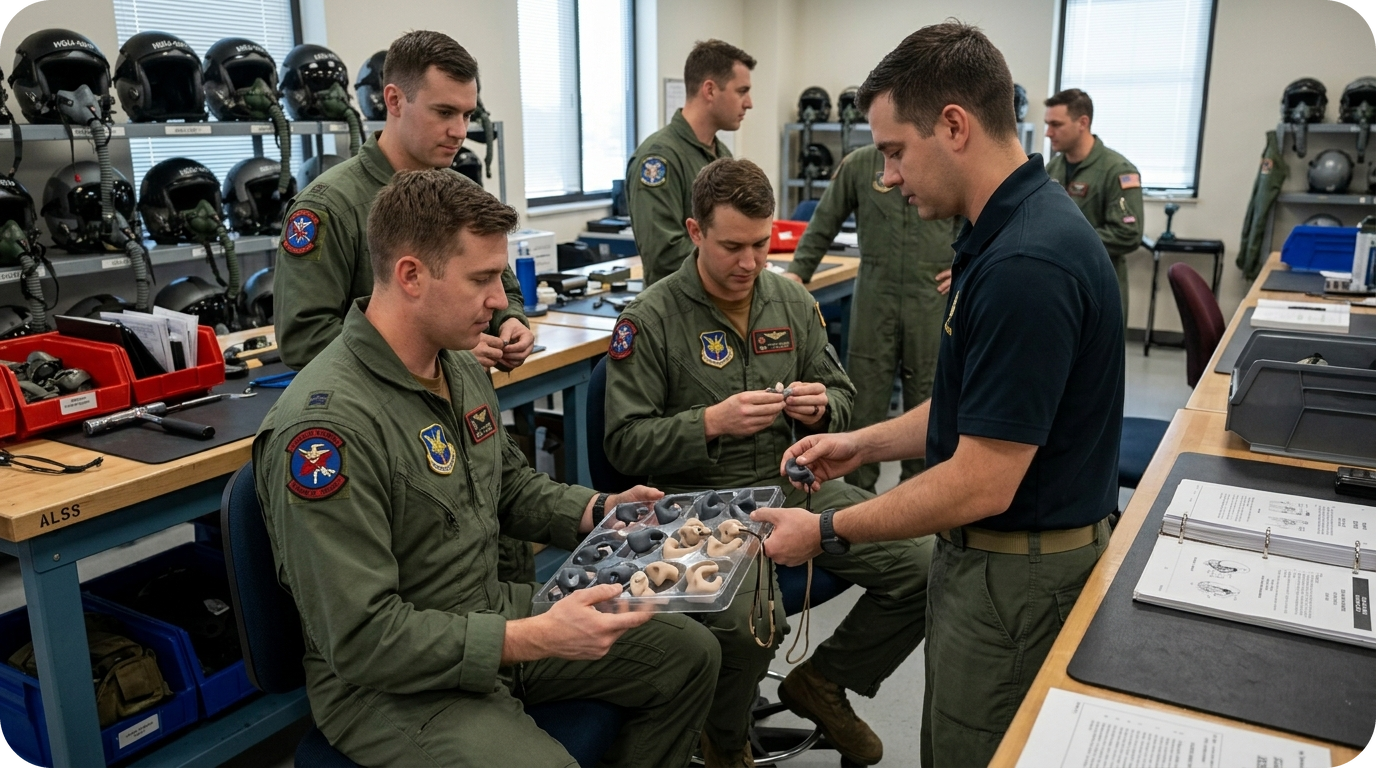
Aware Defense : 개인의 귀를 데이터로 만드는 조달 계약
이 프로그램의 중심에는 eFit이라는 3D 귀 스캐너가 있습니다. 접촉 없이 광학 방식으로 귀와 외이도의 형상을 두 번째 굴곡 지점 너머까지 포착하며, 90마이크론 이하의 치수 정확도를 확보한다고 설명됩니다. 즉, 개인의 귀 형상이 매우 정밀한 디지털 데이터로 먼저 확보되는 구조입니다.
문제는 그다음입니다. 스캔한 데이터가 아무리 정밀해도, 이를 실제 착용 가능한 부품으로 만드는 제조 방식이 받쳐주지 못하면 프로그램은 성립하지 않습니다. 여기서 기존 대량생산 공법의 한계가 분명해집니다.
- 금형을 쓸 수 없는 구조: 사출 성형은 하나의 금형으로 동일한 형상을 반복 생산하는 방식입니다. 그런데 42,000명의 귀가 모두 다르다면, 이론상 금형도 42,000개가 필요합니다. 이는 비용·기간 모두에서 성립하지 않습니다.
- 재고를 미리 쌓을 수 없는 특성: 표준 사이즈로 미리 만들어 창고에 쌓아두는 방식이 아니라, 개인 데이터가 확정된 뒤에야 생산이 시작되는 온디맨드 구조입니다.
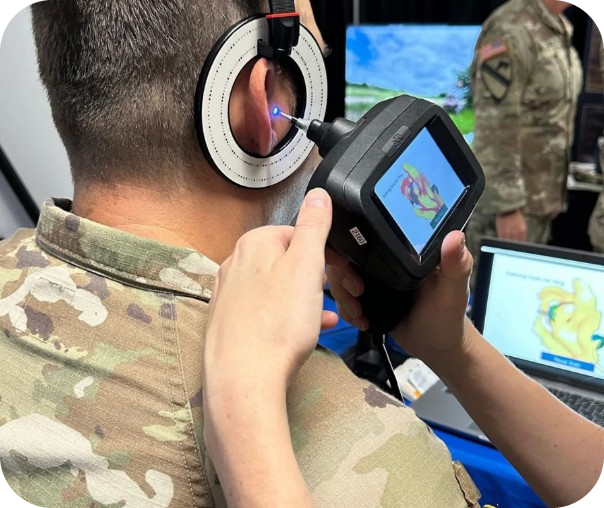
Aware Defense는 5일 만에 700명을 스캔하고 60일 안에 정밀 맞춤 장비를 착용시킬 수 있다고 밝혔습니다. 이 속도는 금형 제작 단계가 아예 존재하지 않기 때문에 가능한 것입니다. 데이터가 곧 부품 설계가 되고, 그 데이터가 그대로 생산 라인으로 넘어가는 방식이기 때문입니다.
연구 단계에서 함대 규모로 : 무엇이 달라졌나
이런 접근이 완전히 새로운 발상은 아닙니다. 과거에도 유사한 개념이 검토된 적이 있습니다. 미 육군 항공의학연구소는 2019년 물리적 귀 본을 뜬 맞춤 이어플러그와 eFit을 포함한 세 가지 디지털 스캐닝 방식을 함께 평가하는 연구를 수행했습니다. 다만 그 연구의 비교 결과는 현재 계약에서 제시되는 정확도 사양보다 앞선 시점의 것이므로, 지금 프로그램에 대한 판정이 아니라 스캐닝 접근법이 그동안 어떻게 검토되어 왔는지를 보여주는 배경으로 이해하는 편이 정확합니다.
핵심 차이는 이것입니다. 과거의 유사 시도들이 연구 단계에서 멈췄던 반면, 이번 계약은 같은 스캐닝 접근을 군 함대 규모의 실제 조달로 옮겼다는 점입니다. 시범 사업이나 민간 소매 제품이 아니라, 5년짜리 단독 공급 프로그램으로 편입된 것입니다.
제조 관점에서 보면, '만들 수 있는가'와 '균일한 품질로 반복 양산할 수 있는가'는 완전히 다른 문제입니다. 연구실에서 몇 개를 정밀하게 만드는 것과, 형상이 저마다 다른 수만 개를 동일한 신뢰성으로 계속 찍어내는 것은 차원이 다릅니다. 이 지점에서 필요한 것이 안정적인 적층제조 인프라와 공정 관리입니다.

개별 맞춤 양산을 지탱하는 산업용 SLA 3D프린팅
이런 맞춤 양산의 가능성은 실제 산업 현장에서는 산업용 SLA 3D프린팅을 통해 정밀하게 구현될 수 있습니다. 귀 삽입형 부품이나 하우징처럼 피부에 닿고 밀착되어야 하는 부품은 표면 품질과 치수 재현성이 착용감과 성능을 직접 좌우하기 때문입니다.
SLA 방식은 적층 결이 거의 보이지 않는 매끄러운 표면을 구현하며, GLUCK 기준으로 300mm 범위에서 최대 ±0.05mm 수준의 정밀도와 Ra 0.8 수준의 표면 품질을 확보합니다. 후가공을 거치면 사출품과 구별이 어려운 마감까지 가능합니다. 무엇보다 금형이 없기 때문에, 개인마다 다른 데이터를 그대로 부품으로 전환해 반복 양산할 수 있습니다.
- 금형 없는 반복 양산: 데이터가 바뀌어도 다음 생산분부터 즉시 반영됩니다. 형상이 매번 다른 다품종 맞춤 생산에 구조적으로 맞습니다.
- 양산 규모의 대응력: GLUCK은 산업용 SLA 3D프린터 45기를 365일 24시간 운용하며 연간 23만 개 이상의 부품을 생산합니다. 이는 개별 형상이 다른 웨어러블을 함대 규모로 확장하려 할 때 필요한 반복 양산 능력의 기반이 됩니다.
다만 SLA가 모든 경우의 정답은 아닙니다. 만약 수만 개가 동일한 형상이고 단순한 구조라면, 초기 금형비를 감수하더라도 사출 성형의 개당 단가가 유리합니다. 고하중·고온 환경의 금속 부품 역시 SLA 폴리머의 영역이 아닙니다. GLUCK이 강점을 갖는 지점은 어디까지나 형상이 저마다 다른 정밀 폴리머 하우징·커버·삽입형 부품의 반복 양산 구간입니다. 핵심은 '똑같은 것을 얼마나 많이'가 아니라 '저마다 다른 것을 얼마나 균일하게'입니다.
이번 해군 사례가 제조 업계에 던지는 시사점은 분명합니다. 개인 스캔 데이터를 활용한 맞춤 양산은 더 이상 연구실의 실험이 아니라, 실제 조달·공급망에 편입되는 단계에 들어섰다는 것입니다. 사람마다 다른 형상을 표준 품질로 반복 생산해야 하는 제조사에게, 금형 없는 적층제조는 현실적인 선택지가 되고 있습니다.
GLUCK은 반복 생산이 가능한 산업용 SLA 3D프린팅 인프라를 기반으로
개인 맞춤 웨어러블·정밀 하우징 개발과 양산 전환 과정에 필요한 3D프린팅 제조 솔루션을 지원하고 있습니다.
지금 글룩을 확인해보세요!
📩 글룩 홈페이지 & 온라인 견적: https://www.glucklab.com
📂 글룩 포트폴리오: 글룩 포트폴리오 확인하기
References
[1] 3D Printing Industry, "Aware Defense Wins Five-Year Navy Contract for 3D Scanned Hearing Protection," 3dprintingindustry.com. Link: https://3dprintingindustry.com/news/aware-defense-wins-five-year-navy-contract-for-3d-scanned-hearing-protection-254742/
English Version
How the U.S. Navy Turns 'Ear-Scanned Custom Hearing Protection' for 42,000 People into Mass Production
Hearing loss is one of the most common service-connected disabilities in the military. For personnel working in extreme-noise environments such as carrier decks and flight lines, hearing protection is essential equipment. The problem is that everyone's ears are shaped differently. Poorly fitting protection ends up not being worn, and gear that isn't worn cannot protect anyone, no matter how good it is.
Recently, the U.S. Navy signed a procurement contract that tackles this problem head-on. Aware Defense won a contract to be the sole supplier of custom hearing protection and Communications Earplugs for Naval Aviation personnel over five years, with these devices built using additive manufacturing based on individually 3D-scanned ear data. In the initial phase, 6,373 custom devices were delivered between September 2025 and July 2026, and starting August 2026, production is planned to scale up to 42,000 units.
Here a key manufacturing question arises. How can you repeatedly mass-produce shapes that differ from person to person, without molds, at a scale of tens of thousands? This article examines the structure of "mass customization"—converting individual scan data into actual wearable parts—from the perspective of the precision and surface quality of industrial SLA 3D printing.
Aware Defense: A Procurement Contract That Turns Individual Ears into Data
At the center of this program is a 3D ear scanner called eFit. It captures the geometry of the ear and ear canal past the second bend using non-contact optical methods, and is described as achieving dimensional accuracy under 90 microns. In other words, an individual's ear geometry is first secured as highly precise digital data.
The challenge comes next. No matter how precise the scanned data, if the manufacturing method that turns it into a wearable part cannot keep up, the program cannot stand. Here the limits of conventional mass-production methods become clear.
- A structure where molds cannot be used: Injection molding produces identical shapes repeatedly from a single mold. But if 42,000 ears are all different, in theory 42,000 molds would be needed—unfeasible in both cost and time.
- A nature that prevents pre-stocking inventory: Rather than making standard sizes in advance and stockpiling them, production only begins after individual data is confirmed—an on-demand structure.
Aware Defense stated it can scan 700 personnel in five days and fit precision devices within 60 days. This speed is possible precisely because the mold-making stage does not exist at all. The data itself becomes the part design, and that data flows directly into the production line.
From Research Stage to Fleet Scale: What Changed
This approach is not entirely new. Similar concepts have been examined before. The U.S. Army Aeromedical Research Laboratory conducted a 2019 study evaluating custom earplugs made from physical ear impressions alongside three digital scanning methods, including eFit. However, that study's comparative findings predate the accuracy specifications cited in the current contract, so it is more accurate to understand it as background on how scanning approaches have been assessed over time, rather than as a verdict on the current program.
The key difference is this: while past similar attempts stopped at the research stage, this contract moves the same scanning approach into actual procurement at military fleet scale. It is not a pilot project or a civilian retail product, but part of a five-year sole-source supply program.
From a manufacturing standpoint, "can it be made" and "can it be repeatedly mass-produced with uniform quality" are entirely different problems. Making a few precise items in a lab is one thing; continuously producing tens of thousands of differently shaped items with the same reliability is another dimension. What is needed here is stable additive manufacturing infrastructure and process management.
Industrial SLA 3D Printing That Sustains Individual Custom Production
Such mass customization can be precisely realized in actual industry through industrial SLA 3D printing. Parts like ear-insert components or housings that touch and adhere to the skin depend directly on surface quality and dimensional reproducibility for fit and performance.
SLA achieves smooth surfaces where layer lines are barely visible, and by GLUCK's standard secures precision up to ±0.05mm within a 300mm range and surface quality around Ra 0.8. With post-processing, a finish hard to distinguish from injection-molded parts is possible. Above all, because there are no molds, individual data can be converted directly into parts for repeated mass production.
- Mold-free repeat production: Even when data changes, it is reflected immediately from the next production batch. Structurally suited to high-mix custom production where shapes differ each time.
- Production-scale capacity: GLUCK operates 45 industrial SLA 3D printers around the clock, 365 days a year, producing over 230,000 parts annually. This forms the foundation of repeat-production capability needed when scaling individually shaped wearables to fleet scale.
That said, SLA is not the answer in every case. If tens of thousands of units share the same shape and a simple structure, injection molding offers a better per-unit cost even accounting for initial tooling. High-load, high-temperature metal parts are also not the domain of SLA polymers. GLUCK's strength lies specifically in the repeat production of precision polymer housings, covers, and insert parts that each differ in shape. The point is not "how many of the same thing," but "how uniformly you can make things that each differ."
The implication this Navy case sends to the manufacturing industry is clear. Mass customization using individual scan data is no longer a lab experiment—it has entered the stage of being incorporated into actual procurement and supply chains. For manufacturers who must repeatedly produce differently shaped items at standard quality, mold-free additive manufacturing is becoming a realistic option.
GLUCK supports the 3D printing manufacturing solutions needed for developing custom wearables and precision housings and for the transition to mass production, based on its industrial SLA 3D printing infrastructure capable of repeat production.
Check out GLUCK now!
📩 GLUCK Website & Online Quote: https://www.glucklab.com
📂 GLUCK Portfolio: View the GLUCK Portfolio
References
[1] 3D Printing Industry, "Aware Defense Wins Five-Year Navy Contract for 3D Scanned Hearing Protection," 3dprintingindustry.com. Link: https://3dprintingindustry.com/news/aware-defense-wins-five-year-navy-contract-for-3d-scanned-hearing-protection-254742/
#글룩 #GLUCK #3D프린팅 #산업용3D프린팅 #SLA3D프린팅 #맞춤양산 #매스커스터마이제이션 #웨어러블 #청력보호구 #온디맨드 #3DPrinting #SLA3DPrinting #AdditiveManufacturing #MassCustomization #Wearables #HearingProtection #OnDemandManufacturing #DfAM
원문 기사 이미지 출처
'인사이트 (Insights)' 카테고리의 다른 글
| 협동로봇이 IMTS에서 새 세대로 진화하자, 로봇 외장 제조에 생긴 변화 (0) | 2026.09.21 |
|---|---|
| 셀레 이탈리아 : 엉덩이 압력을 스캔해 만든 '1인 1안장' 양산의 비밀 (0) | 2026.09.17 |
| 난초 한 송이를 위한 AI 로봇, 감성 오브제가 된 로봇의 외장은 어떻게 만들까 (0) | 2026.09.15 |
| 접착제 없이 조립되는 스니커즈 : 3D프린팅 밑창과 전통 갖신의 결합 (0) | 2026.09.14 |
| 애플이 새 아이폰 힌지 커버를 금형 없이 찍어낸 이유 (0) | 2026.09.11 |