
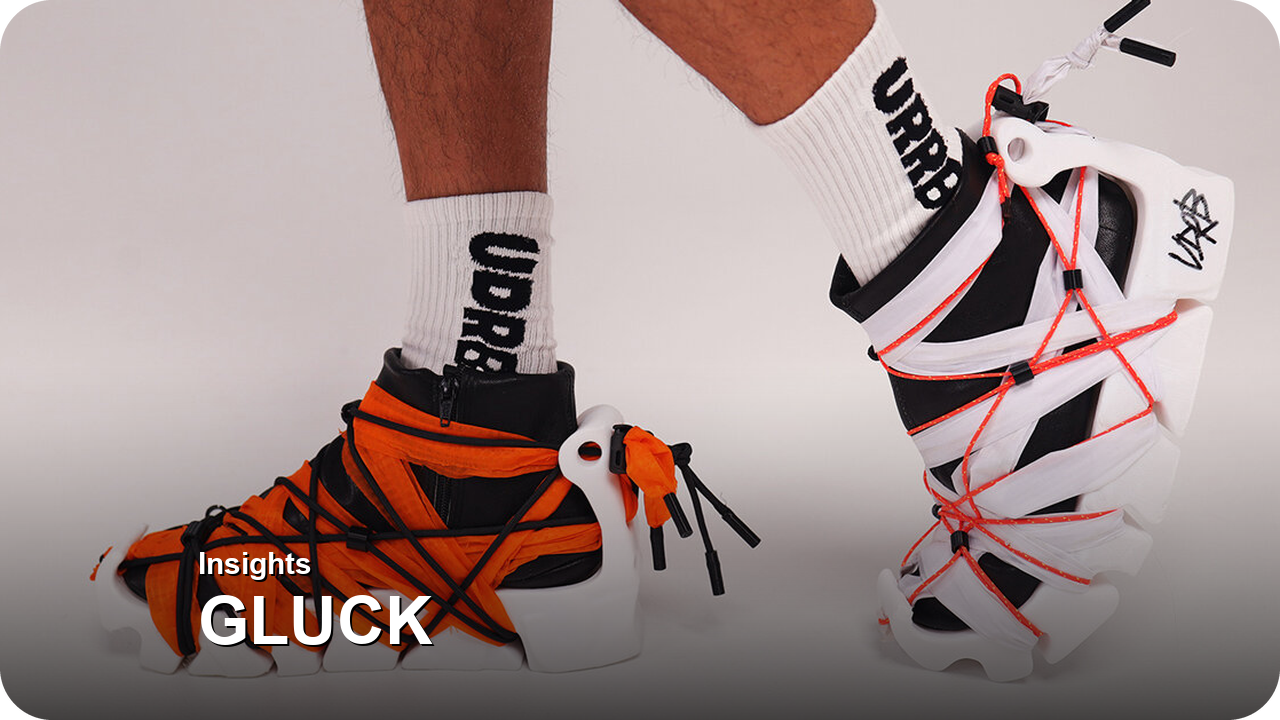
신발 한 켤레는 생각보다 복잡한 물건입니다. 갑피와 밑창, 쿠션과 아웃솔이 여러 겹의 접착제로 붙어 있고, 그 접착층은 나중에 신발을 재활용하거나 부품만 교체하기 어렵게 만드는 원인이 되기도 합니다. 최근 디자인·제조 업계에서는 이 '붙이는 방식' 자체를 다시 보는 흐름이 나타나고 있습니다.
디자이너 다니야르 우데르베코프(Daniyar Uderbekov)가 선보인 모듈형 무접착 스니커즈 'UDRB'는 그런 흐름을 잘 보여주는 사례입니다. 3D프린팅으로 만든 밑창과 아시아 전통 신발의 제작 방식을 결합해, 접착제 없이 부품을 끼워 맞추는 구조로 완성한 신발입니다. 밑창은 발의 형태와 움직임에 맞춰 곡면과 내부 구조를 설계했고, 갑피는 전통 장인의 손기술과 이어지도록 구성했습니다.
여기서 제조 관점의 질문이 자연스럽게 떠오릅니다. 3D프린팅 신발 밑창은 맞춤 양산과 디자인을 어떻게 결합할까요? 화려한 디자인 뒤에는 "사람마다 다른 발 형상과 디자인을, 금형 없이 어떻게 반복 생산할 것인가"라는 만드는 쪽의 과제가 숨어 있습니다. 이 글은 그 지점을 중심으로 사례를 제조 관점에서 다시 읽어봅니다.
UDRB : 접착제를 설계로 대체한 신발
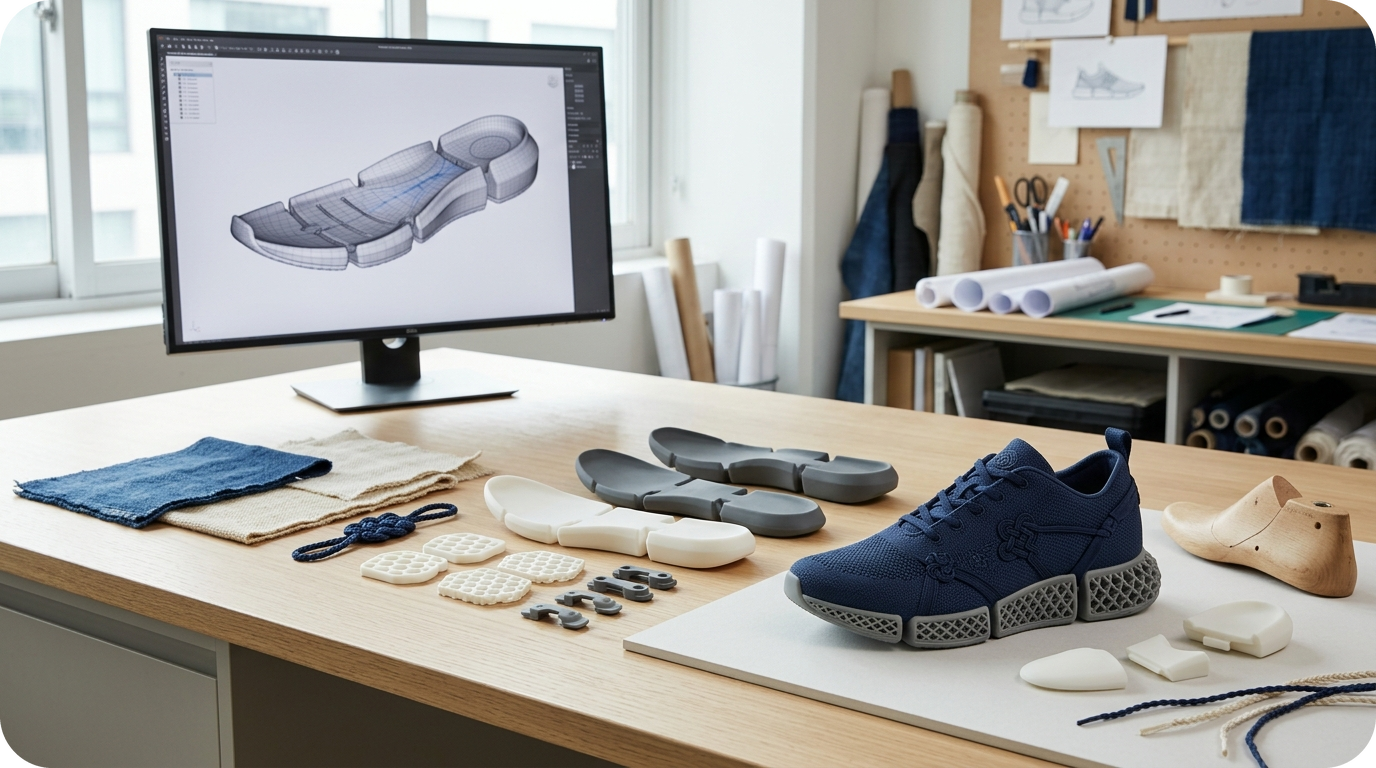
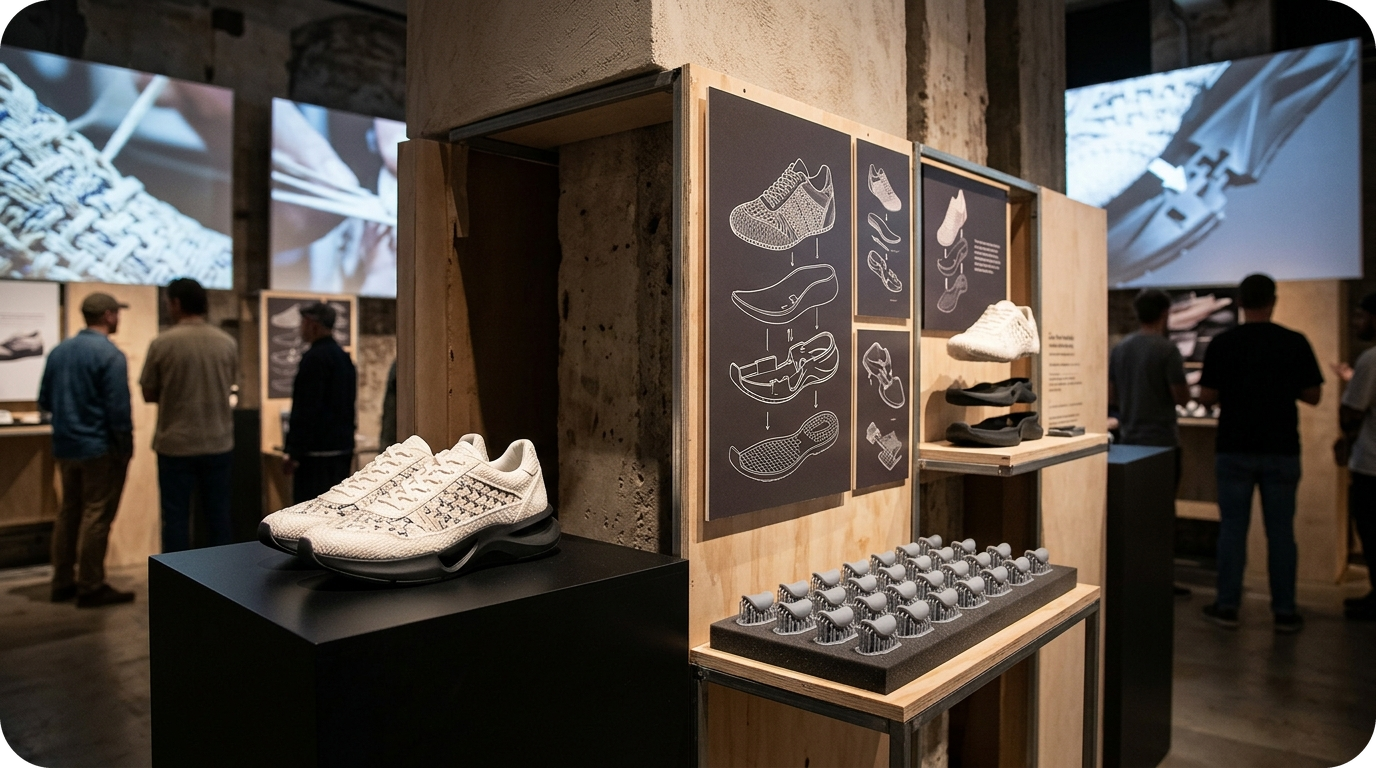
UDRB 프로젝트의 핵심은 '붙이지 않는다'는 원칙입니다. 대부분의 스니커즈는 아웃솔·미드솔·갑피를 접착제로 결합하는데, 이 방식은 대량 생산에는 익숙하지만 한계도 뚜렷합니다.
기존 방식으로 이런 신발을 만들려면 밑창 형상마다 별도의 금형이 필요합니다. 문제는 두 가지입니다. 첫째, 발 크기와 형태가 사람마다 다른데 형상을 조금만 바꿔도 금형을 새로 파야 해 소량·다품종 대응이 사실상 불가능합니다. 둘째, 접착 공정은 조립을 복잡하게 만들고, 한번 붙인 뒤에는 부품 교체나 분리가 어려워 수리·재활용 관점에서 불리합니다.
UDRB는 이 문제를 접착이 아니라 결합 구조 자체를 설계에 넣어 해결했습니다. 밑창을 3D프린팅으로 제작하면서, 부품이 서로 끼워 맞춰지도록 형상을 미리 설계한 것입니다.
- 금형 없는 형상 자유도: 발의 곡면과 하중 분포에 맞춘 내부 격자 구조를 밑창에 직접 구현했습니다. 사출로는 만들기 까다로운 비정형 곡면과 중공 구조를 그대로 출력할 수 있습니다.
- 조립의 단순화: 접착 대신 결합부를 설계에 통합해, 부품을 끼워 맞추는 방식으로 조립 공정을 줄였습니다.
이 방식은 신발에만 해당되지 않습니다. 형상이 제각각이고 부품을 통합해야 하는 제품이라면, 금형에 얽매이지 않는 제조 방식이 그대로 적용될 수 있습니다.
전통 갖신과 만난 3D프린팅
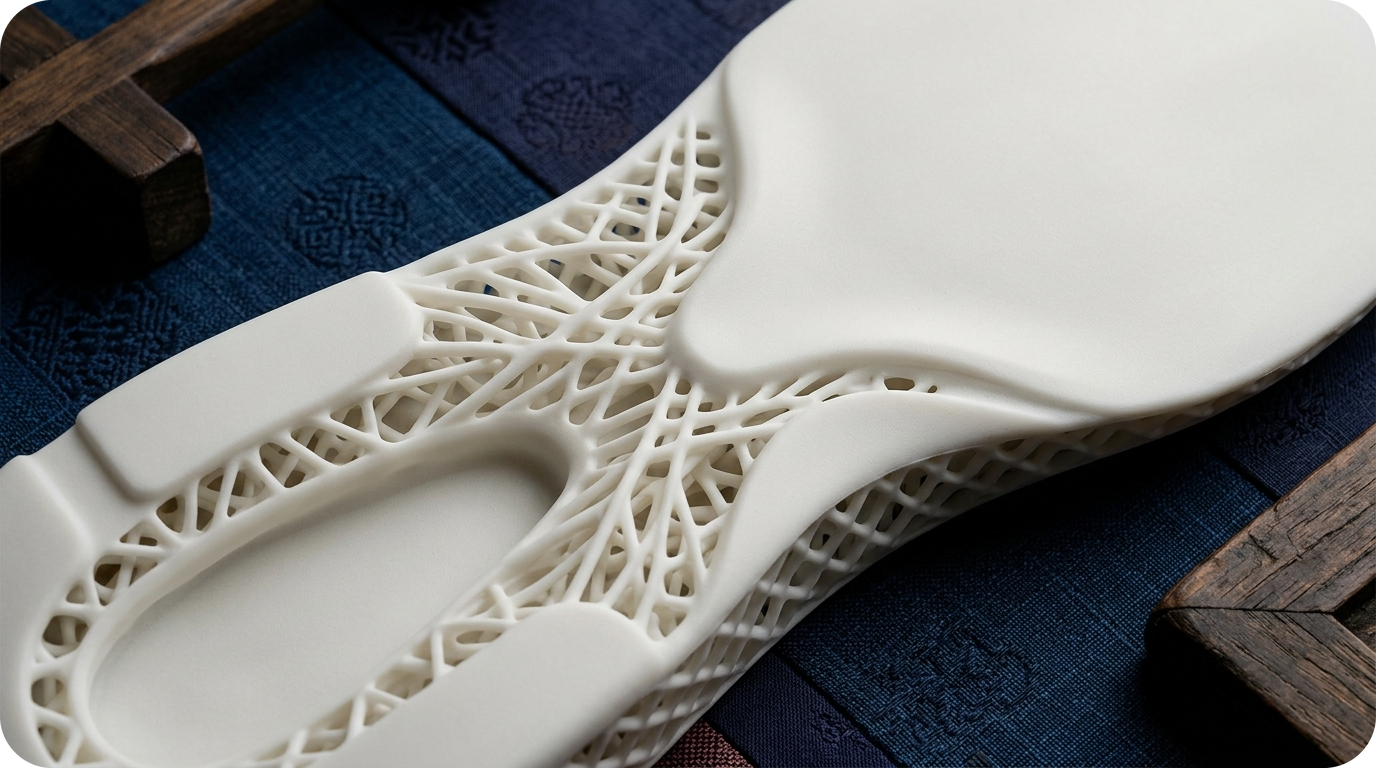
UDRB가 흥미로운 또 다른 이유는, 첨단 기술을 전통 공예와 대립시키지 않았다는 점입니다. 밑창은 디지털 설계와 3D프린팅으로, 갑피는 아시아 전통 신발의 손기술로 만들어 두 방식을 한 켤레 안에 담았습니다.
전통 갖신은 사람의 발에 맞춰 형태를 잡아온 오랜 역사를 가지고 있습니다. 하지만 손으로 만드는 방식은 밑창처럼 정밀한 곡면과 반복 품질이 필요한 부분에서는 편차가 생기기 쉽습니다. 반대로 3D프린팅은 정밀하고 균일한 밑창을 반복 생산하는 데 강하지만, 갑피의 질감과 손맛까지 대체하기는 어렵습니다.
두 방식을 나눠 맡긴 것은 이 때문입니다. 정밀·반복이 중요한 밑창은 디지털 제조가, 감성과 촉감이 중요한 갑피는 장인의 손이 맡는 역할 분담입니다. 이렇게 보면 3D프린팅은 전통을 밀어내는 기술이 아니라, 사람마다 다른 발 데이터를 반영한 맞춤 밑창을 브랜드 오브제 수준으로 양산하게 해주는 도구에 가깝습니다.
산업용 SLA로 본 맞춤 양산의 조건
UDRB 같은 가능성은 실제 산업 현장에서는 산업용 SLA 3D프린팅을 통해 더 정밀하게 구현될 수 있습니다. 다만 SLA가 모든 상황의 정답은 아닙니다. 어떤 조건에서 유리하고 어떤 조건에서는 기존 방식이 나은지를 구분하는 것이 중요합니다.
수만 켤레 이상 동일한 밑창을 찍어내는 초대량·단순 형상이라면, 여전히 사출 성형이 단가에서 유리합니다. 반대로 발 형상별로 곡면이 다르거나, 시즌마다 디자인이 바뀌거나, 설계 변경이 잦은 다품종 제품이라면 이야기가 달라집니다. 금형비가 없어 형상을 바꿔도 초기 비용 부담이 없고, 파일만 수정하면 바로 다시 출력해 검증할 수 있기 때문입니다. 초도 검증에서 중·대량 반복 양산으로 이어지는 구간에서 SLA의 강점이 특히 큽니다.
GLUCK은 이런 다품종 맞춤 양산 구간을 겨냥한 인프라를 갖추고 있습니다. 약 45기의 산업용 SLA 장비를 365일 24시간 운용하며 연 23만 개 이상을 반복 생산하고, 최대 ±0.05mm 정밀도와 Ra 0.8 수준의 표면을 구현합니다. 후가공을 거치면 사출품과 구별이 어려운 마감까지 가능해, 밑창·커버류처럼 표면이 곧 제품 가치가 되는 부품에 적합합니다. 실제로 로봇 외장 커버 소량 양산이나 브랜드 오브제·굿즈처럼, 개별 형상을 반복 양산하는 프로젝트에서 이런 방식이 활용됩니다.
결국 UDRB가 보여준 것은 3D프린팅이 접착과 금형이라는 두 가지 제약을 동시에 풀 수 있다는 가능성입니다. 물론 모든 신발을 이렇게 만들 필요는 없습니다. 하지만 사람마다 다른 형상을, 자주 바뀌는 디자인으로, 금형 없이 반복 생산해야 하는 브랜드라면 산업용 SLA는 충분히 현실적인 선택지가 됩니다.
GLUCK은 반복 생산이 가능한 산업용 SLA 3D프린팅 인프라를 기반으로
브랜드 제품·맞춤 부품 개발과 양산 전환 과정에 필요한 3D프린팅 제조 솔루션을 지원하고 있습니다.
지금 글룩을 확인해보세요!
📩 글룩 홈페이지 & 온라인 견적: https://www.glucklab.com
📂 글룩 포트폴리오: 글룩 포트폴리오 확인하기
References
[1] designboom, "modular glue-free sneakers connect 3D printing with traditional asian craftsmanship," designboom. Link: https://www.designboom.com/design/modular-glue-free-sneakers-3d-printing-traditional-asian-craftsmanship-udrb-daniyar-uderbekov/
Glue-Free Sneakers: How a 3D-Printed Sole Met Traditional Asian Footwear
A pair of shoes is more complex than it seems. Uppers, midsoles, cushioning, and outsoles are bonded together with multiple layers of adhesive, and those adhesive layers make it hard to later recycle the shoe or replace individual parts. Recently, the design and manufacturing world has begun to rethink this "bonding" approach itself.
The modular, glue-free sneaker "UDRB" by designer Daniyar Uderbekov is a strong example of this shift. It combines a 3D-printed sole with the construction methods of traditional Asian footwear, assembling parts by interlocking rather than gluing. The sole is designed with curves and internal structures matched to the shape and motion of the foot, while the upper is built to carry on traditional artisanal craft.
A manufacturing question naturally arises here. How does a 3D-printed sole combine custom production with design? Behind the striking aesthetics lies a maker's challenge: how do you repeatedly produce soles that differ from person to person, and in varied designs, without molds? This article rereads the case from that manufacturing angle.
UDRB: Replacing Adhesive with Design
The core of the UDRB project is the principle of "no bonding." Most sneakers join the outsole, midsole, and upper with adhesive—a method familiar to mass production but with clear limits.
Making such a shoe the traditional way requires a separate mold for each sole shape. Two problems follow. First, since foot sizes and shapes vary by person, even a small change in geometry demands a new mold, making low-volume, high-mix production practically impossible. Second, the bonding process complicates assembly and, once glued, makes parts hard to replace or separate—a disadvantage for repair and recycling.
UDRB solved this by building the joining structure into the design itself rather than relying on adhesive. The sole is 3D-printed with geometry pre-designed so that parts interlock.
- Mold-free geometric freedom: Internal lattice structures matched to the foot's curves and load distribution are built directly into the sole. Free-form surfaces and hollow structures that are difficult to injection-mold can be printed as-is.
- Simpler assembly: By integrating joints into the design instead of gluing, the assembly process is reduced to interlocking parts.
This approach isn't limited to shoes. For any product with varied geometries and a need for part integration, a manufacturing method free from molds can apply directly.
3D Printing Meets Traditional Footwear
Another reason UDRB is compelling is that it does not pit advanced technology against traditional craft. The sole is made with digital design and 3D printing, while the upper is made with the handcraft of traditional Asian footwear—both held within a single pair.
Traditional footwear has a long history of shaping to the human foot. But handmade methods tend to vary where precise curves and repeatable quality are needed, such as the sole. Conversely, 3D printing excels at repeatedly producing precise, uniform soles, yet it is hard to replace the texture and touch of a handmade upper.
That is why the two methods were split. The sole, where precision and repeatability matter, is handled by digital manufacturing; the upper, where feel and texture matter, by the artisan's hand. Seen this way, 3D printing is less a technology that displaces tradition and more a tool that lets a custom sole reflecting each person's foot data be produced at the level of a branded object.
Custom Production Conditions, Seen Through Industrial SLA
Possibilities like UDRB can be realized more precisely in real industry through industrial SLA 3D printing. That said, SLA is not the answer in every situation. What matters is distinguishing where it is advantageous and where traditional methods remain better.
For ultra-high-volume, simple-geometry runs producing tens of thousands of identical soles, injection molding still wins on unit cost. But it's a different story for high-mix products—where curves differ by foot shape, designs change each season, or revisions are frequent. With no mold cost, changing geometry carries no initial burden, and edits can be reprinted and validated immediately. SLA's strengths are especially pronounced in the stretch from initial validation into mid-to-high-volume repeat production.
GLUCK is equipped with infrastructure aimed at exactly this high-mix custom production. It operates roughly 45 industrial SLA machines around the clock, 365 days a year, producing over 230,000 units annually in repeat production, with precision up to ±0.05mm and surfaces around Ra 0.8. With post-processing, finishes hard to distinguish from injection-molded parts are achievable—well suited to parts like soles and covers where the surface is the product's value. In practice, this approach is used in projects that repeatedly produce individual geometries, such as low-volume production of robot exterior covers or branded objects and goods.
Ultimately, UDRB shows that 3D printing can resolve two constraints—adhesive and molds—at once. Of course, not every shoe needs to be made this way. But for a brand that must repeatedly produce varied, frequently changing designs without molds, industrial SLA is a genuinely realistic option.
Based on its industrial SLA 3D printing infrastructure capable of repeat production, GLUCK supports the 3D printing manufacturing solutions needed for branded products and custom parts development and the transition to mass production.
Check out GLUCK now!
📩 GLUCK Website & Online Quote: https://www.glucklab.com
📂 GLUCK Portfolio: View the GLUCK Portfolio
References
[1] designboom, "modular glue-free sneakers connect 3D printing with traditional asian craftsmanship," designboom. Link: https://www.designboom.com/design/modular-glue-free-sneakers-3d-printing-traditional-asian-craftsmanship-udrb-daniyar-uderbekov/
#글룩 #GLUCK #3D프린팅 #산업용3D프린팅 #SLA3D프린팅 #무접착스니커즈 #맞춤양산 #브랜드오브제 #신발제조 #금형없이양산 #DfAM #3DPrinting #SLA3DPrinting #AdditiveManufacturing #MassCustomization #GlueFreeSneakers #FlexibleSeriesProduction #FootwearManufacturing
이미지 출처·라이선스
원문 기사 이미지 출처
'인사이트 (Insights)' 카테고리의 다른 글
| 애플이 새 아이폰 힌지 커버를 금형 없이 찍어낸 이유 (0) | 2026.09.11 |
|---|---|
| ICON은 하나의 건설 시스템으로 전혀 다른 집을 찍어낸다 : '같은 공정, 다른 결과물'의 원리 (0) | 2026.09.11 |
| 수술실의 진짜 비용 : 의료 3D프린팅이 '시제품'을 넘어 양산으로 가야 하는 이유 (0) | 2026.09.08 |
| Figure가 AI 컴퓨팅에 수억 달러를 쏟는 동안, 로봇 '외피'는 누가 만드나 (0) | 2026.09.08 |
| 만지는 순간 완성되는 전시 : 아이들이 만든 3D프린팅 로봇 동물원이 브랜드 오브제에 남긴 힌트 (0) | 2026.09.08 |