
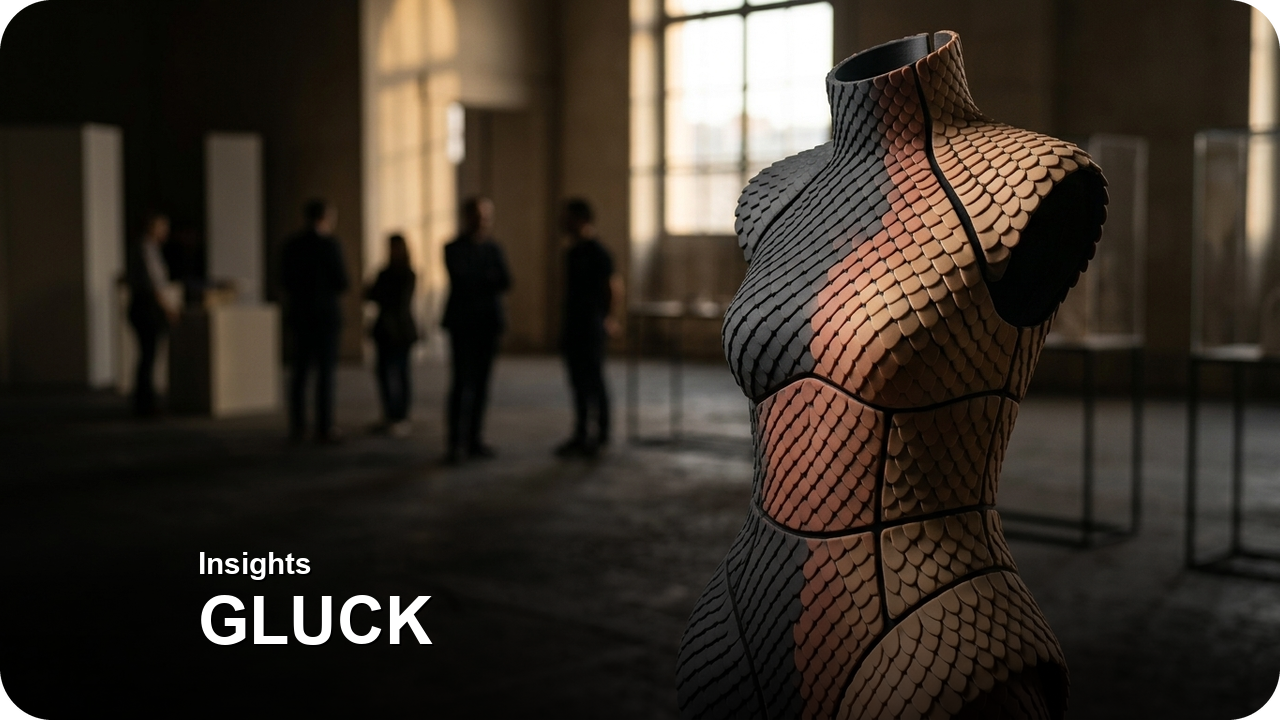
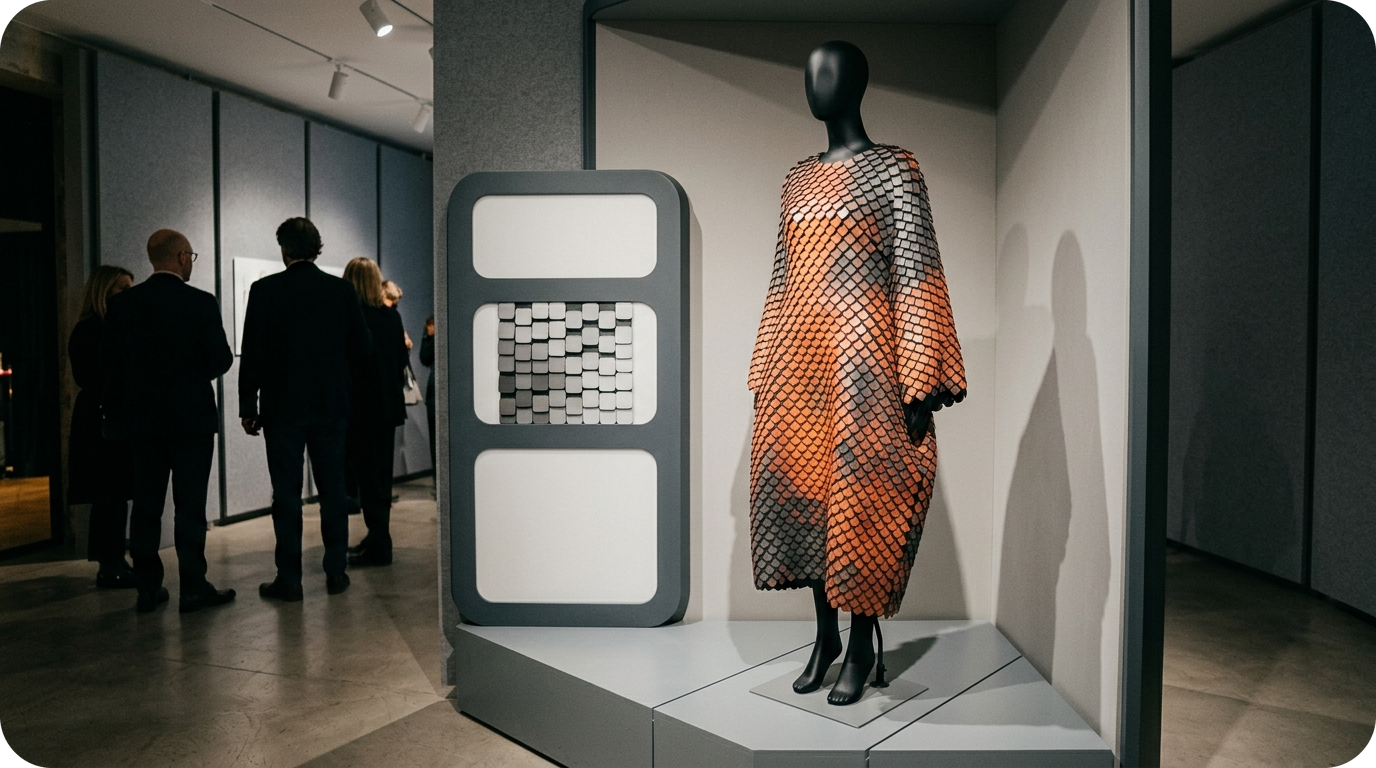
파리 패션위크 무대는 늘 새로운 소재와 기술의 각축장입니다. 그리고 anrealage(언리얼에이지)의 런웨이에서는 조명이 바뀔 때마다 드레스의 색이 통째로 변하는 장면이 등장했습니다. 디자이너 모리나가 쿠니히코가 선보인 이 의상은 한 벌에 최대 2,000개의 e-ink(전자잉크) 패널을 비늘처럼 촘촘히 덧붙여, 옷 전체가 하나의 디스플레이처럼 색을 바꿉니다.
화제의 중심은 색변환 기술이었지만, 제조 관점에서 더 흥미로운 지점은 따로 있습니다. 한 벌을 완성하기 위해 작고 복잡한 패널을 2,000개나 균일하게 만들어야 했다는 사실입니다. 이런 미세 조형 부품은 수량으로 보면 결코 적지 않지만, 그렇다고 금형을 파기에는 애매한 구간에 놓여 있습니다.
그렇다면 패션쇼나 전시용으로 수백~수천 개에 이르는 미세 조형 패널을, 금형 없이 반복·균일하게 양산하려면 어떤 공정이 맞을까요? 이 글에서는 anrealage 드레스를 '한정판 조형 부품 소량 반복생산'이라는 제조 문제로 바꿔 짚어봅니다.
anrealage 드레스를 덮은 2,000개 패널의 제조 문제
anrealage의 드레스가 색을 바꾸는 원리는 전자잉크 패널 하나하나가 신호에 따라 색을 전환하는 데 있습니다. 문제는 이 패널이 옷의 곡면을 따라 비늘처럼 겹쳐야 하므로, 평면이 아니라 미세하게 휘어진 조형 구조를 가져야 한다는 점입니다. 한 벌에 최대 2,000개가 들어가고, 컬렉션 단위로 보면 그 수는 훨씬 늘어납니다.
이런 부품을 기존 방식으로 만들려면 고민이 시작됩니다. 금형(사출)을 쓰면 개당 단가는 낮아지지만, 패널 형상 하나당 금형을 따로 파야 하고, 쇼마다 디자인이 바뀌는 패션 특성상 금형은 곧 사장됩니다. 문제는 두 가지로 압축됩니다.
- 자본지출과 리드타임: 복잡한 곡면 패널의 금형은 제작에 상당한 비용과 수 주의 시간이 들고, 패널 형상이 여러 종이면 비용은 그만큼 늘어납니다.
- 설계 변경과 MOQ: 런웨이 콘셉트는 시즌마다 바뀌는데, 금형은 한 번 파면 수정이 어렵고 최소주문수량(MOQ)의 벽에 부딪힙니다. 2,000개는 금형 양산 기준으로는 오히려 '어중간한' 수량입니다.
핵심은 수량이 적어서가 아니라, 형상이 복잡하고 자주 바뀌는데 수량까지 애매해서 금형이 맞지 않는다는 점입니다.

왜 '복잡한데 애매한 수량'이 가장 어려운 구간일까요?
제조에서 가장 난감한 영역은 흔히 '중간 수량·고복잡도' 구간입니다. 수십 개라면 수작업이나 CNC로 깎고, 수십만 개라면 금형을 파서 사출합니다. 그런데 수백~수천 개이면서 형상이 복잡하고 설계가 자주 바뀌는 조형 부품은 이 두 방식 사이 어디에도 깔끔하게 들어맞지 않습니다.
anrealage 드레스의 패널이 바로 그 전형입니다. CNC로 2,000개를 하나씩 깎기에는 리드타임이 감당되지 않고, 금형을 파기에는 수량과 변경 빈도 모두 부담입니다. 전시물이나 아트 프로젝트, 한정판 조형 굿즈에서 반복적으로 나타나는 구조이기도 합니다.
이 구간의 판단 기준은 절대 수량이 아니라 형상 다양성과 변경 빈도입니다. 같은 패널을 대량으로 변경 없이 찍는다면 사출이 답이지만, 복잡한 곡면 패널을 수백~수천 개, 그것도 디자인이 자주 바뀌는 조건으로 만들어야 한다면 접근 자체를 달리해야 합니다. 핵심은 '만들 수 있느냐'가 아니라 '복잡 형상을 균일하게, 변경을 감당하며 반복할 수 있느냐'입니다.
복잡 조형을 금형 없이 반복하는 산업용 SLA, 그리고 글룩
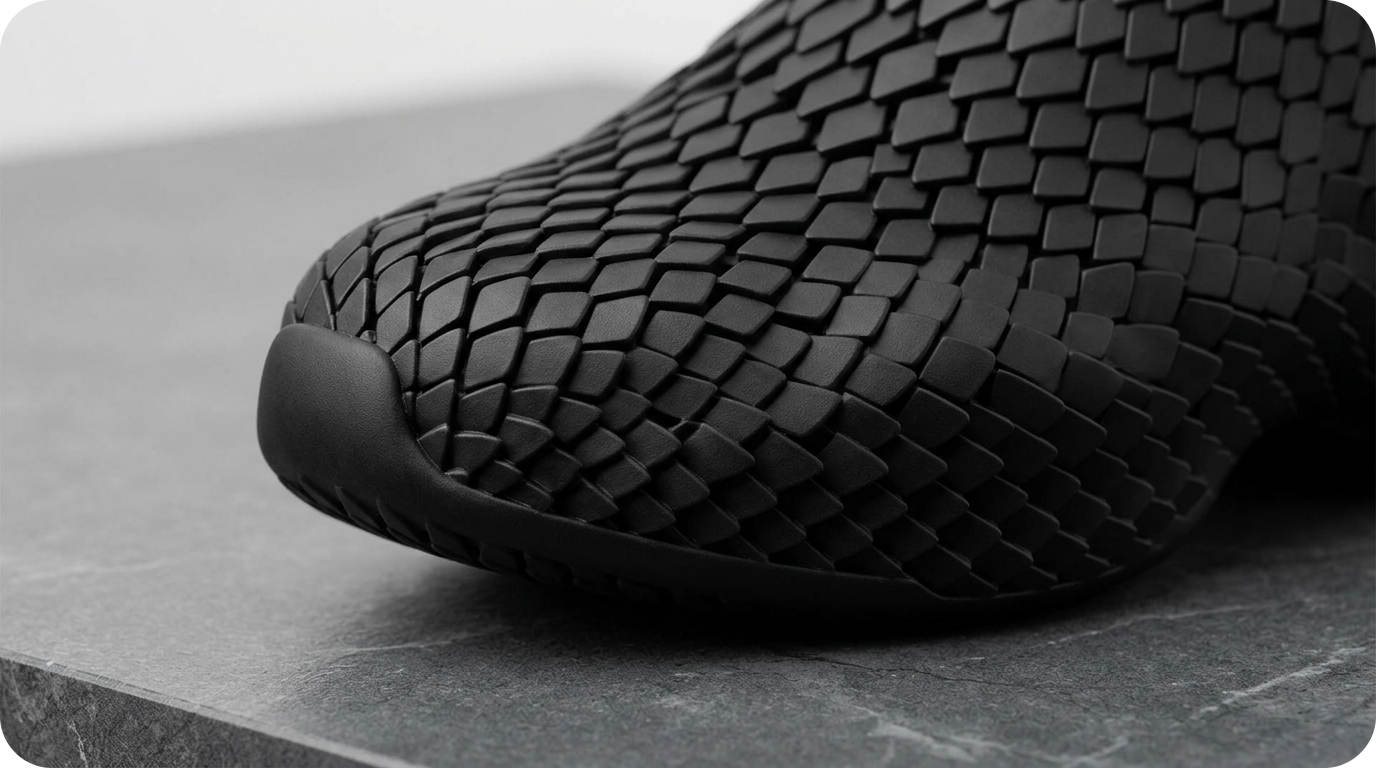
이런 '복잡한데 수량이 애매한' 조형 부품은 실제 산업 현장에서는 산업용 SLA 3D프린팅을 통해 구현될 수 있습니다. 금형을 파지 않고 디지털 설계 데이터에서 바로 성형하므로, 패널 형상이 바뀌어도 파일만 수정해 다시 출력하면 됩니다. 설계 변경이 잦은 런웨이·전시 프로젝트의 리듬과 맞는 방식입니다.
글룩은 45기의 산업용 SLA 3D프린터를 365일 24시간 운용하며, 금형 없이 동일 형상을 반복 성형하는 양산 체계를 갖추고 있습니다. 글룩의 산업용 SLA는 300mm 기준 최대 ±0.05mm의 정밀도와 Ra 0.8 수준의 표면조도를 구현하며, 후가공 시 사출품과 구별이 어려운 마감까지 가능합니다. 색이 투과·반사되는 패널처럼 표면이 품질을 결정하는 부품에서 특히 의미가 큰 강점입니다. 글룩은 이런 체계로 연간 23만 개 이상의 부품을 생산합니다.
이 역량은 패션쇼 패널에 국한되지 않습니다. 글룩은 대형 브랜드 조형물이나 전시용 향합처럼 곡면과 미세 디테일이 많은 복잡 조형물을 반복 양산한 경험을 갖추고 있어, anrealage 드레스 패널 같은 '한정판 조형 부품 소량 반복생산'과 직접 맞닿아 있습니다. 다만 SLA가 모든 경우에 맞는 것은 아닙니다. 형상이 완전히 고정되어 있고 수십만 개 규모로 동일 패널을 찍는다면 개당 단가에서 사출이 유리하고, 큰 하중을 견뎌야 하는 구조 부품이라면 금속이 적합합니다. SLA는 복잡 형상·다품종·잦은 변경이라는 조건에서 유력한 선택지가 됩니다.
그래서 처음의 질문으로 돌아가 봅니다. 수백~수천 개의 미세 조형 패널을 금형 없이 반복·균일하게 양산하려면 어떤 공정이 맞을까요. 형상이 복잡하고 디자인이 자주 바뀌며 수량이 금형 기준으로 애매한 구간이라면, 금형 없이 설계 변경을 그대로 흡수하며 복잡 조형을 균일하게 반복하는 산업용 SLA가 현실적인 답이 됩니다. anrealage의 2,000개 패널은 색변환 기술의 무대인 동시에, 복잡 조형 부품 반복생산이라는 제조 문제를 또렷하게 보여준 사례입니다.
GLUCK은 반복 생산이 가능한 산업용 SLA 3D프린팅 인프라를 기반으로
한정판 조형 부품과 전시·브랜드 조형물 개발과 양산 전환 과정에 필요한 3D프린팅 제조 솔루션을 지원하고 있습니다.
지금 글룩을 확인해보세요!
📩 글룩 홈페이지 & 온라인 견적: https://www.glucklab.com
📂 글룩 포트폴리오: 글룩 포트폴리오 확인하기
References
[1] designboom, "anrealage wraps dresses in up to 2,000 e-ink panels for color-changing 'skin'," designboom. Link: https://www.designboom.com/technology/anrealage-dresses-eink-panels-color-changing-skin-kunihiko-morinaga/
English Version
anrealage's Color-Changing Dress: How to Repeatedly Form 2,000 'Scales' Without a Mold
The Paris Fashion Week runway is always a proving ground for new materials and technologies. And anrealage's show featured dresses whose colors shifted entirely each time the lighting changed. Designed by Kunihiko Morinaga, each garment was covered with up to 2,000 e-ink panels arranged like scales, turning the entire dress into something resembling a display that changes color.
The spotlight fell on the color-changing technology, but the more intriguing point from a manufacturing perspective lies elsewhere: completing a single garment required producing 2,000 small, complex panels with uniform quality. In terms of quantity, such micro-formed parts are far from few—yet the volume is awkward for cutting a mold.
So, how do you repeatedly and uniformly mass-produce hundreds to thousands of micro-formed panels for a fashion show or exhibition, without a mold? In this article, we reframe the anrealage dress as a manufacturing problem of "repeated small-batch production of limited-edition sculptural parts."
The Manufacturing Problem Behind 2,000 Panels
The dress changes color because each e-ink panel switches hue in response to a signal. The challenge is that these panels must overlap like scales along the garment's curves—meaning they aren't flat, but subtly curved sculptural structures. Up to 2,000 go into a single garment, and across a full collection, the number grows far larger.
Making such parts the traditional way raises dilemmas. Injection molding lowers the per-unit cost, but each panel shape requires its own mold, and since fashion designs change with every show, the mold quickly becomes obsolete. The problem narrows to two points.
- Capital Expenditure and Lead Time: A mold for a complex curved panel takes considerable cost and weeks of time; with multiple panel shapes, the cost grows accordingly.
- Design Changes and MOQ: Runway concepts shift every season, yet molds are hard to modify once cut, and they run into minimum order quantity (MOQ) walls. By mold-based standards, 2,000 units is an "in-between" volume.
The key isn't that the quantity is small—it's that the shape is complex and frequently changing, while the volume itself is awkward, making molds a poor fit.
Why Is "Complex but Awkward-Volume" the Hardest Zone?
The trickiest territory in manufacturing is often the "mid-volume, high-complexity" zone. A few dozen units can be hand-finished or CNC-machined; hundreds of thousands justify a mold for injection. But sculptural parts numbering in the hundreds to thousands—complex in shape and frequently redesigned—fit neatly into neither method.
anrealage's panels are a textbook case. Carving 2,000 units one by one via CNC is unmanageable in lead time, while cutting a mold burdens both volume and change frequency. This structure recurs often in exhibition pieces, art projects, and limited-edition sculptural goods.
The judgment criterion here isn't absolute quantity but shape diversity and change frequency. If you print identical panels in large volumes with no changes, injection is the answer; but if you must make complex curved panels in the hundreds to thousands, with designs that shift often, the approach itself must change. The core is not "can it be made," but "can complex shapes be repeated uniformly while absorbing change."
Industrial SLA—and GLUCK—That Repeat Complex Shapes Without a Mold
In real industrial settings, such "complex yet awkward-volume" sculptural parts can be realized through industrial SLA 3D printing. Since parts are formed directly from digital design data without cutting a mold, a changed panel shape simply needs a file revision and a reprint. This matches the rhythm of runway and exhibition projects, where design changes are frequent.
GLUCK operates 45 industrial SLA 3D printers around the clock, 365 days a year, with a production system that repeatedly forms identical shapes without molds. GLUCK's industrial SLA achieves precision up to ±0.05mm per 300mm and surface roughness around Ra 0.8, with post-processing that yields a finish hard to distinguish from injection-molded parts. This is an especially meaningful strength for parts like panels, where color transmission and reflection make surface quality decisive. Through this system, GLUCK produces over 230,000 parts annually.
This capability isn't limited to fashion-show panels. GLUCK has experience repeatedly producing complex sculptural works—large brand objects and exhibition incense vessels full of curves and fine detail—placing it directly alongside the "repeated small-batch production of limited-edition sculptural parts" like anrealage's dress panels. That said, SLA is not the fit for every case. If shapes are fully fixed and hundreds of thousands of identical panels are needed, injection wins on per-unit cost; for structural parts bearing heavy loads, metal is better. SLA becomes a compelling option under the conditions of complex shapes, high variety, and frequent change.
So let's return to the opening question: how do you repeatedly and uniformly mass-produce hundreds to thousands of micro-formed panels without a mold? When shapes are complex, designs change often, and volume is awkward by mold standards, industrial SLA—which absorbs design changes without a mold while repeating complex forms uniformly—becomes the realistic answer. anrealage's 2,000 panels were both a stage for color-changing technology and a vivid illustration of the manufacturing problem of repeated sculptural-part production.
GLUCK supports the development and transition to mass production of limited-edition sculptural parts and exhibition/brand objects, based on an industrial SLA 3D printing infrastructure capable of repeatable production.
Check out GLUCK now!
📩 GLUCK Website & Online Quote: https://www.glucklab.com
📂 GLUCK Portfolio: View GLUCK Portfolio
References
[1] designboom, "anrealage wraps dresses in up to 2,000 e-ink panels for color-changing 'skin'," designboom. Link: https://www.designboom.com/technology/anrealage-dresses-eink-panels-color-changing-skin-kunihiko-morinaga/
#글룩 #GLUCK #3D프린팅 #산업용3D프린팅 #SLA3D프린팅 #대량생산 #조형물양산 #한정판조형 #패션테크 #복잡형상 #금형없이반복생산 #DfAM #3DPrinting #SLA3DPrinting #AdditiveManufacturing #MassProduction #FashionTech #SculpturalParts #anrealage
'인사이트 (Insights)' 카테고리의 다른 글
| 프린터를 안 사고도 부품을 찍는다 : AM 서비스 시장이 25억 달러에 다가선 이유 (0) | 2026.09.30 |
|---|---|
| 저가 드론이 방위 제조에 던진 질문 : '얼마나 빠르게, 얼마나 유연하게' 만드느냐 (0) | 2026.09.28 |
| 로봇 부품 3개 중 1개는 '긴급'으로 찍힌다 : 로보틱스 개발이 만든 제조 병목 (0) | 2026.09.23 |
| NFL 선수 97%가 쓰는 맞춤 헬멧, 머리마다 다른 형태를 대량으로 찍어내는 법 (0) | 2026.09.22 |
| 미 해군이 42,000명에게 지급하는 '귀 스캔 맞춤 청력보호구', 개별 형상을 양산으로 바꾸는 방법 (0) | 2026.09.21 |