
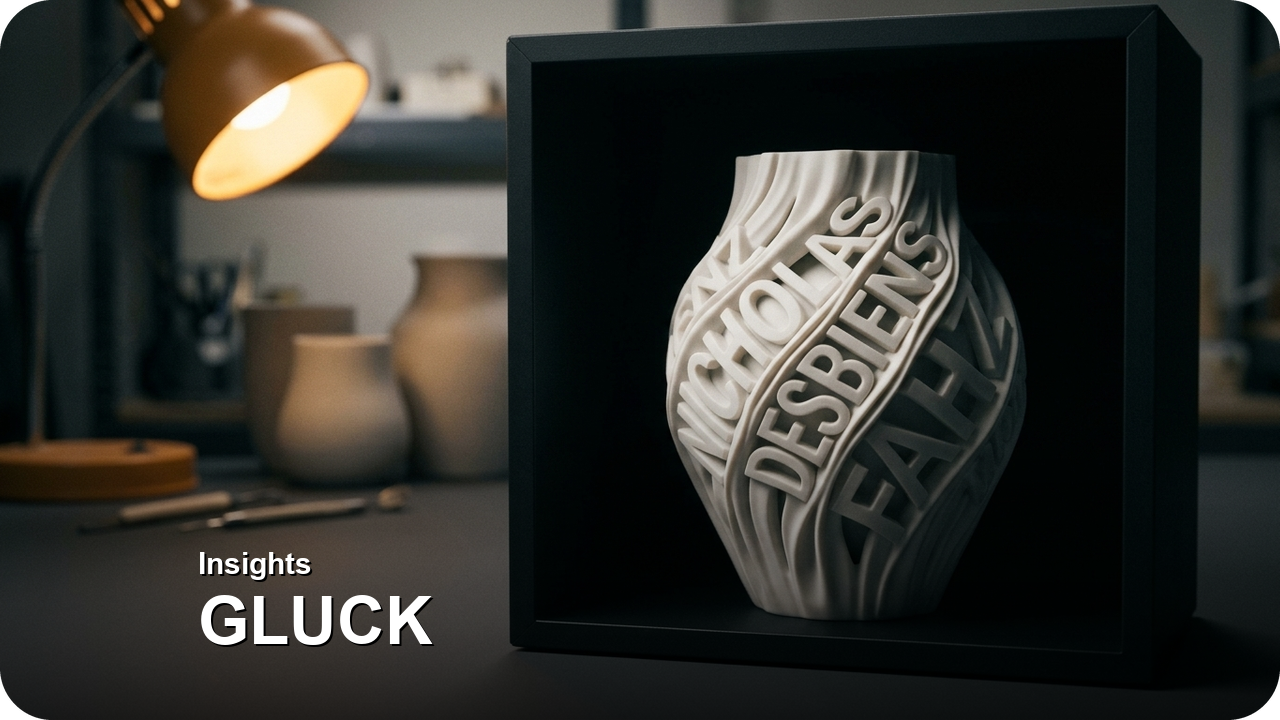
요즘 굿즈 시장을 보면 흐름이 뚜렷합니다. '똑같은 물건을 많이'가 아니라 '나만을 위한 하나'로 무게 중심이 옮겨가고 있습니다. 이름, 얼굴, 반려동물, 기념일처럼 개인의 데이터가 곧 제품의 형태가 되는 시도가 늘어나고 있고, 소비자도 자기 이야기가 담긴 물건에 기꺼이 지갑을 엽니다.
최근 브루클린의 건축가이자 컴퓨테이셔널 디자이너인 니콜라스 데비앙스(Nicholas Desbiens)가 선보인 'Fahz 2.0'은 이 흐름을 한눈에 보여주는 사례입니다. 스마트폰으로 찍은 옆얼굴 사진을 올리면 소프트웨어가 그 윤곽을 자동으로 3D 모델로 변환하고, 그렇게 만들어진 화병이 주문 단위로 생산돼 배송됩니다. 2015년 첫 버전에서는 데비앙스가 포토샵으로 얼굴 윤곽을 일일이 따고 포장·배송까지 직접 했지만, 2.0은 이 과정을 거의 완전히 자동화했습니다.
흥미로운 건 이게 단순한 '신기한 굿즈' 이야기가 아니라는 점입니다. 주문마다 형상이 전부 다른 제품을, 금형도 재고도 없이, 들어오는 주문만큼만 만들어 보내야 한다는 건 꽤 까다로운 제조 과제입니다. 모두 다른 형상의 제품을 어떻게 금형 없이 수량에 맞춰 양산할 수 있을까요? 이 글에서는 Fahz 2.0을 제조 관점에서 풀어, 개인 맞춤 오브제 양산이 성립하는 조건을 짚어봅니다.
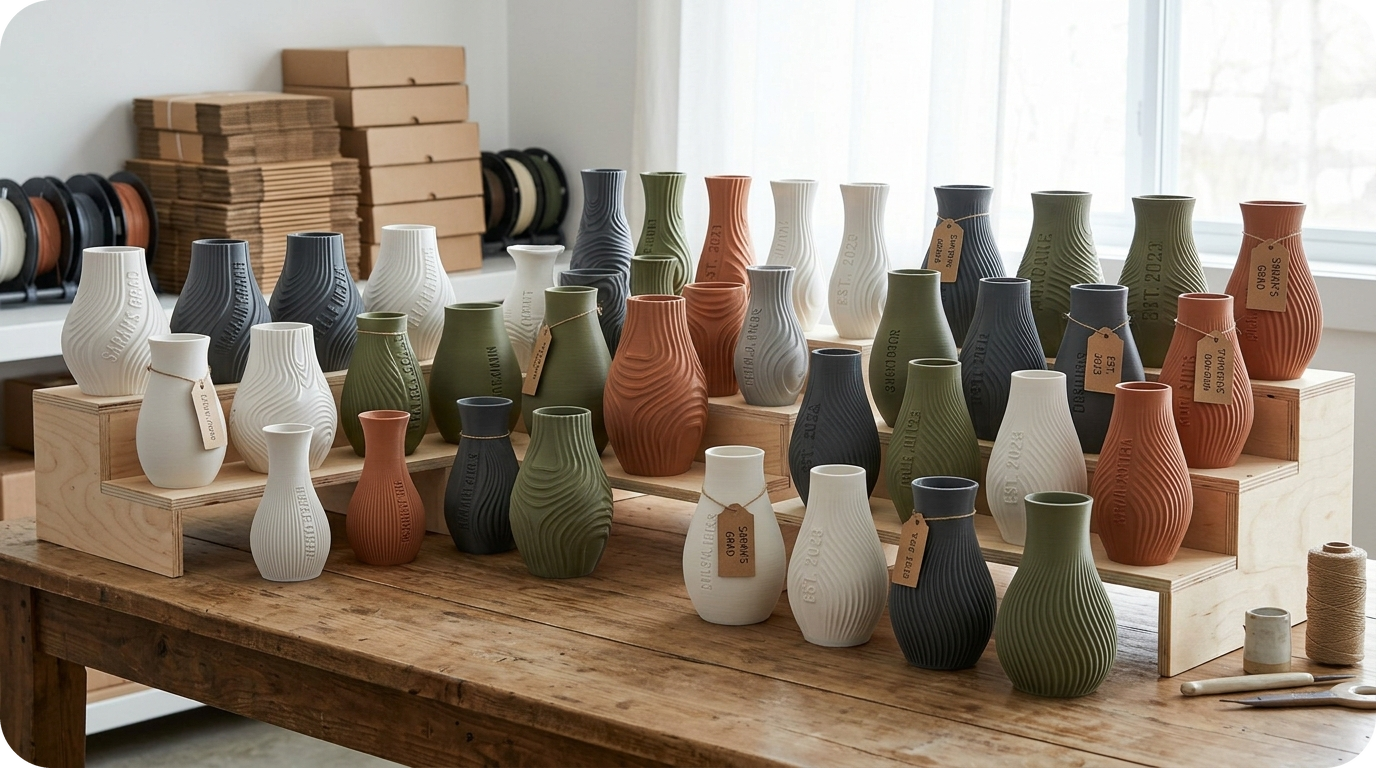
사진 한 장이 곧 설계가 되는 화병, Fahz 2.0
Fahz는 마주 본 두 옆얼굴 실루엣이 하나의 화병 윤곽을 이루는 '루빈의 꽃병(Rubin's vase)' 착시 원리를 사용합니다. 데비앙스는 2014년 아내를 위한 선물로 이 개념을 처음 만들었고, 2015년 첫 킥스타터 캠페인에서 브루클린 아파트에 놓인 3D프린터 2대로 1,000개가 넘는 맞춤 화병을 생산했습니다.
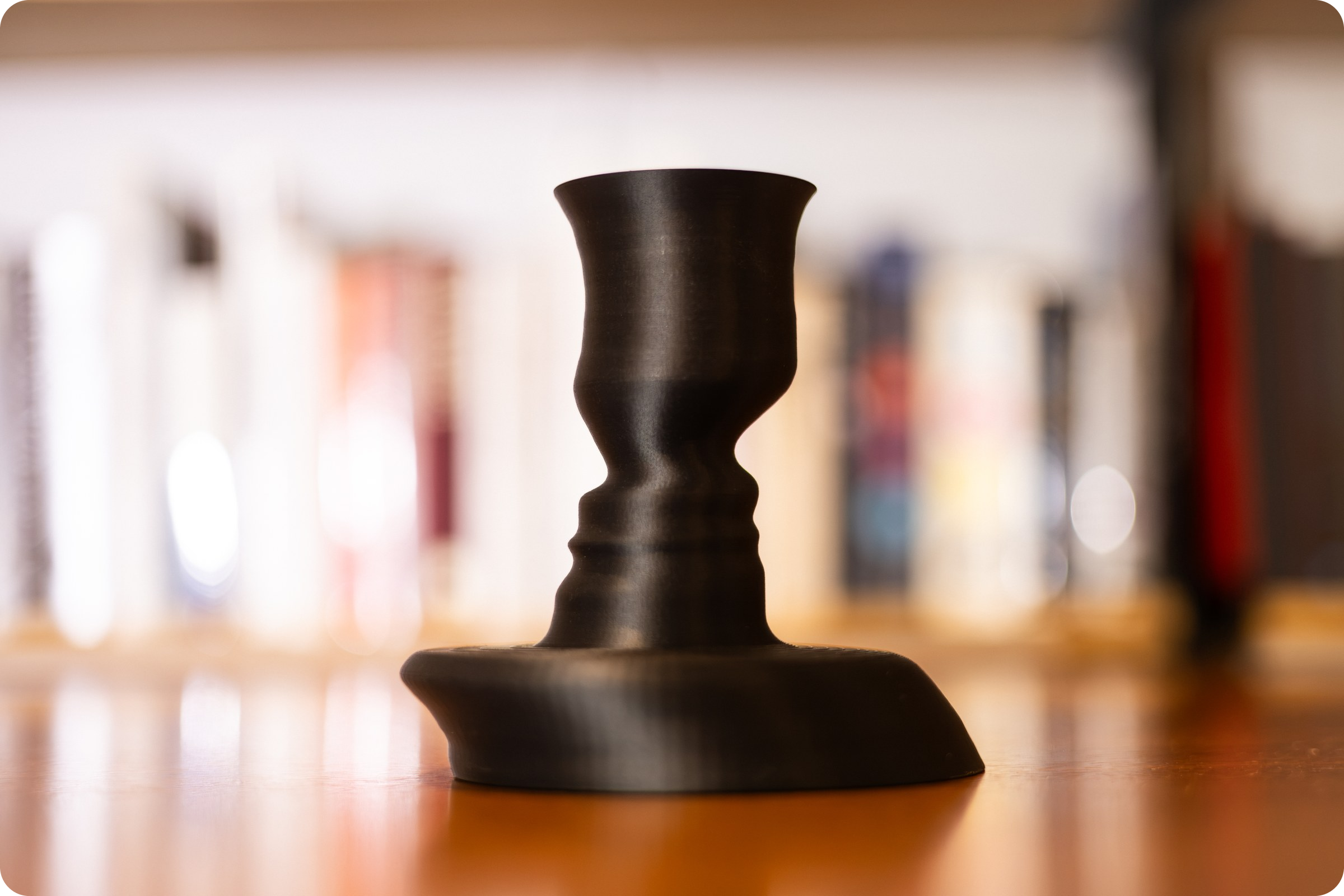
문제는 '제품 하나하나가 다 다르다'는 데 있었습니다. 형상이 매번 바뀌니 금형을 만들 수가 없고, 어떤 얼굴이 주문될지 모르니 재고를 미리 쌓아둘 수도 없습니다. 초판에서는 형상 생성은 라이노·그래스호퍼로 자동화했지만, 고객의 얼굴 윤곽을 포토샵에서 손으로 따는 작업과 포장·배송은 사람이 전부 떠안아야 했습니다. 결국 2018년 주문을 중단한 이유도 "프린터가 어려운 게 아니라, 그 이후의 모든 것이 어려웠다"는 데 있었습니다.
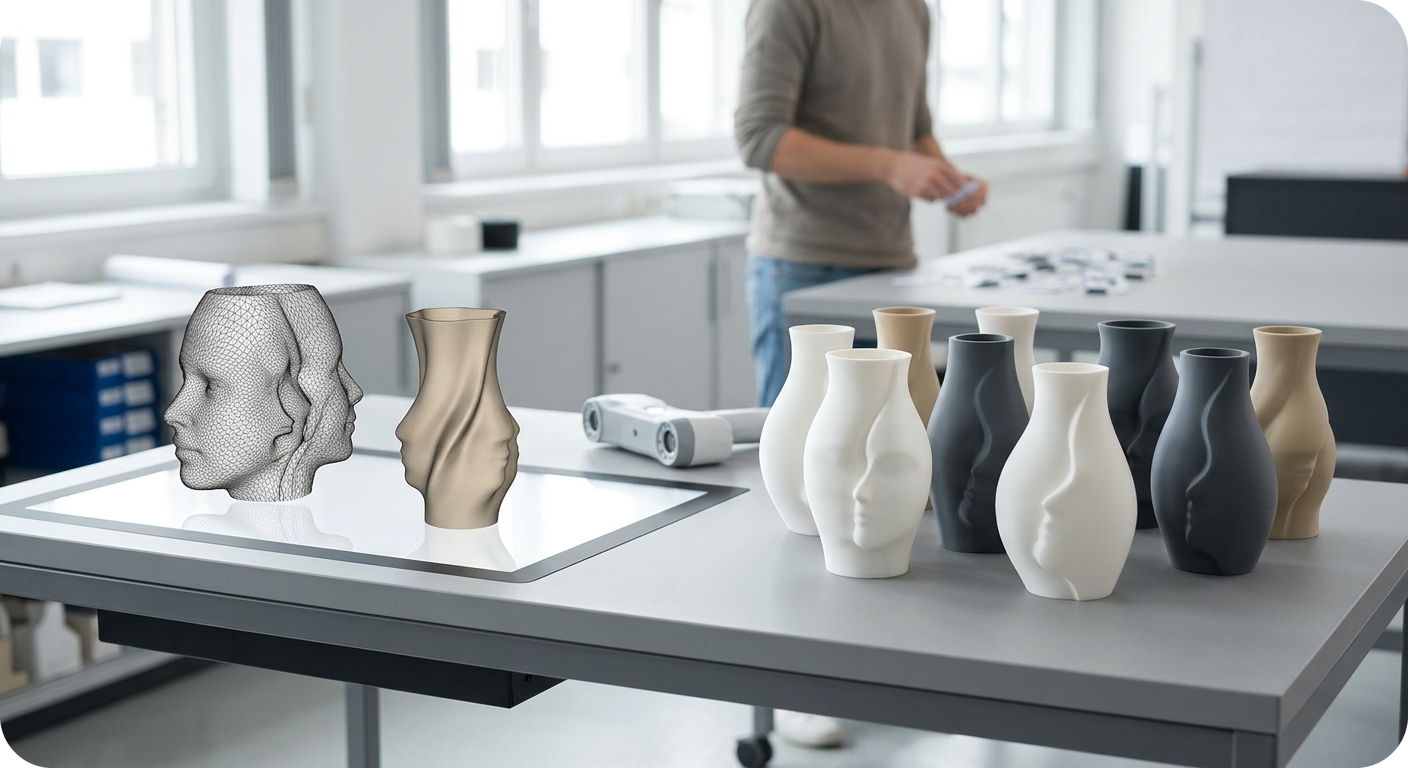
8초 만에 주문에서 생산으로 — 자동화가 바꾼 것
Fahz 2.0은 이 병목을 소프트웨어와 외부 생산 서비스 연결로 풀었습니다. 고객은 브라우저에서 최대 6명의 옆얼굴 사진을 올리고, 소프트웨어가 이를 검증해 자동으로 기하학적 윤곽으로 바꿉니다. 웹 서버에서 바로 출력용 메시가 생성되므로, 사람이 CAD를 만지는 과정이 사라집니다. 사용자는 완성될 화병을 돌려보고 얼굴 위치를 재배치한 뒤 구매할 수 있습니다.
주문이 끝나면 생산 파일과 배송 정보가 API를 통해 미국의 3D프린팅 서비스 업체 Slant 3D로 곧장 전달됩니다. 데비앙스는 초기 주문 하나가 고객의 휴대폰에서 프린트 팜까지 사람 손을 전혀 거치지 않고 8초 만에 넘어갔다고 전했습니다. 각 화병은 서포트 없이 FDM으로 출력되도록 구성되고, 일련번호와 얼굴 위치 마커가 새겨지며, 배송은 주문 후 약 2주로 예상됩니다.
- 형상이 다른데도 '자동 생산': 모든 주문의 형상이 제각각이어도, 데이터가 바로 생산 파일로 변환돼 한 명이 운영하는 맞춤 양산이 성립합니다.
- 재고 없는 온디맨드: 어떤 얼굴이 주문될지 미리 알 수 없으므로 재고를 쌓지 않고, 들어온 주문만큼만 생산해 재고 리스크를 없앱니다.
이 구조는 화병에만 머물지 않습니다. 캐나다의 Mosaic Manufacturing은 환자별 맞춤 보조기를 작업 대기열로 연속 생산하는 벨트 기반 플랫폼 'Orion'을 내놨고, 영국의 XYZO는 얼굴 스캔과 CAD 생성을 결합한 맞춤 수면무호흡 마스크 워크플로를 검토 중입니다. 개인 데이터를 제품 형상으로 바꾸고, 그걸 사람 손을 거의 거치지 않고 생산까지 잇는다는 공통 과제가 여러 분야에서 동시에 다뤄지고 있는 셈입니다.
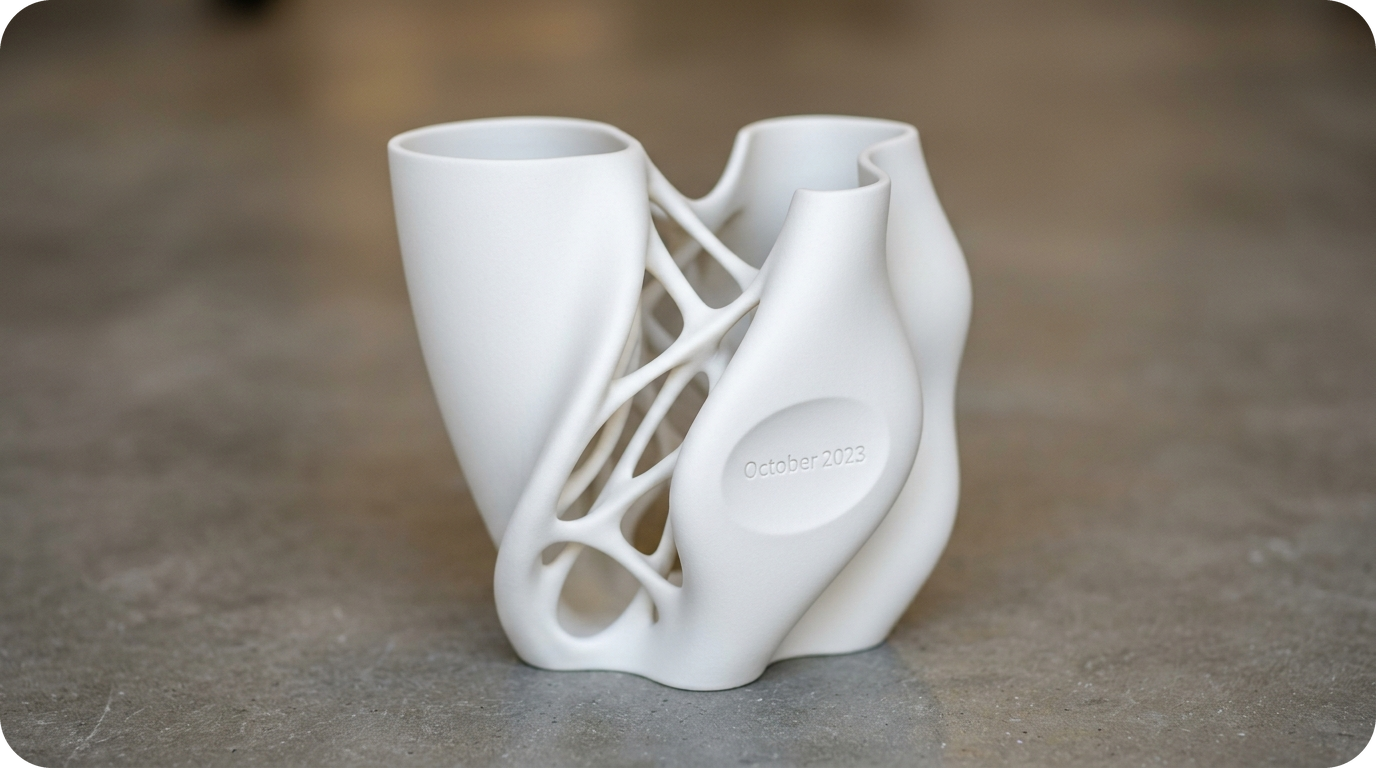
개별 형상 양산을 뒷받침하는 산업용 SLA, 그리고 글룩
Fahz 2.0이 보여준 '형상이 전부 다른 제품을 금형 없이 주문 단위로' 만드는 방식은, 실제 산업 현장에서는 산업용 SLA 3D프린팅으로 한층 정밀하게 구현될 수 있습니다. SLA가 유리한 지점은 명확합니다. 형상이 제각각일수록 금형 방식은 성립하지 않는데, SLA는 디지털 데이터만 바꾸면 추가 비용 없이 다른 형상을 이어서 생산할 수 있기 때문입니다.
글룩은 이 '개별 맞춤 양산' 과제를 실제로 다뤄 왔습니다. 박물관 굿즈나 향합처럼 복잡한 형상의 오브제를 반복 생산한 경험이 있고, 맞춤 데이터를 생산으로 바로 잇는 작업에도 익숙합니다. 글룩의 산업용 SLA는 300mm 기준 최대 ±0.05mm의 정밀도와 Ra 0.8 수준의 표면조도를 구현하며, 후가공을 거치면 사출품과 구별이 어려운 마감을 얻을 수 있습니다. 화병이나 오브제처럼 표면이 곧 제품의 가치가 되는 굿즈에서 특히 의미가 큰 부분입니다. 글룩은 산업용 SLA 3D프린터 45기를 365일 24시간 운용해 연간 23만 개 이상의 부품을 생산하며, 주문 수량에 맞춰 납기를 조정합니다.
다만 SLA가 모든 경우에 맞는 답은 아닙니다. 수만 개가 완전히 똑같은 형상이고 단가를 끝까지 낮춰야 한다면, 금형을 한 번 만들어 찍어내는 사출이 더 유리합니다. 판단의 기준은 '몇 개냐'가 아니라 '형상이 얼마나 다른가'입니다. 형상이 제각각인 맞춤 굿즈라면 수량과 무관하게 금형 없는 반복생산이 현실적인 선택지가 됩니다.
그렇다면 처음의 질문, 모두 다른 형상의 제품을 금형 없이 수량에 맞춰 양산하는 일은 가능할까요. Fahz 2.0은 '설계 자동화 + 금형 없는 생산'이라는 두 축이 맞물릴 때 1인 1제품 양산도 돌아간다는 걸 보여줍니다. 개인의 데이터가 곧 디자인이 되는 굿즈를 재고 없이 주문 단위로 만들고 싶다면, 형상 다양성을 그대로 받아내는 산업용 SLA가 그 출발점이 될 수 있습니다.
GLUCK은 반복 생산이 가능한 산업용 SLA 3D프린팅 인프라를 기반으로
맞춤형 굿즈·오브제 개발과 양산 전환 과정에 필요한 3D프린팅 제조 솔루션을 지원하고 있습니다.
지금 글룩을 확인해보세요!
📩 글룩 홈페이지 & 온라인 견적: https://www.glucklab.com
📂 글룩 포트폴리오: 글룩 포트폴리오 확인하기
References
[1] 3D Printing Industry, "Fahz 2.0 brings automated design and on-demand 3D printing to personalized vases," 3dprintingindustry.com. Link: https://3dprintingindustry.com/news/fahz-2-0-brings-automated-design-and-on-demand-3d-printing-to-personalized-vases-255614/
English Version
A Vase Completed From a Single Photo: How Fahz 2.0 Shows '1 Person, 1 Product' Automated Production
Looking at today's merchandise market, the trend is clear. The center of gravity is shifting from "many identical items" to "one made just for me." Attempts where personal data—a name, a face, a pet, an anniversary—becomes the very form of a product are increasing, and consumers are happily paying for items that carry their own story.
Fahz 2.0, recently unveiled by Brooklyn-based architect and computational designer Nicholas Desbiens, is a case that captures this trend at a glance. Upload a side-profile photo taken on a smartphone, and software automatically converts the outline into a 3D model; the resulting vase is produced per order and shipped. In the first version launched in 2015, Desbiens traced each facial profile by hand in Photoshop and handled packaging and shipping himself—but version 2.0 has almost fully automated this process.
What's interesting is that this isn't simply a "novelty merchandise" story. Producing items whose shape differs with every order, without molds or inventory, making only as many as the orders that come in, is a fairly demanding manufacturing challenge. How can you mass-produce products that are all shaped differently, without molds, matched to quantity? This article interprets Fahz 2.0 from a manufacturing perspective to examine the conditions under which personalized object production holds up.
The Vase Where a Single Photo Becomes the Design: Fahz 2.0
Fahz uses the "Rubin's vase" optical illusion, in which two facing silhouettes form the outline of a vase. Desbiens first created the concept in 2014 as a gift for his wife, and in the first 2015 Kickstarter campaign he produced more than 1,000 personalized vases using two 3D printers in his Brooklyn apartment.
The problem lay in the fact that "every product is different." Since the shape changes each time, no mold can be made, and since you don't know which face will be ordered, you can't stock inventory in advance. In the first edition, geometry generation was automated with Rhino and Grasshopper, but tracing each customer's facial outline in Photoshop, along with packaging and shipping, fell entirely on a person. The reason he stopped taking orders in 2018 was precisely that "the printer was never the hard part—everything after it was."
From Order to Production in Eight Seconds: What Automation Changed
Fahz 2.0 solved this bottleneck by connecting software with an external production service. Customers upload side-profile photos of up to six people in the browser, and the software verifies and automatically converts them into geometric profiles. Because the printable mesh is generated directly on the web server, the step of a human touching CAD disappears. Users can rotate the final vase, rearrange face positions, and then purchase.
Once an order is complete, the production file and shipping information are sent directly to U.S. 3D printing service provider Slant 3D via API. Desbiens noted that one early order moved from the customer's phone to the print farm in eight seconds without any human intervention. Each vase is configured for support-free FDM printing, engraved with a serial number and face-position markers, and delivery is estimated at about two weeks after ordering.
- "Automated production" despite differing shapes: Even when every order's shape is different, the data converts directly into a production file, allowing a mass-customization business run by a single person to work.
- On-demand with zero inventory: Since it's impossible to know in advance which face will be ordered, no stock is held and only as many as ordered are produced, eliminating inventory risk.
This structure isn't limited to vases. Canada's Mosaic Manufacturing released 'Orion,' a belt-based platform that continuously produces patient-specific orthotics through job queues, and the UK's XYZO is studying a personalized sleep apnea mask workflow combining facial scanning and CAD generation. The shared challenge—turning personal data into product form and connecting it all the way to production with almost no human intervention—is being tackled across multiple fields at once.
The Industrial SLA—and GLUCK—Behind Individualized Production
The way Fahz 2.0 makes "products all shaped differently, per order, without molds" can be realized even more precisely in actual industrial settings through industrial SLA 3D printing. The advantage of SLA is clear: the more varied the shapes, the less the mold approach holds up—whereas SLA can continue producing different shapes with no added cost simply by changing the digital data.
GLUCK has actually handled this "individualized production" challenge. It has experience repeatedly producing complex-shaped objects such as museum merchandise and incense cases, and is familiar with connecting custom data directly to production. GLUCK's industrial SLA achieves a precision of up to ±0.05mm (based on 300mm) and surface roughness around Ra 0.8, and with post-processing it can reach a finish hard to distinguish from injection-molded parts. This is especially meaningful for merchandise like vases and objects, where the surface itself becomes the product's value. GLUCK operates 45 industrial SLA 3D printers 24 hours a day, 365 days a year, producing over 230,000 parts annually and adjusting delivery to match order quantity.
That said, SLA is not the answer in every case. If tens of thousands of units share exactly the same shape and unit cost must be driven down as far as possible, injection molding—making one mold and stamping out parts—is more advantageous. The criterion is not "how many" but "how different the shapes are." For personalized merchandise with varying shapes, mold-free repeatable production becomes the realistic choice regardless of quantity.
So, returning to the opening question—is it possible to mass-produce products that are all shaped differently, without molds, matched to quantity? Fahz 2.0 shows that when the two axes of "design automation + mold-free production" mesh, even 1-person, 1-product manufacturing can run. If you want to make merchandise where personal data becomes the design, per order and without inventory, industrial SLA that absorbs shape diversity as-is can be the starting point.
GLUCK supports the 3D printing manufacturing solutions needed for the development and mass-production transition of customized merchandise and objects, based on industrial SLA 3D printing infrastructure capable of repeatable production.
Check out GLUCK now!
📩 GLUCK Website & Online Quote: https://www.glucklab.com
📂 GLUCK Portfolio: View GLUCK Portfolio
References
[1] 3D Printing Industry, "Fahz 2.0 brings automated design and on-demand 3D printing to personalized vases," 3dprintingindustry.com. Link: https://3dprintingindustry.com/news/fahz-2-0-brings-automated-design-and-on-demand-3d-printing-to-personalized-vases-255614/
#글룩 #GLUCK #3D프린팅 #산업용3D프린팅 #SLA3D프린팅 #맞춤형굿즈 #매스커스터마이제이션 #온디맨드양산 #파라메트릭디자인 #금형없는양산 #오브제양산 #3DPrinting #SLA3DPrinting #AdditiveManufacturing #MassCustomization #OnDemandManufacturing #PersonalizedProducts #ParametricDesign
원문 기사 이미지 출처
'인사이트 (Insights)' 카테고리의 다른 글
| 로봇 고객 매출이 1년 만에 2배로 : 로봇 부품 조달의 변화 (0) | 2026.10.02 |
|---|---|
| anrealage 색변환 드레스 : 2,000개 '비늘'을 금형 없이 반복 성형하는 법 (0) | 2026.10.01 |
| 프린터를 안 사고도 부품을 찍는다 : AM 서비스 시장이 25억 달러에 다가선 이유 (0) | 2026.09.30 |
| 저가 드론이 방위 제조에 던진 질문 : '얼마나 빠르게, 얼마나 유연하게' 만드느냐 (0) | 2026.09.28 |
| 로봇 부품 3개 중 1개는 '긴급'으로 찍힌다 : 로보틱스 개발이 만든 제조 병목 (0) | 2026.09.23 |