

맞춤 의족과 보조기는 그동안 3D프린팅이 가장 잘 해낸 분야 중 하나로 꼽혀 왔습니다. 환자의 몸을 스캔해 디지털로 설계하고, 그 데이터를 그대로 출력하면 한 사람에게 꼭 맞는 소켓이나 보조기를 만들 수 있기 때문입니다. 과거에는 숙련된 기공사가 손으로 하던 작업이 상당 부분 디지털로 넘어왔고, 이 분야에서 SLA가 쓰인 역사는 1990년 노스웨스턴대학과 박스터 헬스케어의 의족 소켓 실험까지 거슬러 올라갑니다.
그런데 최근 HP와 DyeMansion은 이 분야의 다음 벽이 '출력'이 아니라 '양산'이라고 짚었습니다. 좋은 맞춤 의료기기 하나를 만드는 것과, 품질과 비용을 지키면서 그런 기기를 수백 개씩 꾸준히 만들어내는 것은 완전히 다른 문제라는 지적입니다. 프린터 한 대에서 좋은 결과물을 얻는 것은 전체 과정의 일부일 뿐, 매일 반복해도 흔들리지 않는 신뢰성 있는 공정을 짜는 것이 진짜 과제라는 것입니다.
여기서 자연스럽게 떠오르는 질문이 있습니다. 환자마다 형상이 다른 맞춤 의료기기를, 일관된 품질을 유지하면서 대규모로 양산하려면 무엇이 필요할까요? 이 글에서는 HP·DyeMansion이 던진 문제를 맞춤 양산(Mass Customization)이라는 제조 관점에서 정리해 봅니다.
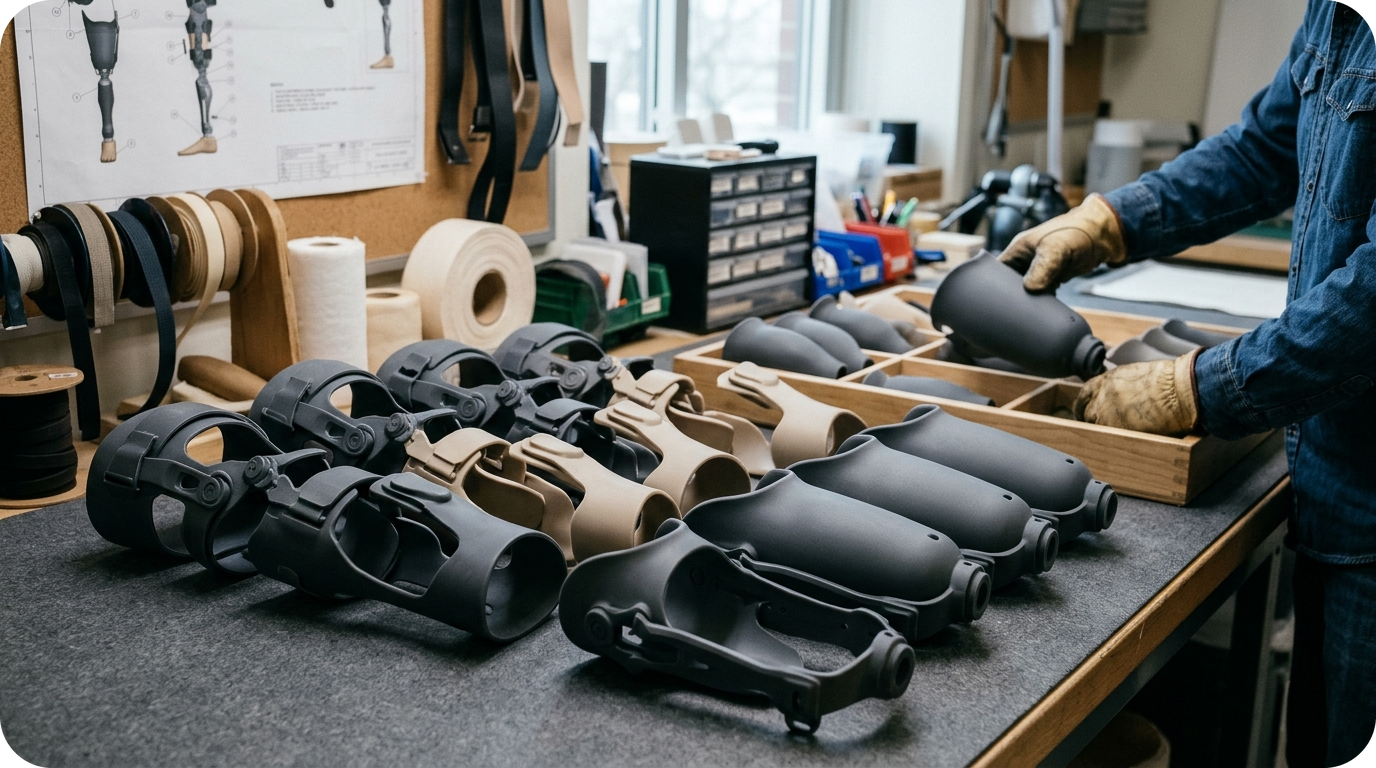
맞춤 의료기기가 양산에서 부딪히는 벽
일반적인 제조는 같은 부품 수천 개를 똑같이 찍어내는 일입니다. 반면 의족과 보조기는 환자마다 설계가 전부 달라야 합니다. 같은 종류의 보조기라도 두 사람에게 똑같은 설계가 맞지 않는 경우가 대부분입니다. 이 지점이 3D프린팅이 이 산업과 잘 맞는 이유이기도 합니다. 설계마다 별도의 금형이나 공구를 만들지 않고도 서로 다른 형상을 바로 생산할 수 있기 때문입니다.
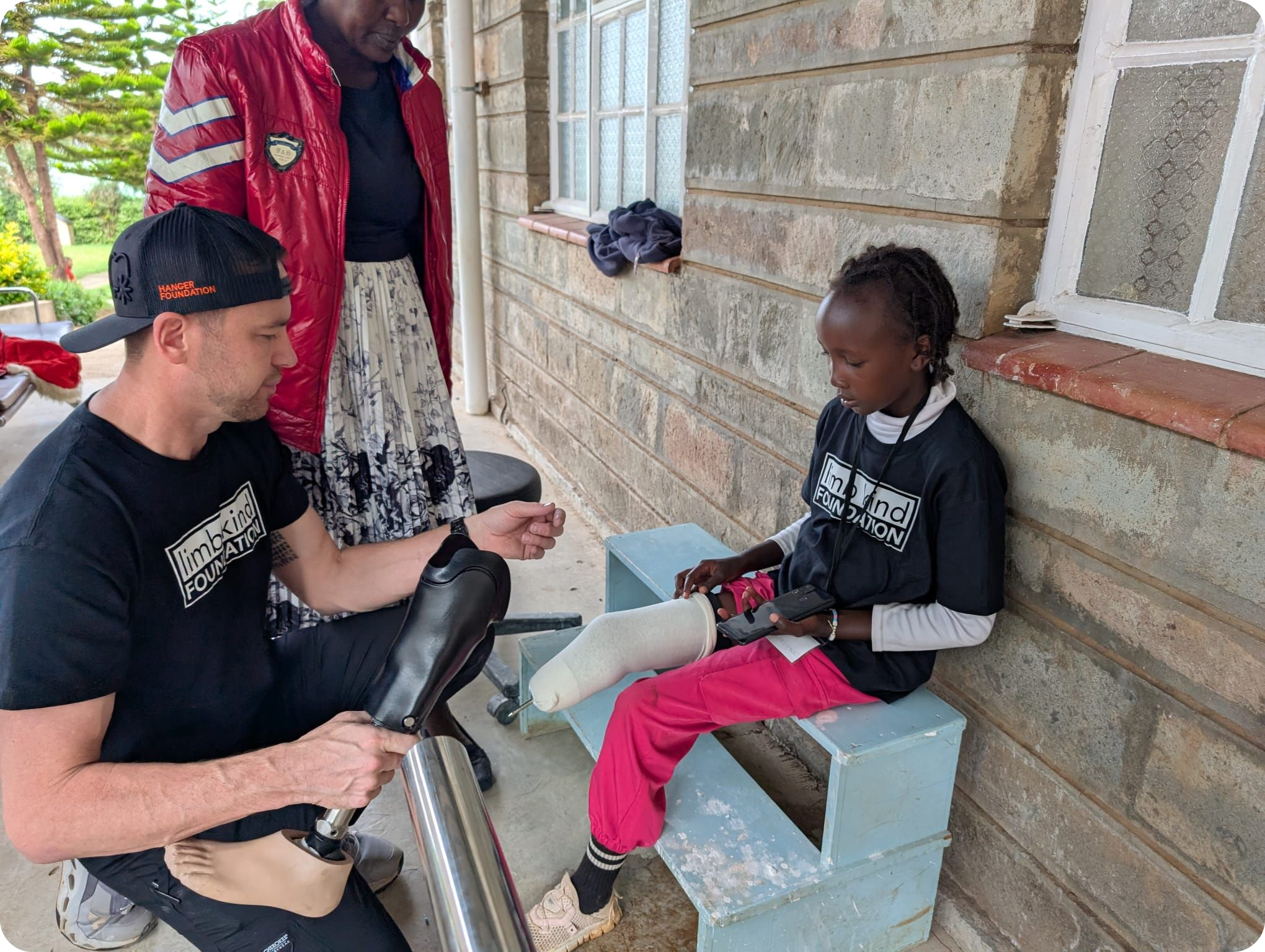
문제는 그 유연함이 그대로 양산의 부담으로 돌아온다는 점입니다. 기존 방식으로 환자마다 다른 형상을 만들려면 개별 몰드가 필요하거나 수작업 비중이 커졌습니다. 금형 없이 출력으로 넘어가도 과제는 남습니다. 모든 기기가 환자의 요구를 충족하는지 하나하나 검증해야 하고, 맞춤 주문이 늘어날수록 어느 부품이 누구의 것인지 관리하기가 급격히 어려워집니다.
- 형상이 매번 다름: 환자별로 설계가 전부 달라 '동일 부품 반복'이라는 양산의 전제가 성립하지 않습니다. 설계 데이터 관리와 부품 추적이 곧 품질 문제로 직결됩니다.
- 출력 전후 작업이 핵심: 3D프린팅은 제조 단계를 줄여주지만, 출력 전 설계·검증과 출력 후 세척·마감 작업은 그대로 남습니다. 하루 종일 착용하는 기기일수록 이 후가공 품질이 완성도를 좌우합니다.
결국 이 분야의 과제는 프린터가 얼마나 빠른지, 몇 개를 찍는지가 아닙니다. 소재, 인력, 품질 검사, 개별 부품 추적, 그리고 완성품 하나당 비용까지 전 공정을 하나의 반복 가능한 흐름으로 엮어내는 일입니다.
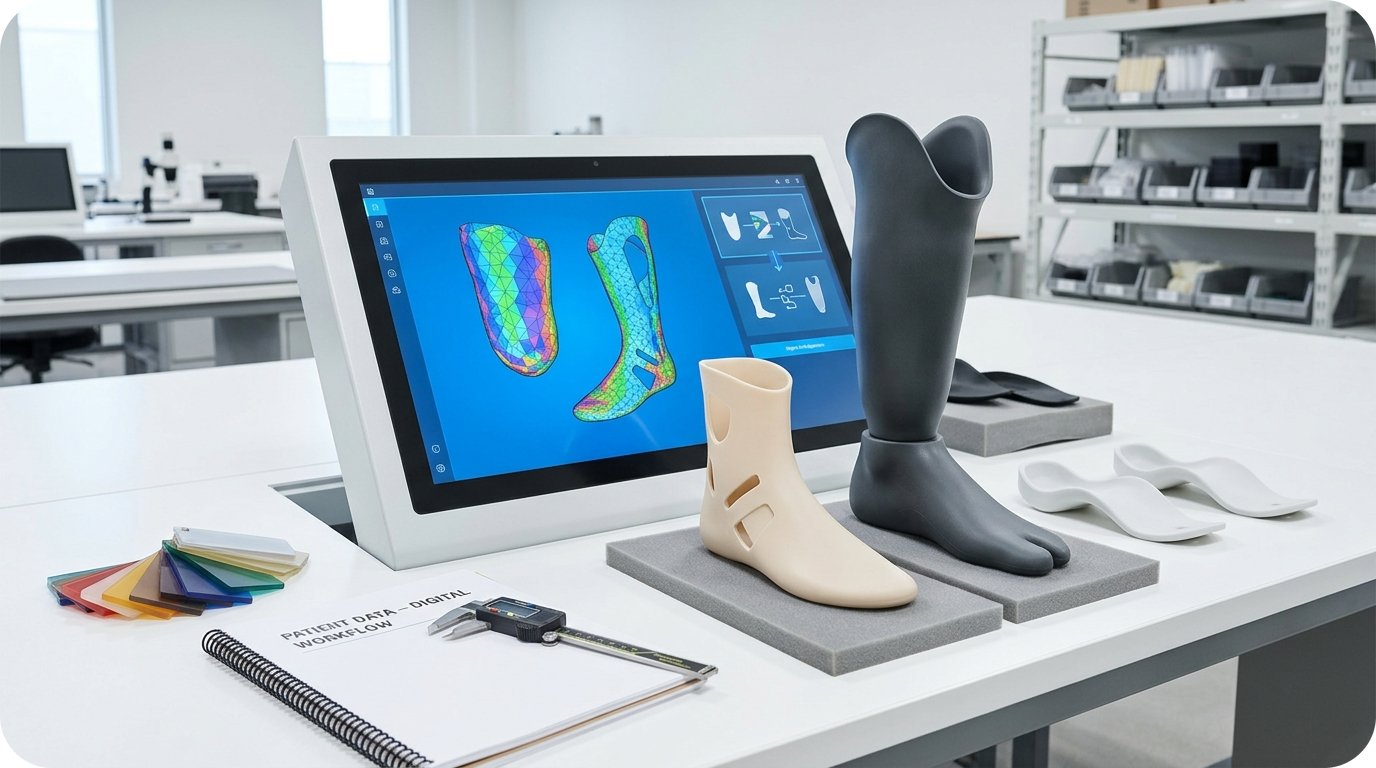
출력 전후를 하나로 엮는 디지털 제조
HP와 DyeMansion이 주목하는 지점이 바로 이 '공정 통합'입니다. HP의 Multi Jet Fusion(MJF) 방식은 한 번의 빌드에서 서로 다른 부품을 동시에 생산할 수 있어, 맞춤이 핵심인 분야에 적합합니다. 서로 다른 환자의 부품을 한 판에 올려 함께 찍는다는 것은, 다품종을 묶어 반복 생산하는 양산의 한 형태입니다.
DyeMansion은 출력 이후의 작업, 즉 부품을 세척하고 마감하는 후가공을 맡습니다. 매일 몇 시간씩 몸에 착용하는 기기라면 제대로 작동하는 것만으로는 부족합니다. 편안해야 하고, 내구성이 있어야 하며, 표면 마감까지 깔끔해야 합니다. 이들이 함께 지적하는 핵심은 분명합니다. 출력 전 설계·검증, 출력, 출력 후 마감이라는 여러 단계를, 맞춤 주문이 늘어나도 안정적으로 반복할 수 있는 하나의 공정으로 묶어야 한다는 것입니다.
이 관점은 의료기기만의 이야기가 아닙니다. 환자별 소켓이나 두개 교정 헬멧처럼 '모든 주문의 형상이 다른' 제품은, 로봇 외장 커버의 다품종 소량 양산이나 브랜드별로 형상이 다른 하우징 생산과 제조 구조가 같습니다. 디지털 설계에서 완성품까지 전 공정을 끊김 없이 연결하는 능력이, 맞춤 양산의 진짜 경쟁력이 됩니다.
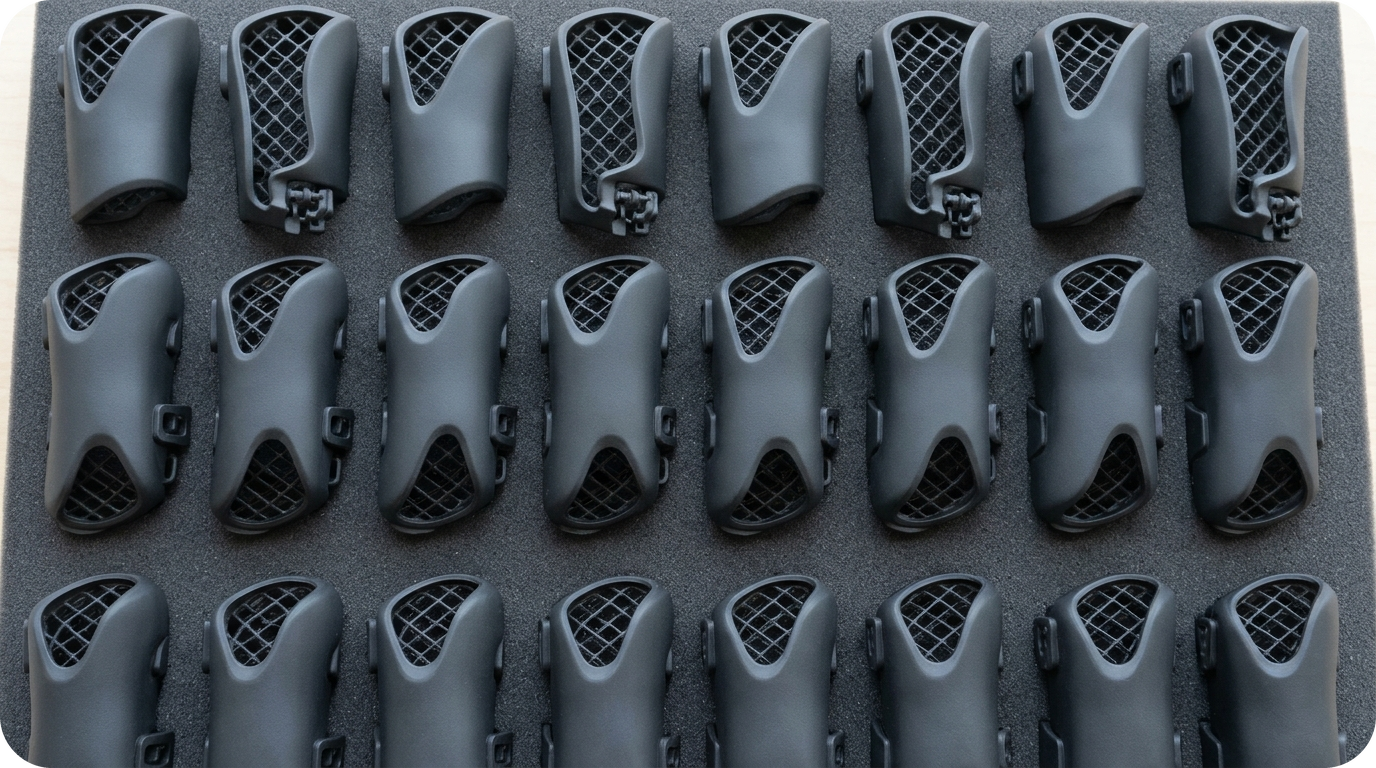
맞춤 양산을 산업용 SLA로 구현하는 글룩
이런 맞춤 양산의 과제는 실제 제조 현장에서 산업용 SLA 3D프린팅으로 구현됩니다. 글룩은 금형 없이 디지털 데이터를 그대로 생산에 연결하므로, 환자나 제품마다 형상이 달라도 추가 금형비 없이 바로 생산에 반영할 수 있습니다. 설계가 매번 다른 다품종 수십~수백 개를 묶어 반복 생산하는 방식은, 맞춤 의료기기가 요구하는 조건과 정확히 맞아떨어집니다.
품질 측면에서도 근거가 분명합니다. 글룩의 산업용 SLA는 300mm 기준 최대 ±0.05mm의 정밀도와 Ra 0.8 수준의 표면조도를 확보하며, 후가공을 거치면 사출품과 구별이 어려운 마감까지 구현합니다. 하루 종일 착용하는 의료기기 하우징·커버처럼 표면과 피팅감이 중요한 부품에, 적층 결이 거의 보이지 않는 SLA의 표면 품질과 후가공 체계가 특히 유효합니다. 글룩은 산업용 SLA 3D프린터 48기를 365일 24시간 운용하며 연간 23만 개 이상의 부품을 생산하고, 다양한 산업 분야에서 누적 100만 파트 이상을 제작해 왔습니다. 글룩은 이 역량을 의료기기 하우징·커버의 양산과 후가공까지 연결합니다.
다만 SLA가 모든 수량과 모든 제품의 답은 아닙니다. 색과 형상이 완전히 동일한 제품을 수만 개 이상 찍는다면 개당 단가에서 사출 성형이 유리하고, 체중을 직접 지지하는 고하중 금속 구조물이라면 금속 공정이 더 적합합니다. 판단의 축은 수량 하나가 아니라 형상 복잡도, 설계 변경 빈도, 그리고 주문마다 형상이 달라지는 맞춤의 정도입니다.
처음의 질문으로 돌아가 봅니다. 환자마다 다른 의족 수백 개를 품질을 유지하며 만들 수 있을까요. 출력 전 설계·검증부터 출력 후 마감까지를 하나의 반복 가능한 공정으로 묶고, 금형 없이 다품종을 함께 양산할 수 있다면 가능합니다. 맞춤 의료기기의 다음 벽은 더 빠른 프린터가 아니라, 개별 형상을 일관된 품질로 반복해내는 양산 체계에 있습니다.
GLUCK은 반복 생산이 가능한 산업용 SLA 3D프린팅 인프라를 기반으로
맞춤 의료기기 개발과 양산 전환 과정에 필요한 3D프린팅 제조 솔루션을 지원하고 있습니다.
지금 글룩을 확인해보세요!
📩 글룩 홈페이지 & 온라인 견적: https://www.glucklab.com
📂 글룩 포트폴리오: 글룩 포트폴리오 확인하기
References
[1] 3DPrint.com, "3D Printed Prosthetics Have Come a Long Way. HP and DyeMansion Look at What's Next," 3DPrint.com. Link: https://3dprint.com/336198/3d-printed-prosthetics-have-come-a-long-way-hp-and-dyemansion-look-at-whats-next/
English Version
Hundreds of Patient-Specific Prosthetics: Can You Make Them Without Sacrificing Quality?
Custom prosthetics and orthotics have long been one of the areas where 3D printing shines. By scanning a patient's body, designing digitally, and printing that data directly, manufacturers can produce a socket or brace that fits one person perfectly. Much of the work once done by hand has moved into the digital realm, and the use of SLA in this field dates back to 1990, when researchers at Northwestern University worked with Baxter Healthcare to produce a prosthetic socket.
Recently, HP and DyeMansion pointed out that the next wall in this field is not "printing" but "scale." Making one good custom device and reliably producing hundreds of them while maintaining quality and cost are entirely different problems. Getting a good result from a single printer is only part of the challenge; the real task is building a process that stays reliable even when repeated every day.
This raises a natural question. What does it take to mass-produce patient-specific devices at scale while maintaining consistent quality? This article revisits the problem HP and DyeMansion raised from the perspective of Mass Customization.
The Wall Custom Devices Hit in Production
Conventional manufacturing means producing thousands of identical parts. Prosthetics and orthotics, by contrast, require a different design for every patient. Even for the same type of brace, the same design rarely works for two different people. This is exactly why 3D printing fits this industry: manufacturers can produce different designs without needing a separate mold or tool for each one.
The challenge is that this flexibility becomes a production burden. Traditional methods required individual molds or heavy manual work to make different shapes per patient. Even moving to printing, challenges remain. Every device must be checked against the patient's needs, and the more custom orders a company handles, the harder it becomes to keep everything organized.
- Every shape is different: Designs differ for each patient, so the "repeat identical parts" premise of mass production doesn't hold. Design data management and part tracking directly become quality issues.
- Pre- and post-printing work is key: 3D printing reduces some steps, but the design and verification before printing and the cleaning and finishing after it remain. For a device worn all day, finishing quality determines completeness.
Ultimately, the challenge is not how fast a printer works or how many parts it produces. It's weaving materials, labor, quality checks, part tracking, and per-unit cost into one repeatable workflow.
Connecting Pre- and Post-Printing Into One Digital Process
This process integration is exactly where HP and DyeMansion focus. HP's Multi Jet Fusion (MJF) can produce multiple different parts in a single build, making it suited to fields where customization is key. Printing different patients' parts together in one build is itself a form of mass-producing varied products in a repeatable way.
DyeMansion handles the post-printing work—cleaning and finishing the parts. For a device worn for hours each day, working properly is not enough; it must be comfortable, durable, and well-finished. Their shared point is clear: the multiple stages of design and verification, printing, and finishing must be bundled into one process that can be repeated reliably even as custom orders grow.
This isn't only a medical-device story. Products where "every order has a different shape"—like patient-specific sockets or cranial helmets—share the same manufacturing structure as low-volume, high-mix production of robot covers or housings that differ by brand. The ability to connect the entire workflow from digital design to finished product becomes the true competitive edge in mass customization.
GLUCK Implementing Mass Customization With Industrial SLA
These mass customization challenges are implemented in the field through industrial SLA 3D printing. GLUCK connects digital data directly to production without molds, so even when shapes differ per patient or product, there is no added tooling cost to reflect them in production. Bundling dozens to hundreds of varied designs into repeatable production aligns precisely with what custom medical devices require.
The quality basis is clear as well. GLUCK's industrial SLA achieves up to ±0.05mm precision at a 300mm reference and surface roughness around Ra 0.8, and with post-processing delivers a finish hard to distinguish from injection-molded parts. For medical device housings and covers worn all day—where surface and fit matter—SLA's near-invisible layer lines and finishing system are especially effective. GLUCK operates 48 industrial SLA 3D printers around the clock, 365 days a year, producing over 230,000 parts annually, and has made over one million parts cumulatively across industries. GLUCK extends this capability to the production and finishing of medical device housings and covers.
That said, SLA is not the answer for every volume or product. For producing tens of thousands of identical units in the same color and shape, injection molding wins on per-unit cost, and for load-bearing metal structures, metal processes are more suitable. The deciding axis is not volume alone but shape complexity, design-change frequency, and the degree of customization that varies by order.
Returning to the opening question: can you make hundreds of different prosthetics while maintaining quality? Yes—if you bundle everything from pre-print design and verification to post-print finishing into one repeatable process, and can mass-produce varied designs together without molds. The next wall for custom medical devices is not a faster printer, but a production system that repeats individual shapes with consistent quality.
GLUCK supports the 3D printing manufacturing solutions needed for custom medical device development and the transition to mass production, based on an industrial SLA 3D printing infrastructure capable of repeatable production.
Check out GLUCK now!
📩 GLUCK Website & Online Quote: https://www.glucklab.com
📂 GLUCK Portfolio: View the GLUCK Portfolio
References
[1] 3DPrint.com, "3D Printed Prosthetics Have Come a Long Way. HP and DyeMansion Look at What's Next," 3DPrint.com. Link: https://3dprint.com/336198/3d-printed-prosthetics-have-come-a-long-way-hp-and-dyemansion-look-at-whats-next/
#글룩 #GLUCK #3D프린팅 #산업용3D프린팅 #SLA3D프린팅 #맞춤의료기기 #의족 #보조기 #맞춤양산 #MassCustomization #DfAM #후가공 #의료기기하우징 #3DPrinting #SLA3DPrinting #AdditiveManufacturing #Prosthetics #Orthotics #MedicalDevice #MassProduction
원문 기사 이미지 출처
'인사이트 (Insights)' 카테고리의 다른 글
| 밤새 출력된 부품이 왜 납품까지 2주 걸릴까 : 리드타임의 진짜 병목 (0) | 2026.11.11 |
|---|---|
| 리쇼어링이 만든 건 공장이 아니라 '선택권'입니다 : 기업이 약정보다 유연성에 지갑을 여는 이유 (0) | 2026.10.30 |
| 브랜드 굿즈 1,000개, 금형 없이 만들 수 있는 국내 제조 방법 (0) | 2026.10.29 |
| 얼굴 수십만 개를 찍기 전, 화면에서 색을 먼저 보는 LAIKA의 양산 품질관리 (0) | 2026.10.23 |
| SYZMIK 헤드기어가 받은 5성 안전 등급, 머리 스캔으로 보호장비를 맞춰 만드는 법 (0) | 2026.10.22 |