
미국 제조업 '리쇼어링(생산 시설을 자국으로 되돌리는 것)' 발표가 끊이지 않습니다. 2025년 한 해 동안 리쇼어링과 외국인 직접투자로 발표된 제조 일자리는 24만 7,063개에 달했습니다. 숫자만 보면 공장이 쏟아져 들어오는 것처럼 보입니다.
그런데 같은 보고서에는 훨씬 조용한 숫자가 하나 더 있습니다. 2025년에 나온 '조건부' 리쇼어링·투자 발표 64건 중, 보고 시점까지 전부 또는 일부라도 실제 프로젝트로 확정된 건 14건뿐이었습니다. 나머지는 아직 '발표'에 머물러 있습니다. 기업은 생산을 되돌리겠다고 선언하고, 공급처를 조사하고, 공정을 검증하는 단계를 발주보다 훨씬 먼저 밟을 수 있습니다. 즉 "국내에서 만들 수 있다"는 것과 "국내에서 만들기로 약정한다"는 것은 전혀 다른 이야기입니다.
이 간극은 적층제조(3D프린팅) 서비스 업계에 묘한 질문을 던집니다. 기업은 왜 국내 생산 약정보다, 필요할 때 생산을 전환할 수 있는 '유연성'에 더 지불하려 할까요? 이 글에서는 리쇼어링 흐름 속에서 실제로 값이 매겨지는 것이 무엇인지, 그리고 그 '선택권'을 어떤 제조 방식이 가장 현실적으로 구현하는지를 제조 관점에서 짚어봅니다.
리쇼어링은 '미국으로의 복귀'와 같은 말이 아닙니다
리쇼어링이라는 단어는 공장이 미국으로 돌아온다는 인상을 줍니다. 하지만 무역 데이터는 더 복잡한 그림을 보여줍니다. 2026년 4월 발표된 한 리쇼어링 지수는 −115에서 −91로 개선됐지만 여전히 마이너스였고, 이는 순(純)오프쇼어링이 계속되고 있다는 뜻이었습니다.
더 결정적인 건 수입의 방향입니다. 2025년 한 해 동안 중국산 제조품 수입은 1,350억 달러 줄었지만, 분석 대상인 다른 13개 저비용 아시아 국가·지역으로부터의 수입은 오히려 1,930억 달러 늘었습니다. 중국 밖으로 생산을 옮긴다는 것이 곧 미국으로 생산을 되돌린다는 뜻은 아니었던 셈입니다.
여기서 제조 담당자가 마주하는 문제가 두 가지 드러납니다.
- 약정의 부담: 국내 생산을 '약정'하려면 설비 투자, 금형 제작, 최소 수량 확보 같은 고정비를 먼저 떠안아야 합니다. 그런데 관세·지정학 리스크는 언제 어느 방향으로 움직일지 불확실합니다.
- 재고 리스크: 수요가 확정되지 않은 상태에서 대량 생산 체제를 깔면, 팔리지 않은 물량이 그대로 창고 비용과 재고 손실로 돌아옵니다.
결국 기업이 원하는 건 "지금 전부 국내에서 만들겠다"가 아니라 "필요해지면 국내에서 바로 만들 수 있게 준비해두겠다"에 가깝습니다. 문제는 그 '준비 상태'를 유지하는 비용을 누가 부담하느냐입니다.
투자자들은 '프린터 대수'가 아니라 '고객 관계'에 베팅합니다
리쇼어링 숫자가 엇갈리는 와중에도 제조 서비스 업체에 대한 투자는 꾸준히 진행되고 있습니다. 2026년 10월, 한 사모펀드의 포트폴리오 기업 Fathom Digital Manufacturing은 정밀 가공·전자 제조·복합 조립·특수 마감 역량을 가진 세 회사를 인수했습니다. 거래 후 Fathom은 10개 시설과 약 700명의 인력, 25종 이상의 제조 서비스를 갖추게 됐습니다.
흥미로운 지점은 이 인수가 '프린터를 더 늘리는' 전략이 아니라는 데 있습니다. 설계·시제품 단계의 고객을, 검증된 양산 단계까지 '그대로 데리고 가는' 구조를 짜는 쪽에 가깝습니다. 또 다른 사례인 ADDMAN은 올해 1월 Forecast 3D를 인수해 SLS·MJF 같은 분말 적층 역량과 디지털 견적 인프라를 더했고, 거래 후 적층제조 장비가 160대를 넘었다고 밝혔습니다.
여기서도 중요한 건 장비 수가 아니라 공정 사이의 관계입니다. 고객은 적층제조 시제품으로 시작해, SLS·MJF로 소·중량 생산을 거치고, 수량이 늘면 사출로 옮겨갈 수 있습니다. 한 업체가 이 전환 과정 내내 고객을 붙잡을 수 있다면, 제품 수명주기의 여러 단계에 걸쳐 수익을 낼 수 있습니다.
- 값이 매겨지는 건 전환의 유연성: 투자자들이 사들이는 것은 프린터 숫자가 아니라 고객 관계, 생산 검증 자격, 그리고 서로 보완되는 공정 조합입니다. 즉 "단계가 바뀔 때마다 공급처를 바꾸지 않아도 되는 유연성"에 값이 매겨지고 있습니다.
실제로 공개 실적도 이 분화를 보여줍니다. 한 디지털 제조 플랫폼은 2026년 2분기에 매출이 41% 늘며 마켓플레이스가 급성장했지만, 또 다른 업체는 CNC 가공과 사출이 각각 13%대로 늘어난 반면 3D프린팅 매출은 2.6% 줄었습니다. 편리한 제조 조달 시장은 커지고 있지만, 그 성장이 모든 공정에 똑같이 돌아가는 것은 아니라는 뜻입니다.
금형 없는 유연 양산이 '약정 없는 선택권'을 만듭니다 : 산업용 SLA라는 조건부 대안
지금까지의 흐름을 한 문장으로 줄이면 이렇습니다. 기업은 생산을 '약정'하기보다, 필요할 때 생산할 수 있는 '유연성'에 지갑을 엽니다. 그런데 이 유연성을 가장 직접적으로 막는 것이 바로 금형입니다. 금형은 한 번 파면 설계를 바꾸기 어렵고, 투자비를 회수하려면 정해진 수량을 반드시 찍어야 합니다. 약정과 재고 부담이 금형이라는 설비에 그대로 묶여 있는 셈입니다.
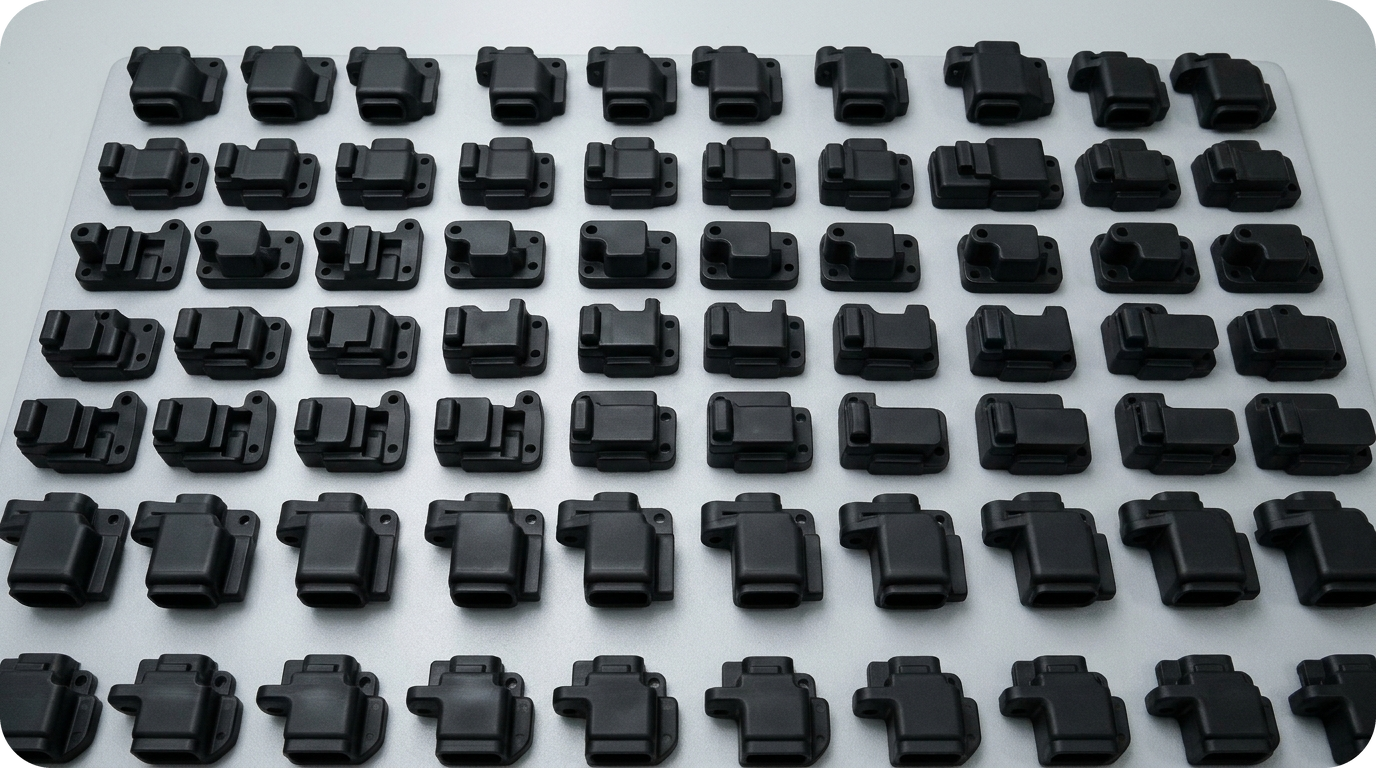
이런 가능성은 실제 산업 현장에서는 산업용 SLA 3D프린팅을 통해 더 구체적으로 구현됩니다. 글룩은 금형 없이 디지털 파일만으로 생산에 들어가기 때문에, 설계를 바꿔도 금형 수정비와 대기 시간이 발생하지 않고 수요가 발생하는 시점에 맞춰 수량을 유연하게 조절할 수 있습니다. '지금 다 만들어두는' 대신 '필요할 때 바로 만드는' 온디맨드(수요 기반 생산) 방식이, 리쇼어링이 만들어낸 '선택권'과 그대로 맞닿아 있습니다.
품질 면에서도 양산 부품으로 쓸 수준이 뒷받침됩니다. 글룩의 산업용 SLA는 300mm 기준 최대 ±0.05mm의 정밀도와 Ra 0.8 수준의 표면조도를 구현하며, 후가공 시 사출품과 구별이 어려운 마감까지 가능합니다. 글룩은 45기의 산업용 SLA 장비를 365일 24시간 운용해 연간 23만 개 이상의 부품을 생산하고 있어, 다품종을 반복해서 양산하는 Flexible Series Production에 대응합니다. 로봇 외장 커버 소량 양산이나 생산라인 지그·치구·검사구처럼, 형상이 제각각이면서도 반복 생산이 필요한 부품이 여기에 해당합니다.
다만 이 방식이 모든 경우의 답은 아닙니다. 완전히 같은 형상을 수만 개 이상 안정적으로 찍어야 한다면 개당 단가에서 사출이 유리하고, 고하중을 견뎌야 하는 금속 부품이라면 금속 공정이 적합합니다. SLA가 힘을 발휘하는 구간은 따로 있습니다. 형상이 복잡하거나, 설계 변경이 잦거나, 수요가 불확실해 약정을 걸기 어려운 다품종 중·대량 구간입니다. 바로 리쇼어링을 검토하는 기업들이 가장 자주 맞닥뜨리는 상황입니다.
처음의 질문으로 돌아가 봅니다. 기업은 왜 국내 생산 약정보다 '필요할 때 생산할 유연성'에 더 지불할까요? 발주를 확정하지 않고도 국내 공급 능력을 확보할 수 있고, 수요가 움직이는 대로 수량을 맞출 수 있으며, 설계가 바뀌어도 고정비가 묶이지 않기 때문입니다. 금형 없이 수량을 유연하게 가져가는 생산 방식은, 이 '선택권'을 비용 부담 없이 손에 쥐는 가장 현실적인 경로 중 하나입니다. 자사 제품의 형상과 수요 곡선을 떠올려보면, 지금 필요한 것이 '약정'인지 '유연성'인지가 조금 더 선명해질지도 모릅니다.
GLUCK은 반복 생산이 가능한 산업용 SLA 3D프린팅 인프라를 기반으로
제조 양산 전환 과정에 필요한 3D프린팅 제조 솔루션을 지원하고 있습니다.
지금 글룩을 확인해보세요!
📩 글룩 홈페이지 & 온라인 견적: https://www.glucklab.com
📂 글룩 포트폴리오: 글룩 포트폴리오 확인하기
References
[1] 3D Printing Industry, "Reshoring is creating options. Who gets paid for them?," 3dprintingindustry.com. Link: https://3dprintingindustry.com/news/reshoring-is-creating-options-who-gets-paid-for-them-255999/
English Version
What Reshoring Actually Creates Is Not Factories, But 'Options' : Why Companies Pay for Flexibility Over Commitment
US manufacturing reshoring announcements keep coming. In 2025 alone, 247,063 manufacturing jobs were announced through reshoring and foreign direct investment. By the numbers, it looks like factories are pouring back in.
But the same report contains a much quieter figure. Of the 64 "conditional" reshoring and investment announcements made in 2025, only 14 had converted—fully or partially—into confirmed projects by the time of the report. The rest remain at the "announcement" stage. Companies can declare their intent to bring production home, investigate suppliers, and qualify processes long before they place an order. In other words, "being able to make it domestically" and "committing to make it domestically" are two very different things.
This gap raises a curious question for the additive manufacturing (3D printing) service industry. Why do companies pay more for the flexibility to switch production when needed than for a commitment to domestic production? This article examines, from a manufacturing perspective, what is actually being valued amid the reshoring trend—and which production method most realistically delivers that "option."
Reshoring Is Not the Same as 'Returning to America'
The word reshoring suggests factories returning to the US. But trade data shows a more complicated picture. A reshoring index released in April 2026 improved from −115 to −91, yet remained negative—indicating that net offshoring continues.
More telling is the direction of imports. In 2025, imports of manufactured goods from China fell by $135 billion, but imports from the other 13 low-cost Asian countries and regions in the analysis rose by $193 billion. Moving production out of China did not mean bringing production back to the US.
Two manufacturing problems emerge here.
- The burden of commitment: Committing to domestic production requires absorbing fixed costs upfront—equipment investment, tooling, minimum order quantities. Yet tariff and geopolitical risks are uncertain in timing and direction.
- Inventory risk: Setting up mass production before demand is confirmed turns unsold volume directly into warehousing costs and inventory losses.
What companies want is closer to "be ready to make it domestically when needed" than "make everything domestically now." The question is who bears the cost of maintaining that readiness.
Investors Are Betting on 'Customer Relationships,' Not 'Printer Counts'
Even as reshoring numbers remain mixed, investment in manufacturing service providers continues. In October 2026, a private equity firm's portfolio company, Fathom Digital Manufacturing, acquired three companies with precision machining, electronics manufacturing, complex assembly, and specialized finishing capabilities. After the deal, Fathom had 10 facilities, about 700 employees, and more than 25 manufacturing services.
The notable point is that this acquisition was not a strategy of "adding more printers." It was closer to building a structure that carries customers from design and prototyping straight through to qualified production. Another example, ADDMAN, acquired Forecast 3D in January, adding SLS and MJF powder-bed capacity and digital quoting infrastructure, and reported an additive fleet exceeding 160 systems after the deal.
Here too, what matters is not the machine count but the relationships between processes. A customer can start with an additive prototype, move to short-to-mid-run production via SLS or MJF, and shift to injection moulding as volumes grow. If one provider can keep that customer throughout the transition, it can earn across several stages of the product lifecycle.
- What gets priced is the flexibility of transition: What investors are buying is not printer numbers but customer relationships, production qualifications, and complementary processes. In short, "the flexibility to not have to change suppliers at each stage" is being priced.
Public results confirm this split. One digital manufacturing platform grew revenue 41% in Q2 2026 on a surging marketplace, while another saw CNC machining and injection moulding each grow in the low teens, but 3D printing revenue fell 2.6%. The market for convenient manufacturing procurement is expanding, but that growth does not flow equally to every process.
Mold-Free Flexible Production Creates the 'Option Without Commitment': Industrial SLA as a Conditional Option
The flow so far boils down to one sentence: companies open their wallets for the flexibility to produce when needed, rather than committing to production. And what most directly blocks this flexibility is the mold. Once cut, a mold is hard to change, and recovering its cost requires producing a fixed quantity. Commitment and inventory burden are tied directly to the mold as a piece of equipment.
In actual industrial settings, this possibility is realized more concretely through industrial SLA 3D printing. GLUCK goes into production with digital files alone, without molds, so changing a design incurs no mold-modification cost or wait time, and quantities can be flexibly adjusted to match when demand arises. Instead of "making everything now," the on-demand (demand-based production) approach of "making it when needed" aligns directly with the "option" that reshoring has created.
Quality is backed at a level fit for production parts. GLUCK's industrial SLA achieves precision up to ±0.05mm at a 300mm reference and surface roughness around Ra 0.8, with post-processing that produces a finish hard to distinguish from injection-molded parts. GLUCK operates 45 industrial SLA machines around the clock, 365 days a year, producing over 230,000 parts annually—supporting Flexible Series Production that repeatedly manufactures diverse product types. Small-batch production of robot exterior covers, or jigs, fixtures, and inspection gauges for production lines—parts with varying shapes that still need repeated production—fall into this category.
That said, this method is not the answer in every case. If you must reliably produce tens of thousands of identical shapes, injection moulding wins on unit cost, and for metal parts bearing high loads, metal processes are appropriate. SLA's strength lies elsewhere: in diverse mid-to-high-volume ranges where shapes are complex, design changes are frequent, or demand is too uncertain to commit to. This is exactly the situation companies considering reshoring most often face.
Let's return to the opening question. Why do companies pay more for "the flexibility to produce when needed" than for a domestic production commitment? Because they can secure domestic supply capacity without confirming an order, match quantities as demand shifts, and avoid locking in fixed costs even when designs change. A production method that flexibly handles quantity without molds is one of the most realistic paths to holding that "option" without the cost burden. Picture your own product's shape and demand curve, and it may become a little clearer whether what you need right now is "commitment" or "flexibility."
GLUCK supports the 3D printing manufacturing solutions needed throughout the transition to mass production,
based on an industrial SLA 3D printing infrastructure capable of repeatable production.
Check out GLUCK now!
📩 GLUCK Website & Online Quote: https://www.glucklab.com
📂 GLUCK Portfolio: View the GLUCK Portfolio
References
[1] 3D Printing Industry, "Reshoring is creating options. Who gets paid for them?," 3dprintingindustry.com. Link: https://3dprintingindustry.com/news/reshoring-is-creating-options-who-gets-paid-for-them-255999/
#글룩 #GLUCK #3D프린팅 #산업용3D프린팅 #SLA3D프린팅 #리쇼어링 #온디맨드 #유연양산 #금형없는양산 #중대량양산 #DfAM #3DPrinting #SLA3DPrinting #AdditiveManufacturing #Reshoring #OnDemandManufacturing #FlexibleSeriesProduction #MassProduction
원문 기사 이미지 출처
'인사이트 (Insights)' 카테고리의 다른 글
| 브랜드 굿즈 1,000개, 금형 없이 만들 수 있는 국내 제조 방법 (0) | 2026.10.29 |
|---|---|
| 얼굴 수십만 개를 찍기 전, 화면에서 색을 먼저 보는 LAIKA의 양산 품질관리 (0) | 2026.10.23 |
| SYZMIK 헤드기어가 받은 5성 안전 등급, 머리 스캔으로 보호장비를 맞춰 만드는 법 (0) | 2026.10.22 |
| 도면이 사라진 선박 프로펠러, 스캔 하나로 60% 빠르게 되살린 방법 (0) | 2026.10.21 |
| 1980년대 벽돌폰을 되살린 3D프린팅 핸드셋, 한정판은 어떻게 만들까 (0) | 2026.10.19 |