
운동 장비 시장을 보면 '개인 맞춤'이 점점 기본값이 되어가고 있습니다. 러닝화 밑창을 발 압력 데이터로 맞추고, 깔창을 스캔으로 성형하고, 마우스가드를 치아 본에 맞춰 찍는 흐름이 이미 자리를 잡았습니다. 사람 몸이 저마다 다르다는 당연한 사실이, 이제 제조 단계에서 구현 가능한 조건이 된 것입니다.
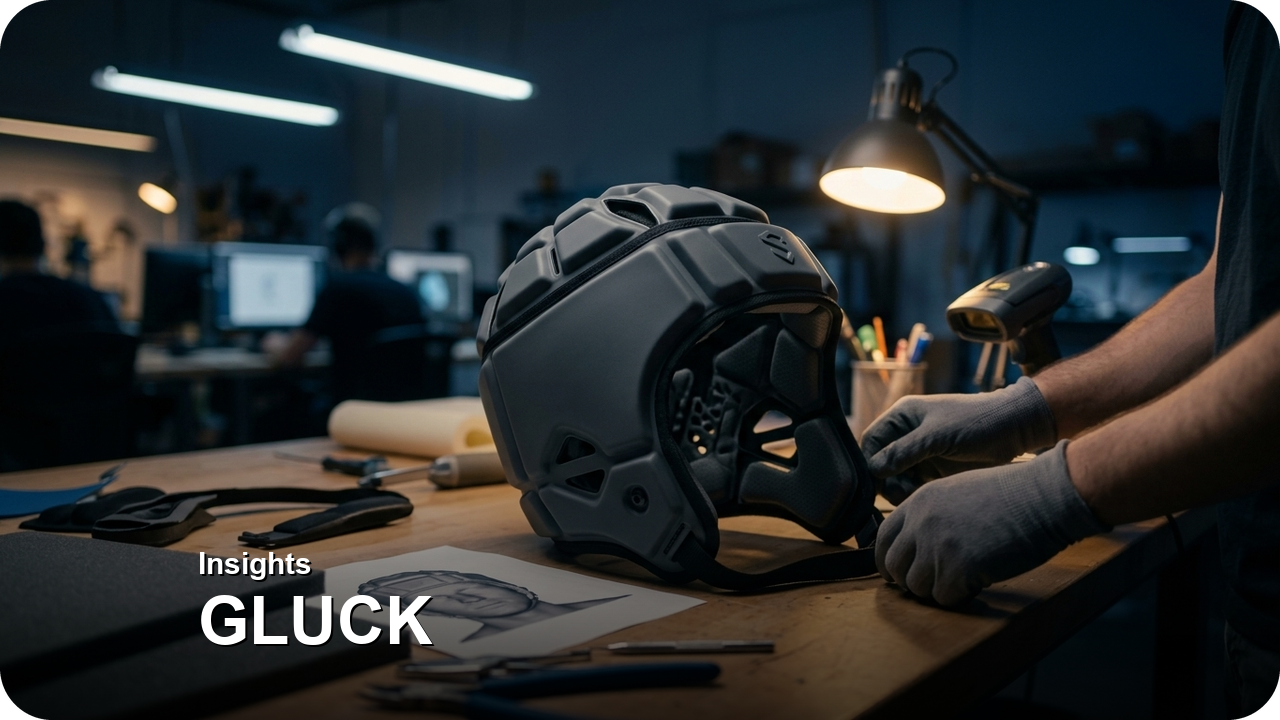
최근 주목받은 사례가 스포츠 장비 스타트업 SYZMIK의 플래그풋볼용 3D프린팅 헤드기어입니다. 이 제품은 버지니아 공대(Virginia Tech)의 헬멧 안전 평가에서 최고 등급인 5성(5-star)을 받았습니다. 흥미로운 건 이것이 단순한 '잘 만든 보호장비' 이야기가 아니라는 점입니다. 핵심은 머리 형상이 사람마다 다른 보호장비를, 금형 없이 어떻게 맞춤 양산하느냐라는 제조 질문에 있습니다.
보호장비는 몸에 밀착될수록 성능이 올라가지만, 밀착될수록 '한 가지 금형으로 다 찍는' 기존 방식과 멀어집니다. 이 글에서는 SYZMIK의 사례를 출발점으로, 개인 데이터 기반 맞춤 보호장비를 어떤 제조 방식으로 양산할 수 있는지 제조 관점에서 짚어봅니다.

SYZMIK 헤드기어 : 5성 등급을 받은 격자 완충 구조
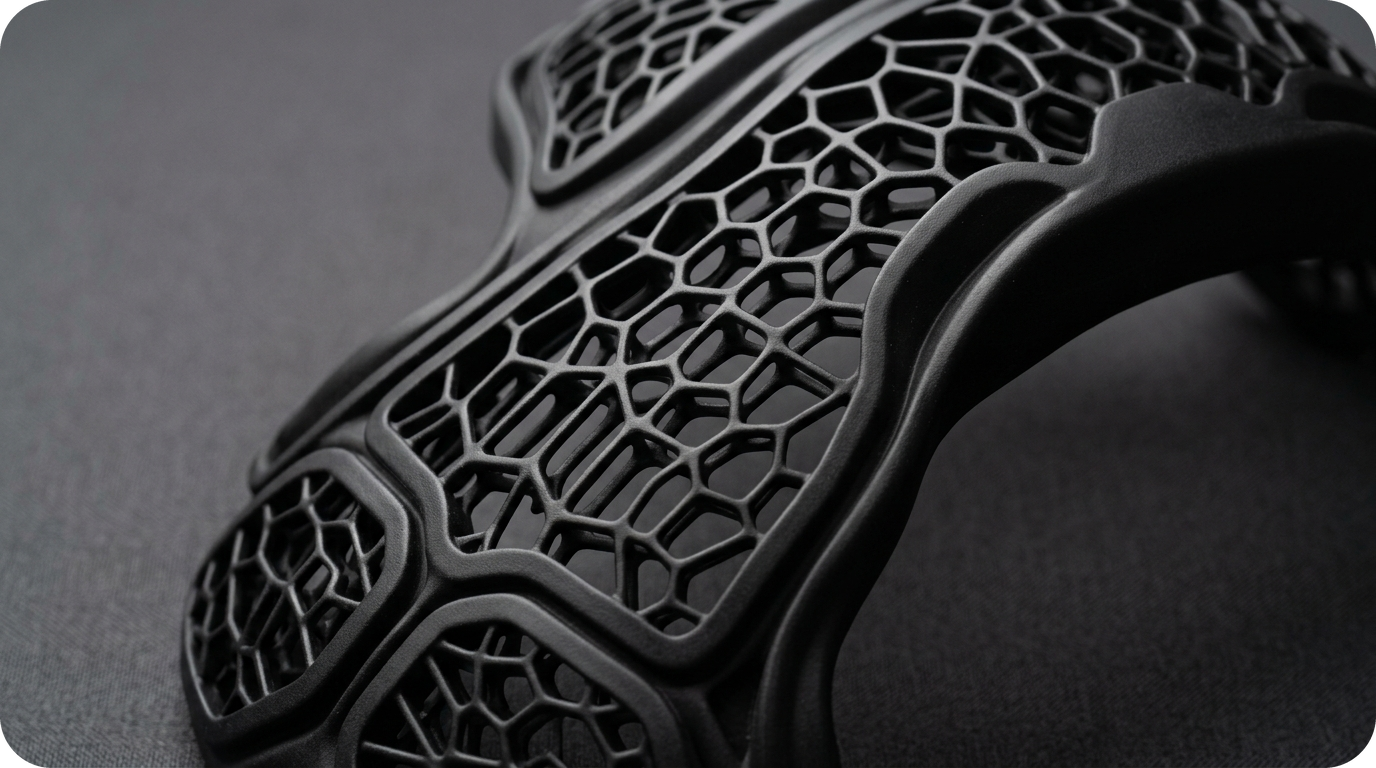
플래그풋볼은 태클이 없는 종목이지만 머리 충돌 위험은 남아 있습니다. SYZMIK의 헤드기어는 이 충격을 흡수하기 위해, 외피 안쪽을 통짜 폼이 아니라 3D프린팅 격자(lattice) 구조로 채웠습니다. 격자의 밀도와 방향을 부위별로 다르게 설계해, 충격이 들어오는 지점마다 변형량을 조절하는 방식입니다.
문제는 이런 구조를 기존 방식으로 만들기가 매우 어렵다는 점입니다. 통짜 폼은 사출·발포로 대량 생산할 수 있지만, 내부가 비어 있는 복잡한 격자 구조는 금형에서 빼낼 수가 없습니다. 금형 성형은 '빠지는 형상'만 만들 수 있기 때문입니다. 게다가 머리 형상은 사람마다 다르므로, 밀착도를 높이려면 결국 형상이 제각각인 제품을 반복해서 만들어야 합니다.
- 복잡 형상의 일체 성형: 부위별로 밀도가 다른 격자 완충 구조를 금형 분할이나 조립 없이 한 번에 성형합니다.
- 형상별 맞춤 반복: 머리 데이터가 바뀌어도 설계 파일만 교체하면 되므로, 동일 라인에서 서로 다른 형상을 반복 생산할 수 있습니다.
이 방식은 헤드기어뿐 아니라 보호대, 깔창, 마우스가드처럼 '몸에 맞물려 성능이 결정되는' 장비 전반에 그대로 적용될 수 있습니다.

왜 개인 맞춤 보호장비는 금형 양산과 맞지 않을까요?
여기서 자연스럽게 떠오르는 질문이 있습니다. 보호장비는 이미 공장에서 잘 만들고 있는데, 왜 굳이 다른 제조 방식을 찾을까요? 답은 '맞춤'과 '금형'이 근본적으로 충돌하기 때문입니다.
금형(사출·발포) 방식은 하나의 형상을 수만 개 이상 똑같이 찍을 때 가장 강합니다. 하지만 머리 스캔 데이터로 형상을 맞추는 순간, 형상 수만큼 금형이 필요해집니다. 금형 하나당 수천만 원에서 억 단위의 초기 비용이 드는데, 사람마다 형상이 다르면 이 구조 자체가 성립하지 않습니다.
또 하나의 벽은 최소주문수량(MOQ, 최소 주문 단위)입니다. 금형 방식은 금형비를 회수하려면 한 형상당 많은 수량을 찍어야 합니다. 그런데 맞춤 보호장비는 특정 형상의 수요가 수백~수천 개 수준인 경우가 많아, MOQ를 채우기 어렵습니다. 결국 '밀착 성능을 높이려는 설계'와 '금형으로 싸게 찍으려는 생산'이 서로를 가로막는 셈입니다.
- 금형비 벽: 형상이 바뀔 때마다 새 금형이 필요해 초기 투자가 급증합니다.
- 설계 변경 부담: 완충 구조를 개선하려면 금형을 다시 파야 해, 개량 속도가 느려집니다.
판단의 기준은 '몇 개를 만드느냐'가 아니라 '형상이 얼마나 다양하고, 얼마나 자주 바뀌느냐'로 옮겨갑니다.
글룩의 산업용 SLA로 맞춤 보호장비를 반복 양산하는 법
이런 가능성은 실제 제조 현장에서 산업용 SLA 3D프린팅으로 구현됩니다. 글룩은 금형 없이 디지털 설계 데이터만으로 생산에 들어가기 때문에, 머리 스캔처럼 사람마다 다른 형상 데이터를 그대로 반복 양산에 연결할 수 있습니다. 형상이 제각각이어도 같은 라인에서 다품종을 반복 생산하는 구조입니다.
보호장비에서 중요한 건 완충 구조의 정밀도와 외피의 마감 품질입니다. 글룩의 산업용 SLA는 300mm 기준 최대 ±0.05mm의 정밀도와 Ra 0.8 수준의 표면조도를 구현하며, 후가공 시 사출품과 구별이 어려운 마감까지 가능합니다. 글룩은 45기의 산업용 SLA 장비를 365일 24시간 운용해 연간 23만 개 이상의 부품을 생산하고 있어, 맞춤 형상이 섞인 중·대량 반복 양산도 안정적으로 소화할 수 있습니다. 부위별 밀도가 다른 격자 구조처럼 금형으로는 빼낼 수 없는 복잡 형상도 일체로 성형합니다.
다만 모든 경우에 SLA가 답은 아닙니다. 수만 개가 완전히 똑같은 형상이라면 금형 사출이 개당 단가에서 여전히 유리하고, 고하중을 받는 금속 구조부라면 금속 가공이 맞습니다. SLA가 유리한 지점은 명확합니다 — 형상이 사람마다 다르거나, 설계 변경이 잦거나, 특정 형상의 수요가 수백~수천 개 규모일 때입니다. 이 조건에서는 금형비도, MOQ도, 긴 리드타임도 걸리지 않습니다.
처음의 질문으로 돌아가 봅니다. 스포츠 보호장비를 개인 머리 데이터로 맞춤 양산하려면 어떻게 해야 할까요? 답은 형상 다양성과 변경 빈도를 먼저 따져보는 것입니다. 사람마다 형상이 다르고 수요가 분산된 보호장비라면, 금형 없이 설계 데이터만 바꿔 반복 생산하는 글룩의 산업용 SLA가 현실적인 선택지가 됩니다.
GLUCK은 반복 생산이 가능한 산업용 SLA 3D프린팅 인프라를 기반으로
맞춤 보호장비 개발과 양산 전환 과정에 필요한 3D프린팅 제조 솔루션을 지원하고 있습니다.
지금 글룩을 확인해보세요!
📩 글룩 홈페이지 & 온라인 견적: https://www.glucklab.com
📂 글룩 포트폴리오: 글룩 포트폴리오 확인하기
References
[1] VoxelMatters, "SYZMIK's 3D printed headgear for flag football earns 5-star rating," voxelmatters.com. Link: https://www.voxelmatters.com/syzmiks-3d-printed-headgear-for-flag-football-earns-5-star-rating/
English Version
How SYZMIK's 5-Star Headgear Is Made: Custom Protective Gear from Head Scan Data
The sports equipment market is making "personalized fit" the default. Running shoe soles are tuned to foot pressure data, insoles are molded from scans, and mouthguards are printed to match dental impressions. The obvious fact that every body is different has now become something manufacturable at the production stage.
A recent standout is the 3D-printed flag football headgear from sports equipment startup SYZMIK. The product earned the top rating of 5 stars in Virginia Tech's helmet safety evaluation. What's interesting is that this isn't simply a story about "well-made protective gear." The real point lies in a manufacturing question: how do you mass-customize protective gear whose head shape differs from person to person, without a mold?
Protective gear performs better the more closely it fits the body, but a closer fit moves it further away from the conventional "one mold fits all" approach. In this article, we use SYZMIK's case as a starting point to examine, from a manufacturing perspective, how personalized data-driven protective gear can actually be produced.
SYZMIK Headgear: A Lattice Cushioning Structure That Earned 5 Stars
Flag football has no tackling, but head-impact risk remains. To absorb this impact, SYZMIK's headgear fills the inside of its shell not with solid foam, but with a 3D-printed lattice structure. By varying the lattice density and orientation by region, it controls deformation at each point where impact enters.
The problem is that such a structure is very difficult to make with conventional methods. Solid foam can be mass-produced by injection or foaming, but a complex lattice structure with hollow interiors cannot be released from a mold. Mold forming can only produce "releasable" geometry. On top of that, head shapes differ by person, so improving fit means repeatedly making products with different geometry.
- Single-piece forming of complex geometry: A lattice cushioning structure with region-specific density is formed in one go, without mold splits or assembly.
- Shape-specific repetition: Even when head data changes, you only swap the design file, so the same line can repeatedly produce different geometries.
This approach applies not only to headgear but across gear whose performance is determined by how it meshes with the body—pads, insoles, mouthguards and more.
Why Doesn't Personalized Protective Gear Fit Mold-Based Mass Production?
A natural question arises here. Factories already make protective gear well, so why seek a different manufacturing method? The answer is that "customization" and "molds" fundamentally conflict.
Mold-based (injection/foam) methods are strongest when stamping one identical shape tens of thousands of times. But the moment you fit geometry to head-scan data, you need as many molds as there are shapes. Each mold costs tens of thousands to hundreds of thousands of dollars upfront, and if shapes differ per person, this structure simply doesn't hold.
Another wall is the MOQ (Minimum Order Quantity). To recover mold costs, mold methods need to stamp many units per shape. But demand for a given custom protective shape is often only in the hundreds to thousands, making the MOQ hard to meet. In the end, "design that boosts fit performance" and "production that stamps cheaply with molds" block each other.
- The tooling-cost wall: A new mold is needed every time the shape changes, sharply raising initial investment.
- Design-change burden: Improving the cushioning structure means re-cutting the mold, slowing down iteration.
The deciding criterion shifts from "how many you make" to "how varied the shapes are, and how often they change."
How GLUCK Repeatedly Mass-Produces Custom Protective Gear with Industrial SLA
These possibilities are realized on the actual production floor through industrial SLA 3D printing. Because GLUCK goes into production with digital design data alone—no mold—it can connect per-person geometry data, like head scans, directly to repeat mass production. Even when shapes differ, the same line repeatedly produces many variants.
What matters in protective gear is the precision of the cushioning structure and the finish quality of the shell. GLUCK's industrial SLA delivers precision up to ±0.05mm at a 300mm basis and surface roughness around Ra 0.8, with finishes that are hard to distinguish from injection-molded parts after post-processing. GLUCK operates 45 industrial SLA machines around the clock, 365 days a year, producing over 230,000 parts annually—so it can reliably handle mid-to-high-volume repeat production that mixes custom shapes. It also forms complex geometry that molds can't release, such as lattice structures with region-specific density, in a single piece.
That said, SLA is not the answer in every case. If tens of thousands of units share the exact same shape, injection molding still wins on per-unit cost, and for high-load metal structural parts, metal machining is the right fit. Where SLA is advantageous is clear—when shapes differ per person, when design changes are frequent, or when demand for a specific shape is in the hundreds to thousands. Under these conditions, there are no tooling costs, no MOQ, and no long lead times.
Let's return to the opening question. How should you mass-customize sports protective gear from individual head data? The answer is to first weigh shape diversity and change frequency. For protective gear where shapes differ per person and demand is dispersed, GLUCK's industrial SLA—producing repeatedly by swapping design data without a mold—becomes a realistic choice.
GLUCK supports the 3D printing manufacturing solutions needed for custom protective gear development and the transition to mass production, based on an industrial SLA 3D printing infrastructure capable of repeatable production.
Check out GLUCK now!
📩 GLUCK Website & Online Quote: https://www.glucklab.com
📂 GLUCK Portfolio: View GLUCK Portfolio
References
[1] VoxelMatters, "SYZMIK's 3D printed headgear for flag football earns 5-star rating," voxelmatters.com. Link: https://www.voxelmatters.com/syzmiks-3d-printed-headgear-for-flag-football-earns-5-star-rating/
#글룩 #GLUCK #3D프린팅 #산업용3D프린팅 #SLA3D프린팅 #맞춤양산 #보호장비 #헤드기어 #격자구조 #매스커스터마이제이션 #금형없이양산 #온디맨드 #3DPrinting #SLA3DPrinting #AdditiveManufacturing #MassCustomization #ProtectiveGear #SportsEquipment #Lattice #DfAM
'인사이트 (Insights)' 카테고리의 다른 글
| 도면이 사라진 선박 프로펠러, 스캔 하나로 60% 빠르게 되살린 방법 (0) | 2026.10.21 |
|---|---|
| 1980년대 벽돌폰을 되살린 3D프린팅 핸드셋, 한정판은 어떻게 만들까 (0) | 2026.10.19 |
| Nothing CMF 스피커, 외장 패널을 사용자가 직접 뽑아 바꾼다 : 교체형 파트가 여는 가전 커스텀 양산 (0) | 2026.10.16 |
| 699달러 SLA 프린터 시대, 레진은 대중화됐지만 '양산'은 왜 여전히 다른 문제일까 (0) | 2026.10.15 |
| 사진 한 장으로 완성되는 화병, Fahz 2.0이 보여준 '1인 1제품' 자동 양산 (0) | 2026.10.14 |