
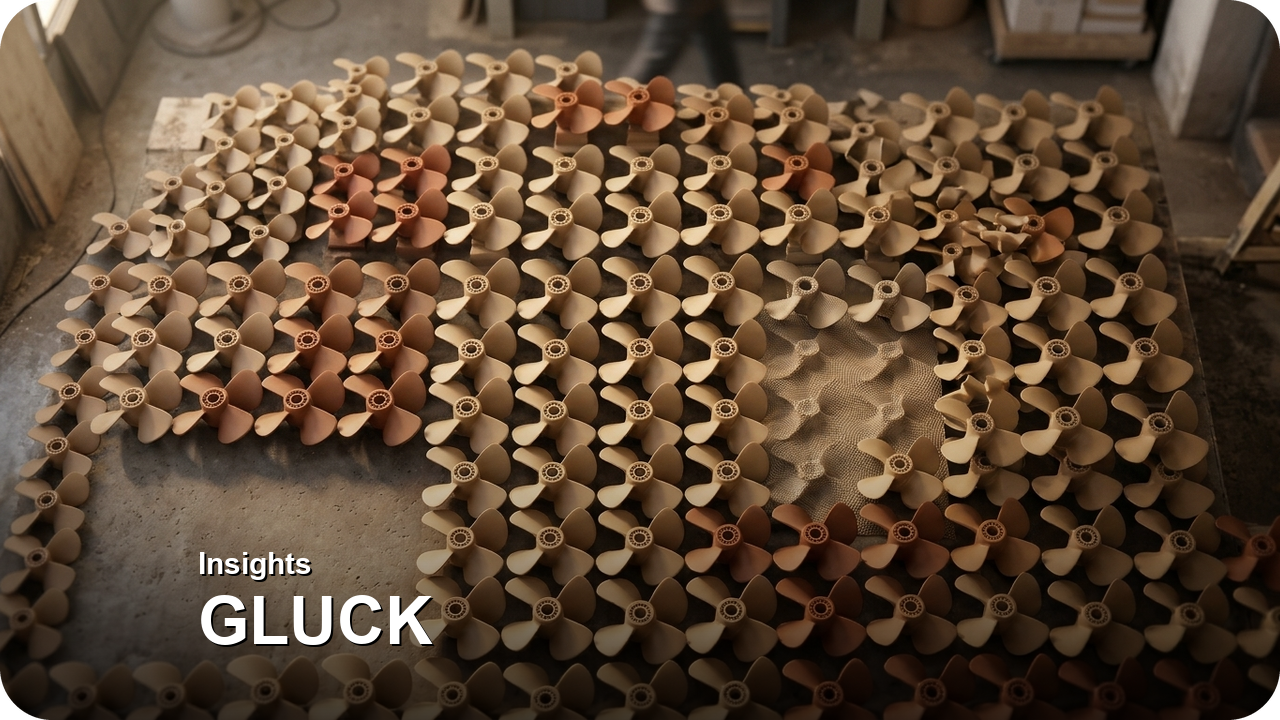
선박이 정비 독에 들어왔는데 교체할 부품의 도면이 어디에도 없는 상황을 떠올려 봅니다. 오래된 선박이거나 제조사가 사라진 부품이라면 드문 일도 아닙니다. 블레이드의 곡률, 피치, 블레이드가 허브로 이어지는 곡선 — 이 모든 정보가 오직 눈앞의 실물 하나에만 남아 있을 때, 제조 현장은 '똑같은 것을 어떻게 다시 만드느냐'는 난감한 질문과 마주합니다.
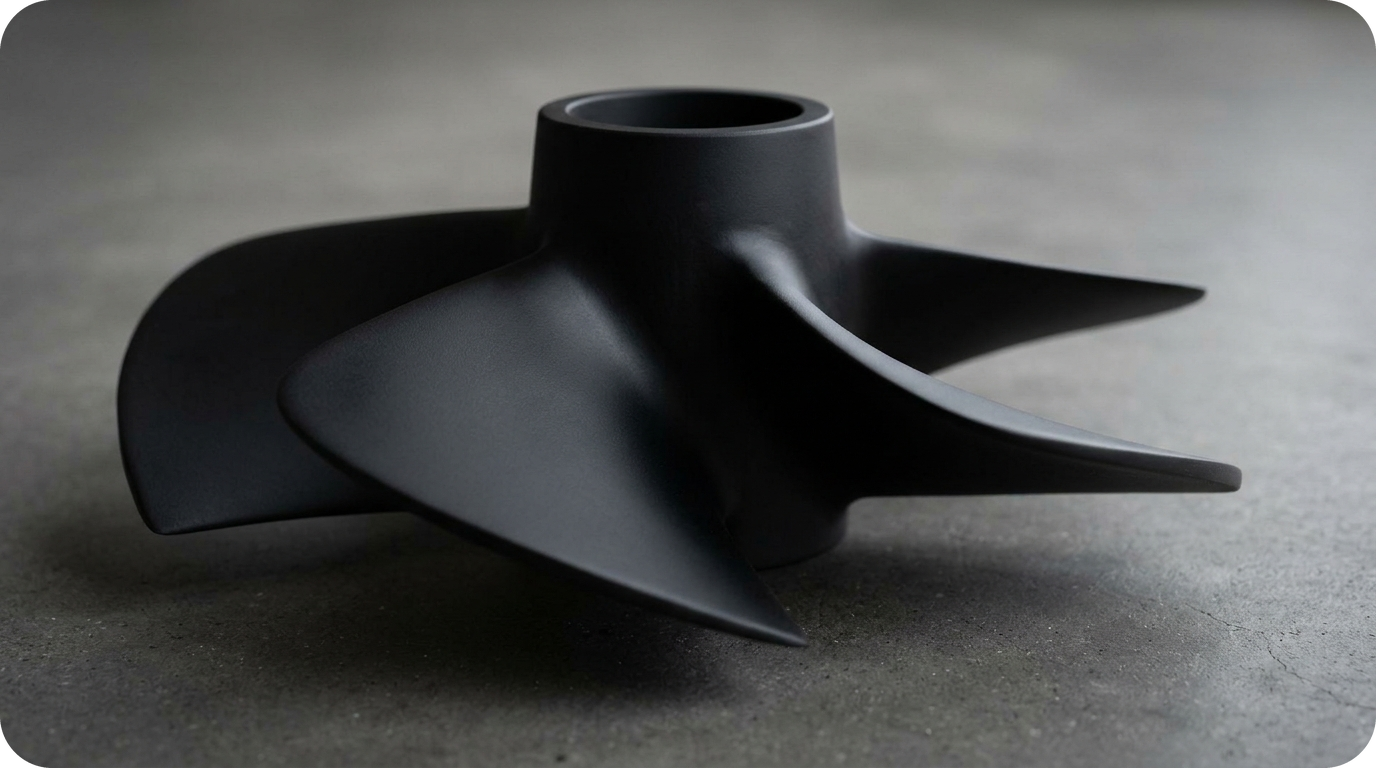
두바이에서 JOME Engineering이 처리한 선박 프로펠러 교체 작업이 바로 그런 경우였습니다. 선주는 기존 프로펠러와 동일한 부품을 빠르게 원했지만 CAD 파일도, 금형도 남아 있지 않았습니다. JOME은 원본을 3D 스캔해 디지털 마스터를 만들고, 그 데이터로 26kg짜리 스테인리스 프로펠러를 그대로 다시 제작했습니다. 주조로 만들었다면 새 금형을 제작하고 주물 공장 대기 줄에 몇 주를 더 기다려야 했을 작업입니다.
여기서 자연스럽게 떠오르는 물음이 있습니다. CAD도 금형도 없는 교체 부품을 어떻게 빠르게 다시 만들 수 있을까요? 이 사례는 단순한 선박 정비 이야기가 아니라, 도면 없는 단종·교체 부품을 다루는 모든 제조 현장이 안고 있는 리드타임과 재고 문제를 건드립니다. 이 글에서는 그 과정을 제조 관점에서 짚어봅니다.
도면 없이 실물만 남은 프로펠러를 되살린 JOME의 방식
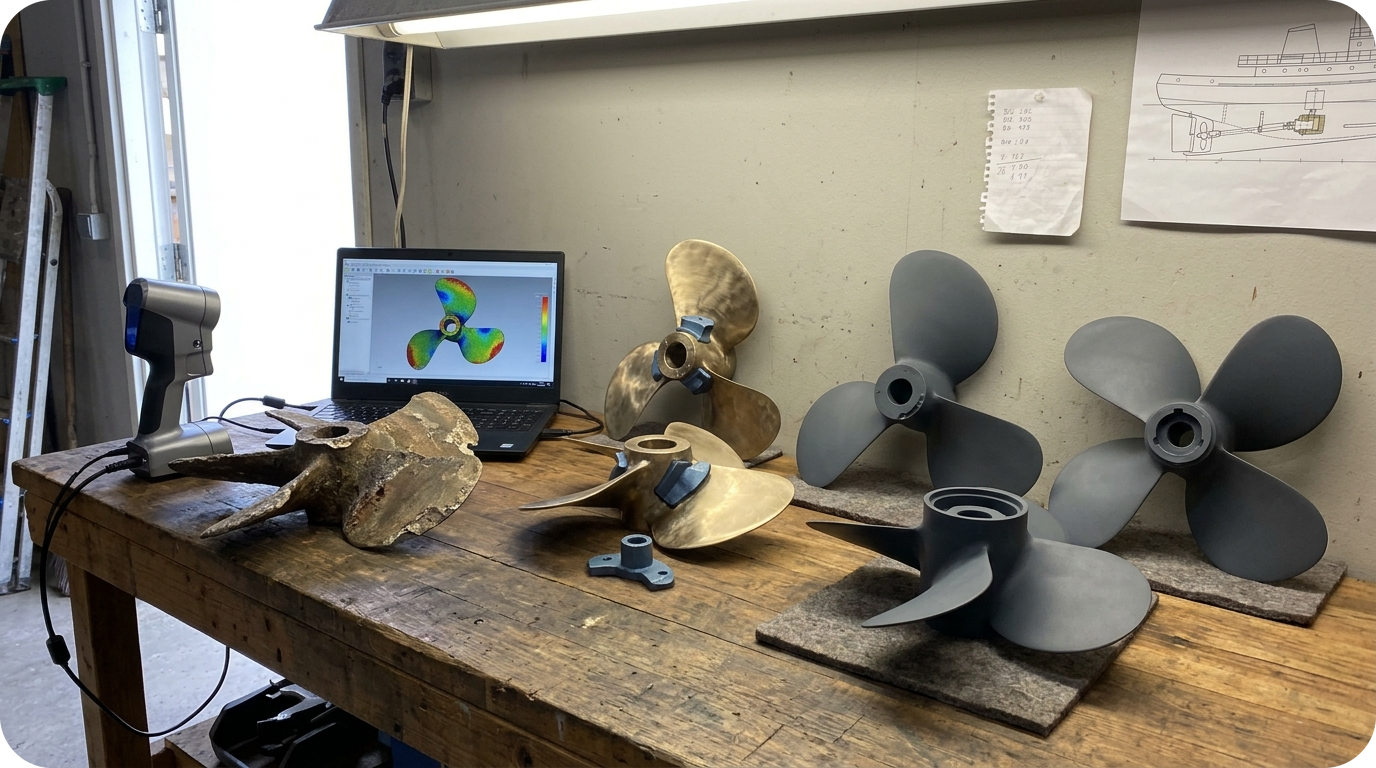
프로펠러 블레이드는 뒤틀린 자유 곡면이라 기준점을 잡기가 어려운 형상입니다. 도면이 있어도 재현이 까다로운데, 도면조차 없으니 형상 정보는 오직 실물에만 존재했습니다. JOME은 원본을 스캔해 디지털 마스터를 만들고, SS316L 스테인리스 소재로 와이어 아크 적층(WAAM, 금속 와이어를 녹여 쌓는 금속 적층 방식) 장비 위에서 교체품을 쌓아 올렸습니다.
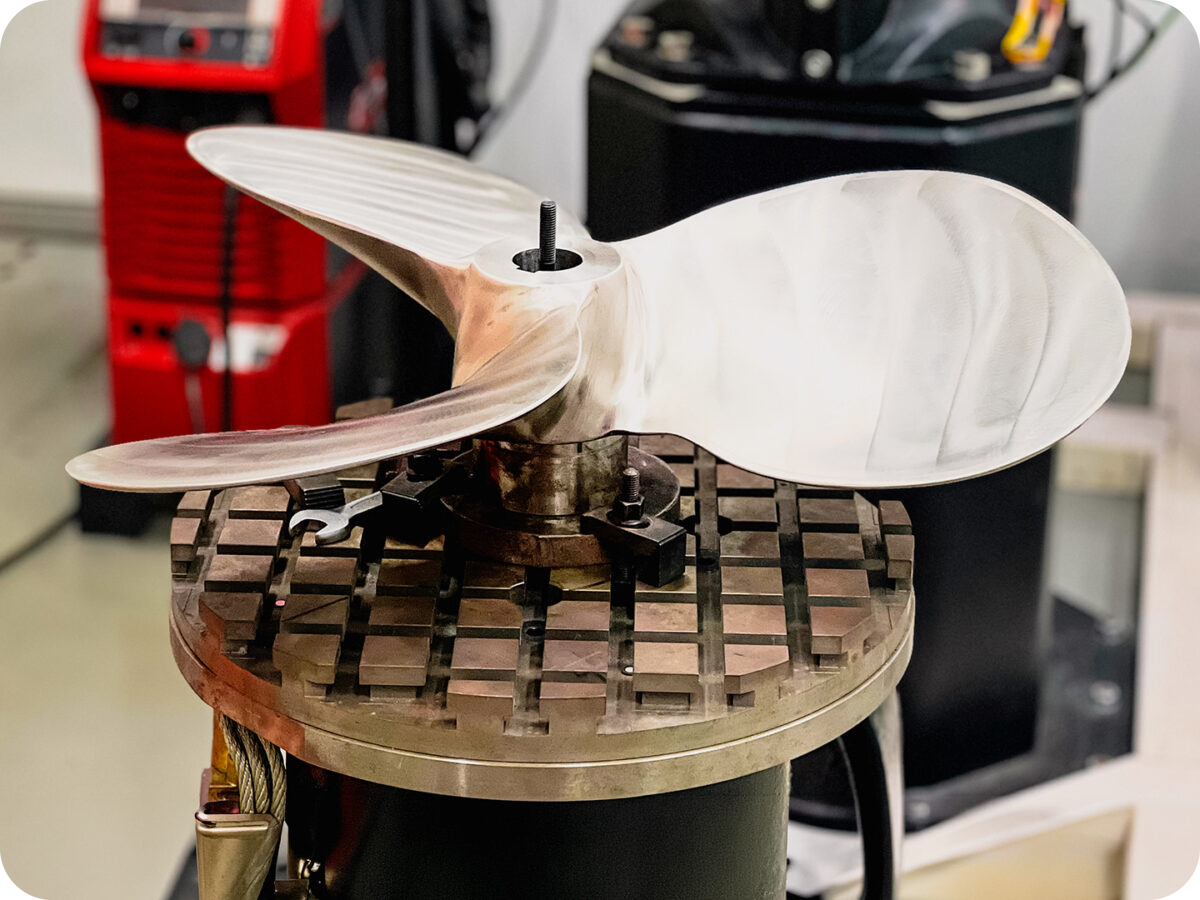
제작은 구간을 나눠 진행됐습니다. 먼저 중앙 허브를 가공하고, 침투 탐상 검사로 균열과 기공이 없는지 확인한 뒤 세 개의 블레이드를 그 위에 적층했습니다. 가장 까다로웠던 단계는 약 100시간이 걸린 가공이었습니다. 자유 곡면 블레이드는 정렬 기준점이 적어, 세팅 포인터를 둬도 정렬이 쉽지 않았기 때문입니다.
- 단계마다 재스캔으로 오차 관리: 각 단계가 끝날 때마다 프로펠러를 다시 스캔해 디지털 마스터와 비교하고, 가공에 필요한 소재가 충분히 남았는지 확인했습니다. 이 스캔 기록은 제작 전 과정을 문서로 남기는 효과도 있었습니다.
- 디지털 자산으로 남는 형상: 작업 후 JOME은 프로펠러의 형상을 디지털 파일로 보유하게 됐습니다. 다음 교체품이 필요하면 새로 스캔할 필요 없이 바로 출력 단계로 넘어갈 수 있습니다.
전체 약 120시간 중 적층은 20시간이었고 나머지는 가공과 마감이 차지했습니다. 정밀 금속 부품에서는 흔한 비율입니다. 이 방식은 선박 정비처럼 '예비품이 실물 하나로만 존재하는' 현장에 그대로 적용될 수 있습니다. 스캔이 도면이 담지 못한 형상을 복원하고, 적층이 그것을 직접 재현하는 흐름입니다.
리드타임 60%·비용 40% — 줄어든 건 결국 '금형과 대기'
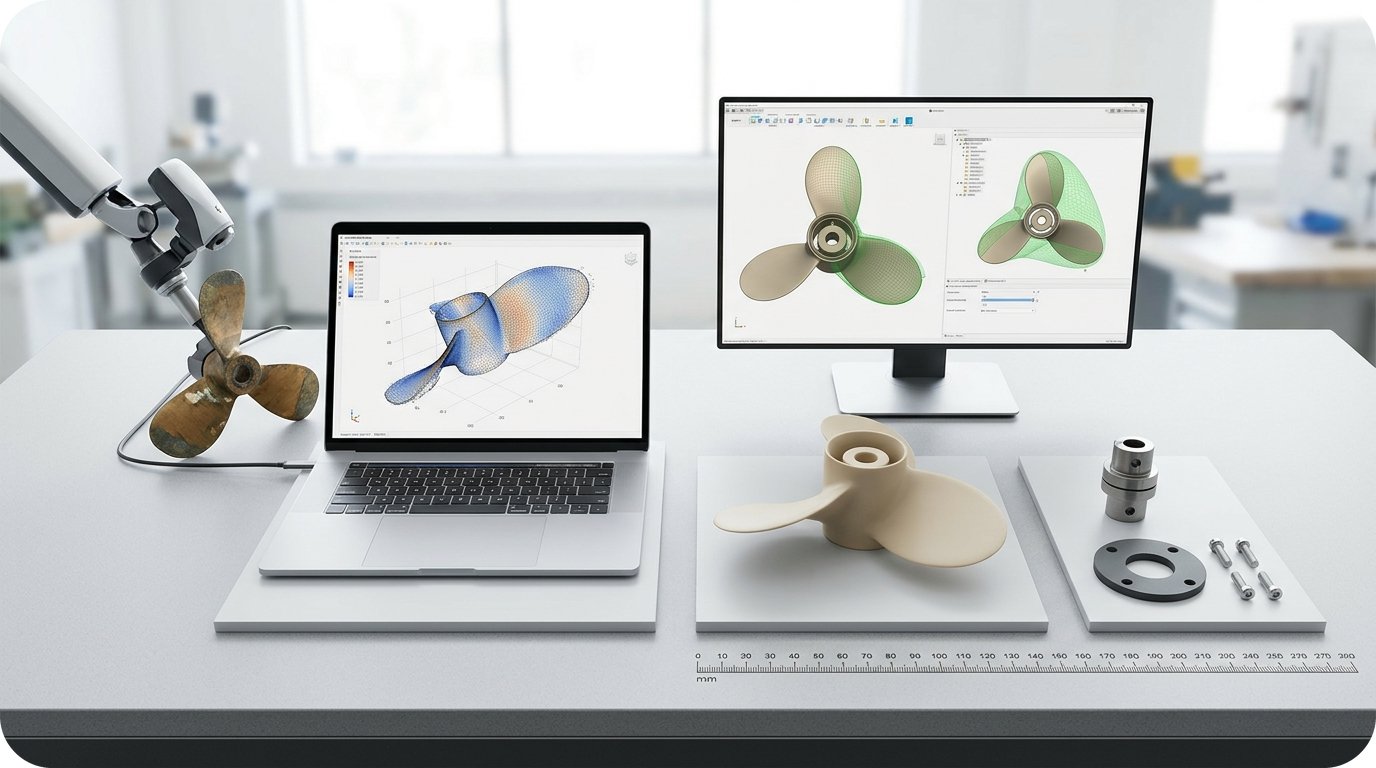
이 사례에서 리드타임이 약 60%, 비용이 약 40% 줄었다는 점은 주목할 만합니다. 다만 숫자 자체보다 무엇을 건너뛰어서 그 숫자가 나왔는가를 보는 편이 제조 관점에서 더 유용합니다.
전통적인 주조 방식에서 단건·교체 부품을 만들 때 가장 큰 벽은 두 가지입니다. 첫째는 금형(툴링) 비용입니다. 단 하나를 만들더라도 새 금형을 제작해야 하고, 그 비용을 나눠 담을 생산량이 없으니 단건 부품에서는 금형비가 그대로 고정비로 얹힙니다. 둘째는 대기 시간입니다. 금형 제작과 주물 공장 대기 줄을 통과하는 데만 몇 주가 걸립니다. 선박이 그만큼 독에 묶여 있다는 뜻이기도 합니다.
리버스 엔지니어링 방식은 이 두 구간을 건너뜁니다. 금형을 만들지 않으니 툴링 비용이 사라지고, 주물 공장 대기 줄도 거치지 않으니 선박이 더 빨리 운항에 복귀합니다. 비용 절감의 핵심은 '생산량이 없어도 되는 구조'에 있습니다. 분산할 생산 물량이 없어 금형비가 그대로 부담이 되던 구조 자체를 없앴기 때문입니다.
도면 없는 부품을 실물에서 복원하는 접근은 이 사례만의 것은 아닙니다. 네덜란드 해군 정비 조직은 2017년에 이미 수리·교체 부품의 도면이나 CAD 파일이 없는 경우가 잦다는 문제를 밝힌 바 있습니다. 노후 선박의 단종 부품이나 선체에 접근하기 어려운 부품이 그런 경우였고, 이들은 실물을 스캔해 디지털 모델을 만든 뒤 3D프린팅·CNC 밀링·사출·수작업 용접 등 여러 공정에 활용했습니다. 즉 '스캔으로 형상을 되살려 유연한 공정으로 재현한다'는 흐름은 산업 전반으로 번지고 있는 셈입니다.
글룩의 산업용 SLA — 폴리머 하우징·커버의 '도면 없는 반복 양산'
앞선 선박 프로펠러는 고하중을 받는 금속 부품이라 금속 적층 공정이 쓰였습니다. 이 영역은 글룩이 다루는 폴리머 SLA와는 다른 분야입니다. 다만 그 사례가 보여준 '도면 없는 부품을 스캔해 디지털 자산으로 만들고, 금형 없이 바로 재제작한다'는 제조 흐름은, 폴리머 외장·하우징·커버 영역에서 산업용 SLA 3D프린팅으로 더 정밀하게 구현될 수 있습니다.
글룩은 금형 없이 디지털 데이터만으로 반복 양산하는 산업용 SLA 인프라를 운영합니다. 제어기 하우징, 센서 브라켓, 검사용 지그·치구, 의료기기 커버처럼 도면이 흩어졌거나 설계 변경이 잦은 폴리머 부품이라면, 디지털 파일을 수정해 바로 다시 출력할 수 있다는 점이 큰 강점이 됩니다. 글룩의 산업용 SLA는 300mm 기준 최대 ±0.05mm의 정밀도와 Ra 0.8 수준의 표면조도를 구현하며, 후가공 시 사출품과 구별이 어려운 마감까지 가능합니다. 글룩은 45기의 산업용 SLA 장비를 365일 24시간 운용해 연간 23만 개 이상의 부품을 생산하고 있습니다.
다만 산업용 SLA가 모든 상황의 답이 되는 것은 아닙니다. 수만 개가 완전히 동일한 형상으로 반복된다면 금형을 한 번 제작해 단가를 낮추는 사출이 유리하고, 고하중을 견뎌야 하는 금속 구조 부품이라면 금속 가공이나 금속 적층이 적합합니다. SLA가 힘을 발휘하는 지점은 수량이 아니라 형상이 제각각이거나, 설계 변경이 잦거나, 수요를 미리 가늠하기 어려운 다품종 중·대량 반복 양산 구간입니다. 금형 없이 디지털 데이터로 바로 생산하므로 재고 리스크와 초기 금형 투자를 함께 줄일 수 있습니다.
처음의 질문으로 돌아가 봅니다. CAD도 금형도 없는 교체 부품을 어떻게 빠르게 다시 만들 수 있을까요? 답은 실물에서 형상을 되살려 디지털 자산으로 만들고, 금형 없이 그 데이터로 바로 생산하는 흐름에 있습니다. 선박 프로펠러가 금속 적층으로 그 가능성을 보여줬다면, 폴리머 하우징·커버·지그처럼 도면이 흩어지기 쉬운 부품에서는 산업용 SLA가 현실적인 선택지가 됩니다. 당장은 아니더라도, 도면 없는 단종 부품 때문에 리드타임이 길어지는 상황이라면 한 번쯤 '우리 부품은 어떤 방식이 맞을까'를 따져볼 만합니다.
GLUCK은 반복 생산이 가능한 산업용 SLA 3D프린팅 인프라를 기반으로
도면 없는 단종·교체 부품 개발과 양산 전환 과정에 필요한 3D프린팅 제조 솔루션을 지원하고 있습니다.
지금 글룩을 확인해보세요!
📩 글룩 홈페이지 & 온라인 견적: https://www.glucklab.com
📂 글룩 포트폴리오: 글룩 포트폴리오 확인하기
References
[1] 3DPrintingIndustry.com, "JOME Engineering 3D Prints Marine Propeller from a Scan, Cutting Lead Time by About 60%," 3D Printing Industry. Link: https://3dprintingindustry.com/news/jome-engineering-3d-prints-marine-propeller-from-a-scan-cutting-lead-time-by-about-60-255801/
English Version
How a Marine Propeller with No Drawings Was Rebuilt 60% Faster from a Single Scan
Picture a vessel in a maintenance dock where the part that needs replacing has no drawings anywhere. For an older ship or a part whose manufacturer no longer exists, this is hardly rare. When the blade curvature, pitch, and the transition from each blade into the hub exist only in the physical object in front of you, the shop floor faces the awkward question of how to make the exact same thing again.
That was precisely the case for the marine propeller replacement JOME Engineering handled in Dubai. The owner needed a part matching the existing propeller, and quickly—but there were no CAD files and no tooling left. JOME 3D scanned the original to create a digital master and rebuilt the 26 kg stainless steel propeller directly from that data. Casting a replacement would have meant producing a new die and then waiting weeks in a foundry queue.
A question naturally follows here: how do you quickly remake a replacement part that has neither CAD nor tooling? This case is not just a story about ship maintenance—it touches the lead time and inventory problems facing any shop dealing with discontinued or replacement parts that have no drawings. This article examines that process from a manufacturing perspective.
How JOME Revived a Propeller That Existed Only as a Physical Object
Propeller blades are twisted freeform surfaces with few usable reference points. They are hard to reproduce even with drawings—and here there were none, so the geometry existed only in the physical part. JOME scanned the original to create a digital master and deposited the replacement in SS316L stainless steel using wire arc additive manufacturing (WAAM, a metal AM process that melts and layers metal wire).
The build was done in sections. The central hub was machined first, and once a dye penetrant inspection confirmed it was free of cracks and porosity, the three blades were deposited on top of it. The most demanding step was machining, which took around 100 hours. Freeform blades have few alignment references, so aligning the piece remained difficult even with setting pointers in place.
- Re-scanning at each stage to control error: After each stage, the propeller was re-scanned and compared against the digital master to confirm enough material remained for further cutting. These scans also left a documented record of the entire build.
- Geometry that remains a digital asset: After the work, JOME held the propeller's geometry as a digital file. A future replacement can go directly to printing without a new scan.
Of the roughly 120 total hours, deposition accounted for 20, with machining and finishing making up the rest—a typical split for precision metal parts. This approach applies directly to settings like marine maintenance, where a spare may exist only as a physical object. The scan recovers geometry that drawings never captured, and additive reproduces it directly.
60% Lead Time, 40% Cost — What Was Cut Was the Tooling and the Wait
It's notable that this case cut lead time by about 60% and cost by roughly 40%. Still, from a manufacturing view, it's more useful to look at what was skipped to produce those numbers than the figures themselves.
In traditional casting, making a one-off replacement part runs into two main walls. The first is tooling cost. Even for a single unit, a new die must be made, and with no production run to absorb it, that die cost lands as a fixed expense on the single part. The second is wait time. Getting through die production and a foundry queue alone takes weeks—time the vessel stays tied up in dock.
Reverse engineering skips both. With no die made, tooling cost disappears, and skipping the foundry queue lets the vessel return to service sooner. The core of the cost savings lies in a structure that requires no production run: the very structure in which die cost burdened the single part has been removed.
This approach of recovering a part's geometry from the physical object isn't unique to this case. A Netherlands naval maintenance organization noted back in 2017 that it often lacked drawings or CAD files for repair or replacement parts—out-of-use parts from older vessels or parts inaccessible on a ship. It built digital models by scanning the physical parts and fed them into processes including 3D printing, CNC milling, injection molding, and manual welding. In other words, the flow of "reviving geometry through scanning and reproducing it with a flexible process" is spreading across industry.
GLUCK's Industrial SLA — "Mold-Free Repeat Production" for Polymer Housings and Covers
The propeller above was a high-load metal part, so a metal AM process was used—a field different from the polymer SLA GLUCK handles. That said, the manufacturing flow that case demonstrated—scanning a part with no drawings, turning it into a digital asset, and remaking it directly without tooling—can be realized even more precisely with industrial SLA 3D printing in the realm of polymer exteriors, housings, and covers.
GLUCK operates an industrial SLA infrastructure that enables repeat production from digital data alone, without molds. For polymer parts whose drawings have scattered or whose designs change often—controller housings, sensor brackets, inspection jigs and fixtures, medical device covers—the ability to edit a digital file and reprint immediately becomes a major strength. GLUCK's industrial SLA achieves precision of up to ±0.05mm at 300mm and surface roughness around Ra 0.8, with finishing that, after post-processing, is hard to distinguish from injection-molded parts. GLUCK runs 45 industrial SLA machines around the clock, 365 days a year, producing over 230,000 parts annually.
Still, industrial SLA is not the answer for every situation. If tens of thousands of fully identical shapes repeat, injection molding—where a single die lowers unit cost—is advantageous, and for metal structural parts that must bear high loads, metal machining or metal AM is the fit. Where SLA shines is not in quantity but in the multi-variety, mid-to-high-volume repeat production range where shapes vary, designs change often, or demand is hard to predict in advance. Because it produces directly from digital data without molds, it can reduce both inventory risk and upfront tooling investment.
Returning to our opening question: how do you quickly remake a replacement part with neither CAD nor tooling? The answer lies in reviving the geometry from the physical object into a digital asset and producing directly from that data without a mold. If the marine propeller showed that possibility through metal AM, then for parts whose drawings easily scatter—polymer housings, covers, jigs—industrial SLA becomes a realistic option. Even if not right now, if long lead times for discontinued parts with no drawings are weighing on you, it's worth asking once: "which method fits our parts?"
GLUCK supports 3D printing manufacturing solutions needed for the development and mass-production transition of drawing-less discontinued and replacement parts, based on its industrial SLA 3D printing infrastructure capable of repeat production.
Check out GLUCK now!
📩 GLUCK homepage & online quote: https://www.glucklab.com
📂 GLUCK portfolio: View the GLUCK portfolio
References
[1] 3DPrintingIndustry.com, "JOME Engineering 3D Prints Marine Propeller from a Scan, Cutting Lead Time by About 60%," 3D Printing Industry. Link: https://3dprintingindustry.com/news/jome-engineering-3d-prints-marine-propeller-from-a-scan-cutting-lead-time-by-about-60-255801/
#글룩 #GLUCK #3D프린팅 #산업용3D프린팅 #SLA3D프린팅 #리버스엔지니어링 #3D스캔 #단종부품 #리드타임단축 #금형없는양산 #디지털파운드리 #3DPrinting #IndustrialSLA #ReverseEngineering #3DScanning #DigitalInventory #LeadTimeReduction #ToolingFree #AdditiveManufacturing
원문 기사 이미지 출처
'인사이트 (Insights)' 카테고리의 다른 글
| 1980년대 벽돌폰을 되살린 3D프린팅 핸드셋, 한정판은 어떻게 만들까 (0) | 2026.10.19 |
|---|---|
| Nothing CMF 스피커, 외장 패널을 사용자가 직접 뽑아 바꾼다 : 교체형 파트가 여는 가전 커스텀 양산 (0) | 2026.10.16 |
| 699달러 SLA 프린터 시대, 레진은 대중화됐지만 '양산'은 왜 여전히 다른 문제일까 (0) | 2026.10.15 |
| 사진 한 장으로 완성되는 화병, Fahz 2.0이 보여준 '1인 1제품' 자동 양산 (0) | 2026.10.14 |
| 로봇 고객 매출이 1년 만에 2배로 : 로봇 부품 조달의 변화 (0) | 2026.10.02 |