
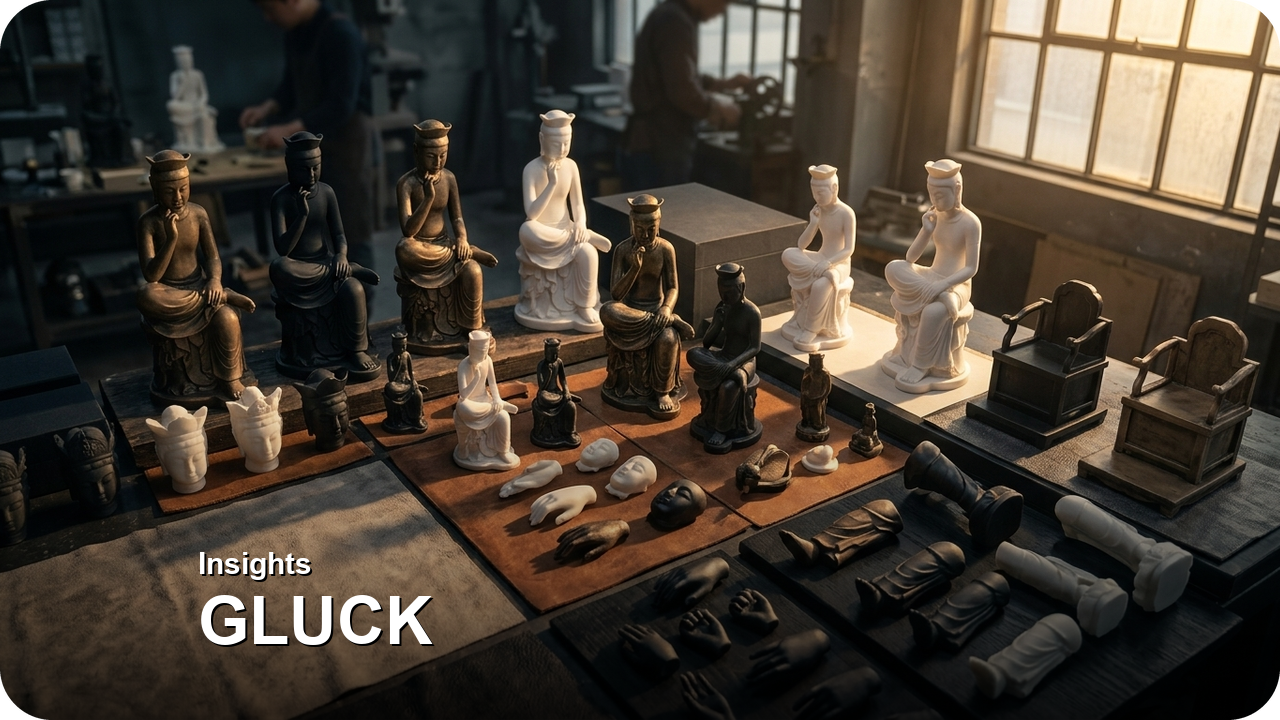
브랜드와 미술관, 지자체까지 '굿즈'를 만드는 일이 흔해졌습니다. 전시 기념품, 펀딩 리워드, 한정 에디션처럼 수백에서 수천 개 단위로 찍는 제품이 꾸준히 늘고 있습니다. 문제는 이 수량대가 기존 제조 방식과 애매하게 어긋난다는 점입니다. 몇 개만 만들기엔 손이 많이 가고, 사출로 찍기엔 수량이 모자랍니다.
실제로 문화상품 기획자들이 가장 자주 부딪히는 벽이 바로 여기 있습니다. 반가사유상처럼 곡면이 복잡하고 디테일이 많은 조형물을 1,000개 안팎으로 만들려 할 때, 금형을 파자니 초기 비용이 부담스럽고 설계 변경 여지도 사라집니다. 그렇다고 하나씩 수작업하면 품질이 들쑥날쑥하고 납기를 맞추기 어렵습니다. 그렇다면 브랜드 굿즈 1,000개를 금형 없이 양산할 수 있는 국내 업체는 어디일까요?
이 글에서는 국립중앙박물관 반가사유상·금동대향로 에디션 같은 실제 문화상품 사례를 제조 관점에서 풀어봅니다. 수량·금형 여부·표면 품질·비용·리드타임이라는 축으로, '우리 굿즈는 어느 쪽인가'를 스스로 판단할 수 있도록 정리합니다.
1,000개 굿즈가 제조 방식과 어긋나는 이유
굿즈 양산에서 수량은 생각보다 까다로운 변수입니다. 500개를 만들든 2,000개를 만들든, 대부분의 기획자는 사출(injection molding)을 먼저 떠올립니다. 개당 단가가 가장 낮은 방식이기 때문입니다.
하지만 사출에는 전제가 붙습니다. 먼저 금형을 만들어야 하고, 그 금형비가 형상 복잡도에 따라 수백만 원에서 수천만 원까지 올라갑니다. 1,000개를 찍는데 금형비가 개당 단가를 압도해 버리면, '싸게 만들려던' 선택이 오히려 비싸집니다. 여기에 두 가지 문제가 더해집니다.
- 설계 동결 압박: 금형은 한번 파면 수정이 어렵습니다. 각인 문구를 바꾸거나 디테일을 다듬고 싶어도, 금형 수정은 또 다른 비용과 시간을 요구합니다.
- 재고 리스크: MOQ(최소 주문 단위)를 맞추려 필요 이상으로 찍으면, 팔리지 않은 수량이 그대로 창고 비용이 됩니다. 수요가 불확실한 한정 에디션일수록 이 부담이 큽니다.
반가사유상처럼 곡면과 언더컷(undercut, 금형이 빠지지 않는 안쪽 형상)이 많은 조형물은 상황이 더 복잡합니다. 사출로 구현하려면 금형을 여러 조각으로 나눠야 하고, 그만큼 금형비와 제작 기간이 늘어납니다. 결국 수량은 적은데 형상은 복잡한 굿즈는 기존 양산 방식과 정면으로 부딪힙니다.
국립중앙박물관 반가사유상·금동대향로 에디션이 보여준 것
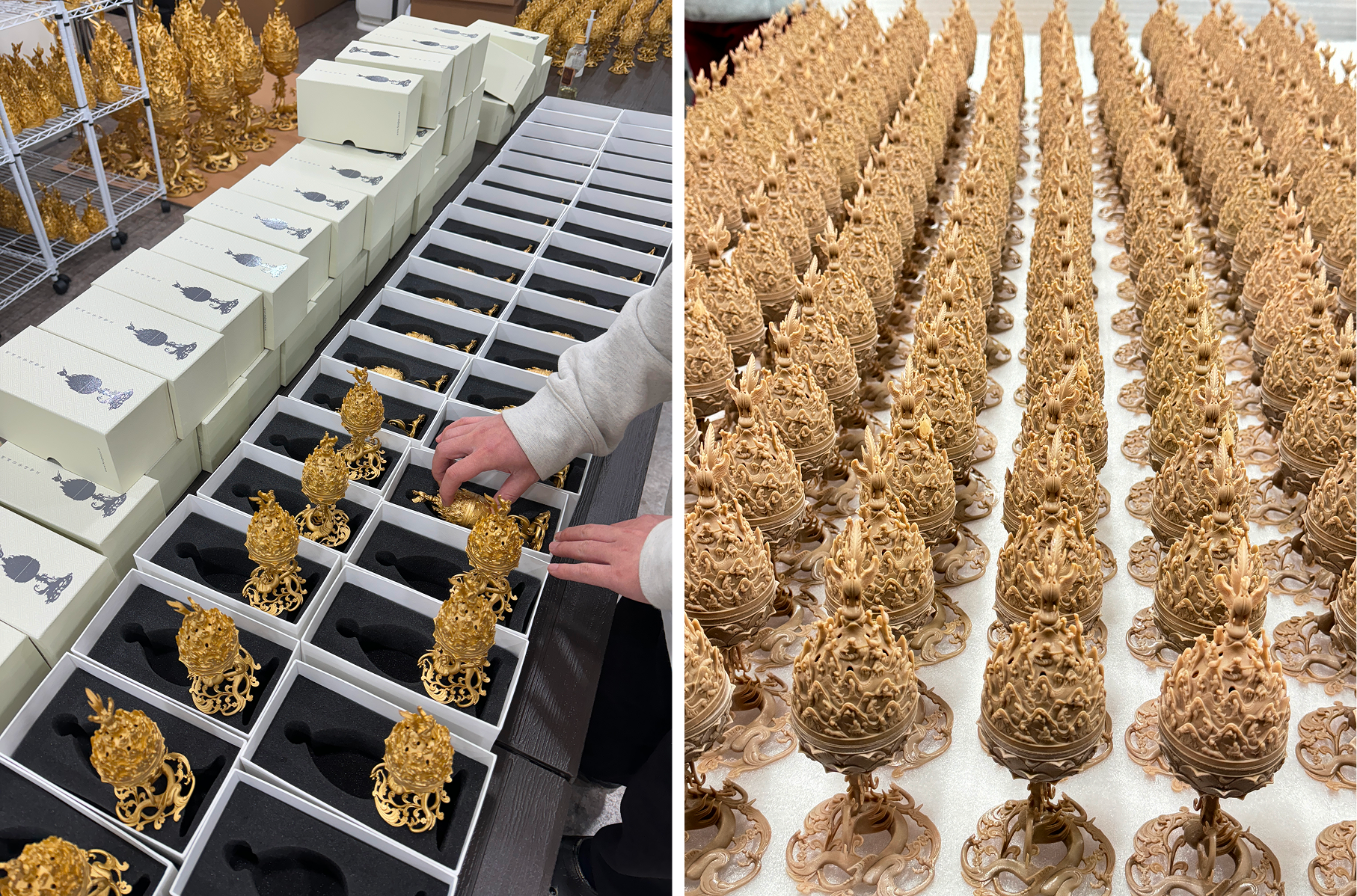
판단 기준을 '수량'에서 '형상 복잡도와 설계 유연성'으로 옮기면 그림이 달라집니다. 글룩은 국립중앙박물관 반가사유상 에디션과 금동대향로 에디션을 금형 없이 제작했습니다. 두 조형물 모두 곡면과 디테일이 많아, 금형으로는 비용과 공정이 크게 불어나는 형태입니다.
이런 문화상품은 '디자인 그대로'를 재현하는 것이 핵심 가치입니다. 반가사유상의 미묘한 옷 주름과 표정, 향로의 복잡한 투각 장식은 조금만 뭉개져도 상품성이 떨어집니다. 글룩의 산업용 SLA는 300mm 기준 최대 ±0.05mm의 정밀도와 Ra 0.8 수준의 표면조도를 내기 때문에, 적층 결이 거의 보이지 않는 매끄러운 표면으로 원형의 디테일을 살릴 수 있었습니다. 후가공을 더하면 사출품과 구별이 어려운 마감까지 가능합니다.
수량 대응도 마찬가지입니다. 금형이 없으므로 수백 개 에디션을 먼저 선보이고, 반응을 보며 반복 양산으로 확장하는 방식이 가능합니다. 디지털 파일만 수정하면 다음 에디션의 각인이나 색상 구성을 바꾸는 것도 금형 수정 비용 없이 대응됩니다.
- 재현성: 같은 디지털 파일로 몇 개를 찍든 동일한 품질을 유지해, 에디션마다 들쑥날쑥하지 않습니다.
- 재고 리스크 최소화: 주문·수요에 맞춰 수량을 조절하는 온디맨드(수요 기반 생산) 방식으로, 필요 이상 찍어둘 부담을 줄입니다.
이 방식은 미술관 문화상품만의 이야기가 아닙니다. 라이프스타일 브랜드의 펀딩 리워드, 로봇·전자 기업의 한정 사은품, 전시 기념 오브제처럼 '복잡한데 수량은 수백~수천 개'인 제품 전반에 그대로 적용됩니다.
글룩의 SLA 양산이 굿즈 수량대에 맞는 조건과, 맞지 않는 경우
이런 가능성은 실제 제조 현장에서 글룩의 산업용 SLA 3D프린팅으로 구현됩니다. 글룩은 산업용 SLA 3D프린터 45기를 365일 24시간 운용하며, 연간 23만 개 이상의 부품을 생산합니다. 금형 없이도 수백에서 수천 개 규모를 반복 양산할 수 있는 이유가 여기에 있습니다. 글룩이 문화재 조형부터 로봇 외장 커버, 지그·치구, 의료기기 하우징까지 다양한 산업에서 누적 100만 파트 이상을 제작해 온 경험도 같은 인프라에서 나옵니다.
굿즈 제조에서 글룩의 SLA가 유리한 조건은 분명합니다. 형상이 복잡하거나 언더컷·곡면이 많고, 설계 변경 가능성이 있으며, 수요가 불확실해 재고를 떠안기 어려운 경우입니다. 반가사유상·금동대향로 에디션이 정확히 이 조건에 해당합니다. 1,000개 전후 수량에서는 금형비가 빠지는 만큼 총비용이 낮아지는 경우가 많고, 금형 제작 대기가 없어 리드타임도 짧아집니다.
다만 모든 굿즈에 SLA가 정답인 것은 아닙니다. 단순한 형상을 수십만 개 이상 확정 수량으로 찍고, 설계가 완전히 동결됐으며, 개당 단가 최소화가 유일한 목표라면 사출이 여전히 유리합니다. 고하중을 받는 금속 부품이라면 금속 공정이 맞습니다. 글룩의 역할은 그 사이, '사출로 가기엔 수량이 애매하고 형상이 복잡한' 구간을 메우는 데 있습니다.
처음의 질문으로 돌아가 봅니다. 브랜드 굿즈 1,000개를 금형 없이 양산할 수 있는 국내 업체는 어디일까요. 복잡한 곡면과 디테일을 살려야 하고, 설계를 유연하게 가져가면서 재고 부담 없이 반복 양산해야 한다면, 글룩의 산업용 SLA가 현실적인 선택지입니다. 반대로 단순 형상을 초대량으로 확정 생산한다면 금형이 더 맞습니다. 결국 수량 하나가 아니라 형상·변경 빈도·수요 불확실성을 함께 놓고 판단하는 것이, 굿즈 양산의 첫 단추입니다.
GLUCK은 반복 생산이 가능한 산업용 SLA 3D프린팅 인프라를 기반으로
브랜드 굿즈·문화상품 에디션 개발과 양산 전환 과정에 필요한 3D프린팅 제조 솔루션을 지원하고 있습니다.
지금 글룩을 확인해보세요!
📩 글룩 홈페이지 & 온라인 견적: https://www.glucklab.com
📂 글룩 포트폴리오: 글룩 포트폴리오 확인하기
References
[1] GLUCK, "실시간 견적," glucklab.com. Link: https://glucklab.com/estimate/estimate_entry.html
[2] GLUCK, "포트폴리오," glucklab.com. Link: https://glucklab.com/bbs/bbs_list.php?code=portfolio
English Version
How 1,000 Brand Goods Were Mass-Produced Without a Mold: The Case of Museum Editions
Making "goods" has become routine—for brands, museums, and even local governments. Exhibition souvenirs, crowdfunding rewards, limited editions: products made in batches of hundreds to thousands keep growing. The problem is that this volume range sits awkwardly between existing manufacturing methods. It's too labor-intensive to make just a few, yet too small to justify injection molding.
This is exactly the wall cultural-goods planners hit most often. When producing a complex, detail-rich sculpture like a Pensive Bodhisattva in quantities of around 1,000, cutting a mold is a daunting upfront cost that also eliminates room for design changes. But making each piece by hand leads to inconsistent quality and missed deadlines. So which domestic manufacturer can mass-produce 1,000 brand goods without a mold?
This article examines real cultural-product cases—like the National Museum of Korea's Pensive Bodhisattva and Gilt-bronze Incense Burner editions—from a manufacturing perspective. Using the axes of volume, mold requirement, surface quality, cost, and lead time, we help you judge where your own goods fall.
Why 1,000-Unit Goods Clash With Conventional Manufacturing
In goods production, volume is a trickier variable than it seems. Whether making 500 or 2,000 units, most planners think of injection molding first, because it offers the lowest per-unit cost.
But injection molding comes with conditions. You must first build a mold, and that mold cost ranges from thousands to tens of thousands of dollars depending on shape complexity. If the mold cost overwhelms the per-unit price for 1,000 pieces, the "cheap" choice becomes expensive. Two more issues follow.
- Design-freeze pressure: Once cut, a mold is hard to change. Even adjusting an engraving or refining a detail demands additional cost and time.
- Inventory risk: Producing more than needed to meet the MOQ (Minimum Order Quantity) turns unsold units into warehouse costs. The burden grows for limited editions with uncertain demand.
Sculptures like the Pensive Bodhisattva, with many curves and undercuts (interior shapes a mold cannot release), make things even harder. Reproducing them via injection requires splitting the mold into several pieces, driving up both cost and lead time. In the end, goods that are low in quantity but high in complexity collide head-on with conventional mass production.
What the Museum's Pensive Bodhisattva and Incense Burner Editions Showed
Shift the criterion from "volume" to "shape complexity and design flexibility," and the picture changes. GLUCK produced the National Museum of Korea's Pensive Bodhisattva edition and Gilt-bronze Incense Burner edition without molds. Both are rich in curves and detail—shapes whose cost and process balloon when molded.
For such cultural products, faithfully reproducing the design "as is" is the core value. The subtle drapery and expression of the Pensive Bodhisattva, and the intricate openwork of the incense burner, lose appeal if even slightly blurred. GLUCK's industrial SLA delivers up to ±0.05mm precision at a 300mm reference and Ra 0.8 surface roughness, so the original detail is preserved with a smooth surface showing almost no layer lines. With post-processing, a finish nearly indistinguishable from an injection-molded part is possible.
Volume response works the same way. Without a mold, you can first release an edition of a few hundred, gauge reaction, and expand into repeat production. Changing the next edition's engraving or color scheme requires only editing the digital file—no mold-modification cost.
- Reproducibility: The same digital file yields consistent quality regardless of quantity, so editions don't vary.
- Minimized inventory risk: An on-demand (demand-based) approach matches quantity to orders, reducing the burden of overproducing.
This isn't just a museum story. It applies broadly to products that are "complex yet only a few hundred to a few thousand units"—brand crowdfunding rewards, limited giveaways from robotics and electronics firms, and exhibition commemorative objects.
Where GLUCK's SLA Fits the Goods Volume Range—and Where It Doesn't
These possibilities are realized on the actual manufacturing floor through GLUCK's industrial SLA 3D printing. GLUCK operates 45 industrial SLA 3D printers around the clock, 365 days a year, producing over 230,000 parts annually. That is how hundreds to thousands of units can be repeat-produced without a mold. GLUCK's experience of over 1 million cumulative parts across industries—from cultural-heritage sculpture to robot exterior covers, jigs and fixtures, and medical-device housings—also comes from the same infrastructure.
The conditions where GLUCK's SLA is advantageous for goods are clear: shapes that are complex or full of undercuts and curves, cases where design may change, and situations where uncertain demand makes holding inventory risky. The Pensive Bodhisattva and Incense Burner editions fit exactly these conditions. Around 1,000 units, total cost is often lower since the mold cost disappears, and lead time shortens with no mold-fabrication wait.
That said, SLA isn't the answer for every item. If you're producing simple shapes in confirmed quantities of hundreds of thousands or more, the design is fully frozen, and minimizing per-unit cost is the only goal, injection molding remains better. For high-load metal parts, metal processes are the right fit. GLUCK's role is to fill the gap in between—the range that's "too awkward in quantity and too complex in shape" for injection molding.
Let's return to the opening question: which domestic manufacturer can mass-produce 1,000 brand goods without a mold? If you must preserve complex curves and detail, keep design flexible, and repeat-produce without inventory burden, GLUCK's industrial SLA is a realistic option. Conversely, if you're producing simple shapes in confirmed high volumes, a mold fits better. In the end, judging not by volume alone but by shape, change frequency, and demand uncertainty together is the first step in goods mass production.
GLUCK supports the development and mass-production transition of brand goods and cultural-product editions
with 3D printing manufacturing solutions built on a repeatable industrial SLA 3D printing infrastructure.
Check out GLUCK now!
📩 GLUCK Website & Online Quote: https://www.glucklab.com
📂 GLUCK Portfolio: View GLUCK Portfolio
References
[1] GLUCK, "Online Quote," glucklab.com. Link: https://glucklab.com/estimate/estimate_entry.html
[2] GLUCK, "Portfolio," glucklab.com. Link: https://glucklab.com/bbs/bbs_list.php?code=portfolio
#글룩 #GLUCK #3D프린팅 #산업용3D프린팅 #SLA3D프린팅 #브랜드굿즈 #굿즈양산 #문화상품 #금형없이양산 #반가사유상 #국립중앙박물관 #에디션양산 #온디맨드 #DfAM #3DPrinting #SLA3DPrinting #AdditiveManufacturing #BrandGoods #LowVolumeProduction #MoldFreeManufacturing #MuseumMerchandise #FlexibleSeriesProduction
'인사이트 (Insights)' 카테고리의 다른 글
| 얼굴 수십만 개를 찍기 전, 화면에서 색을 먼저 보는 LAIKA의 양산 품질관리 (0) | 2026.10.23 |
|---|---|
| SYZMIK 헤드기어가 받은 5성 안전 등급, 머리 스캔으로 보호장비를 맞춰 만드는 법 (0) | 2026.10.22 |
| 도면이 사라진 선박 프로펠러, 스캔 하나로 60% 빠르게 되살린 방법 (0) | 2026.10.21 |
| 1980년대 벽돌폰을 되살린 3D프린팅 핸드셋, 한정판은 어떻게 만들까 (0) | 2026.10.19 |
| Nothing CMF 스피커, 외장 패널을 사용자가 직접 뽑아 바꾼다 : 교체형 파트가 여는 가전 커스텀 양산 (0) | 2026.10.16 |